Nomadic Arts Festival: Celebrating tradition through sound fusion

Turkana artists Mercy Ekaran (left) and Jackson Nakuwa performing at the Nomadic Arts Festival held at the Oshwal Centre on December 6, 2024. 

Photo credit: Anne Mucheke | Nation Media Group

Last Friday, the Oshwal Centre in Westlands, Nairobi, hosted an extraordinary event—the inaugural Nomadic Arts Festival—celebrating the richness of Turkana culture through music and collaboration.

What made this festival so unique was the fusion of traditional Turkana rhythms with contemporary sounds, powered by the collaboration between the Turkana Sessions and the Hive-Mind Ensemble Orchestra, a diverse collective led by jazz musician Eddie Grey.
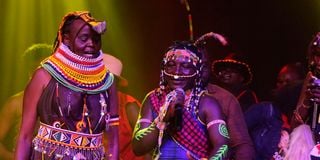
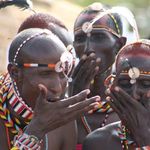
The festival brought together not just the vibrant voices of Turkana but also popular artists from Nairobi, bridging the gap between rural traditions and urban beats.

As the audience entered the Dinesh and Mahesh Chandaria auditorium, they were greeted by colourful displays of beadwork, paintings, and garments from the nomadic tribes of Turkana, Samburu, and Maasai—each piece a reflection of centuries-old traditions.

But the real magic began on stage. The evening showcased a series of performances that blended rap, singing, electronic beats, and DJ sets, seamlessly integrating customary Turkana sounds with contemporary genres.

Lemarti, a Maa-speaking artiste brought his wife on stage as he performs during the inaugural Nomadic Arts Festival at Oshwal Centre, Westlands, Nairobi on December 6, 2024.

Photo credit: Pool

The result was an enchanting mix of high-energy, danceable music that still carried the deep cultural roots of Turkana.

The night reached its crescendo with a performance by the Turkana Sessions, led by artistes Jackson Nakuwa, Mourine Apuu, and Elizabeth Korikel, whose voices soared over Eddie Grey’s orchestral arrangements. The orchestra—strings, winds, and horns—had the difficult task of interpreting music with no formal notation, following rhythms and structures far removed from classical training.

It wasn’t always seamless, but the musicians worked in harmony, adjusting tempo and mood to create something uniquely Turkana.

The crowd erupted when Sanaipei Tande joined the stage, adding a coastal flair to the evening. She performed hits like Kwaheri and Najuta, supported by a blend of guitar, violin, and horns. The moment was a testament to the power of collaboration, as musicians from different backgrounds created a unified sound.

Behind this stunning event were two visionaries: photographer Jackie Lebo, director of the festival, and Eddie Grey, its music director.

Their collaboration began years ago when Jackie was working on a documentary about oil exploration in Turkana, and Eddie was scoring the soundtrack. During the filming, Jackie was struck by the spontaneous music of the Turkana people—sung during work breaks, in markets, and even by children—and recognised the need to share their story with the world.

“We realised that the culture of these people was not defined by oil,” Jackie recalls. “It was their music, their heritage, and their stories that were truly defining who they were. We wanted to give the artistes a platform to tell their own stories, through their art.”

This led to the creation of the Turkana Sessions, a collaborative project that trained local artists in storytelling through music. Eddie, who had spent significant time in Turkana, saw the potential to bring their sound to a global audience.

“Traditional music is not backward. It is from the ancient languages that modern music has evolved. By contrasting it with an orchestra, we can show the world how it can fit into any genre,” he says.

The festival was more than just a celebration—it was an invitation to preserve and evolve culture.

Jackie emphasises that working with the Turkana musicians was about empowering them to tell their own stories, not through external validation, but through their unique artistic voices.

The result was a dynamic fusion of styles that challenged perceptions and bridged the gap between tradition and modernity.

The success of the festival lay in its ability to showcase the talent and resilience of Turkana artistes, many of whom have been involved in a decade-long journey of growth and mentorship.

“The musicians have learned to redefine themselves and their sound,” Jackie says. “What we see today is the result of years of hard work.”

One of the festival’s highlights was the cross-cultural exchange. Alongside the Turkana artistes, Nairobi-based musicians like Eric Wainaina, Muthoni the Drummer Queen, and Maasai performers shared the stage, demonstrating how Kenyan music, in all its forms, can come together in harmony. Even German Ambassador Sebastian Groth joined in, performing on keys with Jackson Nakuwa.

As the evening drew to a close, the audience was on its feet, applauding the groundbreaking performance that had brought together such diverse elements of Kenyan and global music. The spirit of collaboration and cultural preservation was palpable, a testament to what can happen when artistes from different backgrounds come together to create something new and powerful.

For the Turkana community, this festival wasn’t just about music; it was about showcasing their heritage to a wider audience, fostering pride and awareness of their culture.

"We are not just about the land and oil,” said John Hima, a key figure in the Turkana Sessions. “We have a culture that deserves to be heard and celebrated, and we are now sharing it with the world.”

Additional reporting by Anne Mucheke
[email protected]
[email protected]

PAYE Tax Calculator

Note: The results are not exact but very close to the actual.