During the first half of the 20th century, a clear majority of the black population in urban areas in South Africa lived in hostels or servants’ quarters provided by their white employers and were mostly single men as blacks were not permitted to bring their families with them.
However, in the course of World War II, colour bar was relaxed leading to an influx of black families from rural areas into what became known as “townships”. These were informal settlements on the periphery of major towns.
Neither the government nor employers provided new accommodation or homes for this group of workers resulting in overcrowding, poor living conditions and lack of basic amenities thereby contributing to high levels of crime and violence.
Although living conditions were low in shack townships, they enjoyed advantages over more established options in hostels of being cheap and largely unregulated by the apartheid era South African Police. When apartheid was institutionalised in 1948, black people were evicted from properties that were designated “white only” and forced to move into segregated townships.
A new middle class of Africans emerged with moderate literacy within these townships. They were cut adrift from the tribal reserves; urbanised, eager, fast talking and streetwise, socialising in shebeens (informal drinking establishments), dance halls, dressing snappily and driving large flashy cars.
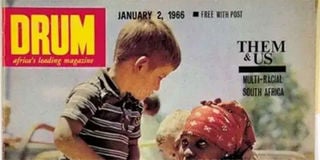
First known as The African Drum the magazine was established in March 1951 and launched in Cape Town by Robert Crisp, a journalist and broadcaster, supposedly to depict black South Africans as “noble savages”. The South African government allegedly sent copies abroad as evidence of its success in managing the “Bantu”. The content consisted mostly of tribal preaching and folk tales but despite a readership of about 20,000, the magazine was not financially viable.
It was only after Jim Bailey, a former RAF pilot and the son of a South African mining magnate, took over later in 1951 that the magazine began to grow. Bailey moved the magazine headquarters to the more vibrant city of Johannesburg and renamed it Drum. The image of the magazine was transformed and its content began to highlight urban black culture. It is said to be the first African lifestyle magazine. The magazine became an important platform for emergent African nationalist movements in anglophone Africa.
“In the teeming Negro and coloured shanty towns of Johannesburg, where newspapers are a rarity, a truck packed high with magazines rumbled through the unpaved streets last week. Wherever it stopped, hundreds of people swarmed about it buying the magazine: The African Drum.”-TIME Magazine 1952.
This quote suggests the popularity of the magazine that was to become known simply as “Drum”. However, the true reach of the magazine surpassed merely “hundreds” of people and became the most widely read newspaper in Africa at the time. A 1959 article in TIME Magazine stated that 240,000 copies of Drum were distributed across Africa, to countries such as Kenya, Ghana, Nigeria and Sierra Leone. The magazine was very popular amongst politicians and the middle class in Kenya. It is said that every copy sold passed at least five hands of readership.
To ensure that the magazine reflected black life in the townships, an editorial board that comprised leading political and cultural figures was elected. The board included such notables as Henry (aka Mr Drum) Nxumalo, Can Themba, Todd Matshikiza, Nat Nakasa and others.
Drum writers included Peter Abrahams, Alex la Guma, Es’kia Mphahlale and Richard Rive all of whom went on to achieve international recognition.
It was not only the writers; the pictures were also important especially since the audience were largely illiterate people. The main photographer and creative director was Jurgen Schadeberg who had arrived in South Africa in 1950 from a war-ravaged Berlin.
He became one of the rare European photographers to capture the daily lives of black people. He trained a generation of rising black photographers, including Ernest Cole, Bob Gosani and later Peter Magubane.
Drum published its first major article in March 1952, entitled “Bethal Today” an eight-page investigative article on a farm in Bethal where African labourers suffered gross human rights violations.
Henry Nxumalo went under cover, posing as one of the workers on the farm and obtained first hand information for the story. This information together with undeniable picture evidence taken by Schadeberg forced the government to change the way farms were managed at Bethal.
Unfortunately, due to continued crackdown by the South African government, by 1965 Drum had lost its zest and simply became a fortnightly supplement magazine. The magazine was revived in 1968 and purchased in 1984 by Naspers, the owners of City Press and True Love.
In 2010, South Africa’s Media24 shut down subsidiary magazines Drum and True Love in Kenya, citing low sales. Carol Mandi, the Kenyan publishing mogul and her husband purchased the two magazines in 2011.
With the benefit of hindsight, I now understand why my primary school teacher, the Scottish missionary, Ms Fanny Cluness described Drum magazine as the lowliest of the gutter press.
Whenever she caught any of us with a copy of the magazine, severe punishment and reprimand was guaranteed. The myth had to be maintained at all costs.
Unlock a world of exclusive content today!Unlock a world of exclusive content today!