No easy visa, no easy life: Young Kenyans navigate education and work in US

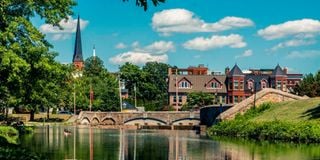
A creek against a blue sky and church steeple leads to a downtown area of suburban Maryland in the US.

Photo credit: Shutterstock

In a world where migration bans are tightening and visa hurdles are becoming steeper, many young Kenyans are finding it increasingly difficult to build careers abroad. 

Companies willing to hire entry-level foreigners must navigate complex, expensive regulations, often paying thousands of dollars in fees for a single work permit.
Despite these challenges, a growing number of Kenyans are pushing beyond the limits through education, research opportunities, and scholarships to carve their own spaces in the United States.

One of those determined individuals is Victor Moronge. At 28, Victor is pursuing his Doctor of Philosophy in Nutrition at the University of Maryland College Park, courtesy of a fully-funded scholarship.

Before Victor boarded a plane to the US, he shared the fate of many Kenyan graduates; through with school and trying to find a job. He studied medical microbiology at Jomo Kenyatta University of Agriculture and Technology (JKUAT) and graduated in 2021.

“After finishing school, you expect to get a job in what you studied. But I did not find anything in my field,” he says.

Months of job search yielded no fruit. Then he landed a sales job in the medical pharmaceutical industry. It was not what he trained for, and the job was unstable. Three months in, there was some restructuring and he lost the job.

“That was in July 2022. It was difficult. But then an opportunity to travel came. Immediately I got the visa, I left,” he explains.

Victor’s desire to go started back in 2019. He feared what life after university would look like. “In Kenya, from primary school to high school to university, everything seems planned. But after university you ask yourself, where is the guarantee of what is next for me?”

He spent time on LinkedIn, messaging researchers and professionals across the world. One of the people he connected with started sending him scholarship opportunities. Through that, Victor learned about assistantships in US universities.

Victor Moronge, 28, is a PhD Student in Nutrition at the University of Maryland, Adapting to rigorous research expectations and high living costs.

Photo credit: Pool

“US universities accept you for a Doctor of Philosophy and they fund you through assistantships. You come in to help with teaching or research, and they give you a stipend and remove your tuition fee.”

This is how he got his funding. He did not need a master’s degree. His programme combined two years of master’s level work and then continued into a Doctor of Philosophy.

When Victor arrived in Maryland at the end of August 2022, he was elated. But soon reality settled in. “Like many Kenyans, when you come here the first weeks you feel like going back home. You are excited to come, then homesickness comes,” he says.

The weather shocked him. The food confused him. The silence of the society surprised him. “In Kenya you hang out with friends. Here it is a lonely society,” he says. Public transport was also a challenge. A short distance could take one hour because of slow bus routes.

Money is always tight

But the academic world opened new doors for him. He worked with professors from different disciplines and collaborated with universities like Johns Hopkins.

Life in the US is not cheap. Victor explains it in very practical terms.

“The cost of living is high, but they also pay you according to where you live,” he says. In his area near Washington District of Columbia, rent is expensive. A one-bedroom apartment can cost Sh193,950 or more. A simple loaf of bread costs Sh645.

However, students have cheaper options. Some residents who own large houses rent out individual rooms. “Most students pay Sh90,510 for a room in a house. That is what many of us can afford with our stipend,” Victor says.

The idea that school in the US is easy is something he dismisses quickly. “They say exams are simple, but that is not true. You need to score very high to be in the top category,” he says.

Research work is also demanding. And since international students are not allowed to work outside the university without permission, money is always tight.

As for his future, Victor keeps his mind open. “I'd like to come back home if there is a job that pays well. If the opportunity is good, people come back home,” he says.

Samuel Mweni, 30, is a data scientist by training. He began his degree at American University in Washington D C and graduated in May 2024.

Since then, his path has taken him deep into the world of artificial intelligence (AI). “I have worked with companies such as Scale AI, Label Box and even OpenAI,” he explains.

His work involves training AI models, checking data and helping these systems learn how to perform data science tasks.

But Samuel’s story did not begin in an American technology company. It began in a small Kenyan classroom many years ago, when he was still in primary school. He was in Class Four or maybe Class Five when he first heard about the US.

But the dream felt impossible. His relative who had gone abroad was not close to Samuel. They had never even met. Still, the stories he heard about the US stayed with him for years.

After high school, Samuel went on to study statistics and computer science at the Technical University of Mombasa. Even then, his heart was set on travelling abroad. “I did not know how to start. I was not very computer literate at the time, but I tried,” he says.

Samuel Mweni, 30, is a data Science graduate from American University in Washington DC, From a small classroom in Kenya to studying AI in the United States.

Photo credit: Pool

When he completed his undergraduate studies, he applied to universities in the US. Many options required application fees he could not afford. Then one offered him a fee waiver. He applied and was accepted.

“When I saw the university had given me Sh3,361,800, I celebrated,” he says. “ I thought it was enough.” But the dream almost ended there. Tuition was over Sh12,930,000. He needed another Sh10,344,000, money he could never raise. By early 2020, he gave up temporarily, and when the pandemic hit the world, he couldn’t see light at the end of the tunnel.

However, between 2021 and 2022, the university kept reaching out to him. They reminded him that his admission would expire soon. One day, while working on the family farm, he received an email that said it was his final chance. “I told myself, this year I must go,” he says.

He tried again to apply for a study loan. During his student days, he had once taken a small loan of about Sh500. That tiny loan had blocked him in the past. But in 2022, his credit record was cleared through an intervention by the government (the policy that saw many people’s names removed from the Credit Record Bureau (CRB) listing) and this time his application went through.

“I explained my situation to the admissions team and financial aid office at the university,” he says. “One lady added Sh2,586,000 to my funding.” With this support and the loan, he finally secured the documents he needed.

In 2022, Samuel boarded a plane to the US.

Nothing, however, prepared him for his first hours in America. A cousin was meant to pick him up, but when Samuel arrived in Qatar for his connecting flight, the cousin stopped answering his calls and never appeared.

When Samuel landed in Dallas, his phone stopped working. He had no one to call, no internet, and only Sh9,050 in his pocket. “I asked a bus driver if the bus could take me to Washington D C,” he says. “He said yes. I got in.”

He found a hotel that offered free WIFI. That helped him contact people and find a cheap student hostel for the next night. Someone at the hotel helped him get a cab because he did not have any apps on his phone.

It took him days to settle down. “I did not eat for some time because I had no money,” he says. People he met online sent him small amounts. Someone sent him Sh2,580. Another helped him find a temporary place to stay. Slowly, things began to fall into place.

Once he reached campus, he met other students and caught up with classes. The school supported him, and the financial aid office even helped cover his remaining tuition when his loan reached its limit.

The cost of living was a shock. “We would go to the supermarket and convert everything into Kenyan shillings,” he says. “Bread was Sh775!.”
Housing came with challenges too. “I was scammed Sh96,975 for a place I never got to stay in,” he says.

On the brighter side, he loved the free parks, the bright Christmas lights and the peaceful riverside paths in Tacoma Park, where he lived during his studies. “There were places with lights that everyone could enjoy. I loved that,” he says.

Samuel notes that employment has become a challenge, “Right now getting a job is difficult, even the H1B visa is almost impossible because employers have to pay Sh12,930,000 for it.”

Building on experience

In New Jersey, 28-year-old Kelline Omondi, a graduate student at Rutgers University in New Brunswick, is pursuing a master’s degree.

Before he travelled abroad, Kelline worked for the Ministry of Agriculture and Livestock Development as an agribusiness officer.

“I was part of a programme called the Emergency Locust Response Program. When the locusts invaded, they caused a lot of destruction.

Farmers lost their crops and their livelihoods. After fighting the locusts, the next step was to help farmers recover and return to where they were before.”

Kelline Omondi, 28, is a Graduate Student in Agricultural Economics from Rutgers University in New Jersey, gaining experience abroad while planning to return home to Kenya.

Photo credit: Pool

Alongside his work, Kelline built a strong academic foundation. He graduated in 2021 from JKUAT with a degree in Agricultural Economics.

After completing his studies, his transition into the working world was quick. “It took me around four months to find a job,” he said. “I was lucky.”

Kelline’s journey to the US was not simple. He received an admission offer in October 2023, but a lack of visa appointment dates forced him to defer his start date to September 2024. His first attempt to secure a visa was a painful setback.

“I decided to try my luck elsewhere,” he says. That decision took him to South Africa, where he finally received his visa in August. He travelled to the US at the end of the same month. A partial scholarship that covered 60 percent of his school costs. He paid the rest from his own pocket.
When Kelline landed in New Jersey, he was completely alone.

“I did not have any family living close by,” he says. “Getting from the airport to where I was going was very difficult because I did not know the way.”

Culture shock followed closely behind. He remembers his first day of class clearly. “I had to ask my professor to please speak slowly. People from New Jersey speak very fast. I had not adapted to their accent, so I kept missing words,” he says with a laugh. Over time, communication became easier, although he jokes that his classmates still struggle to understand his Kenyan accent.

But the biggest challenge was finding a place to live.

“It is not easy because of my skin colour,” he says. Some landlords refused to rent to him once they saw him in person. “When I went for house tours, some landlords became uncomfortable and stopped responding afterwards.”

To avoid wasted time, he started using his real profile picture when asking about housing. He says, “If they want to deny me, I want them to deny me from the beginning.”

He eventually found a three-bedroom house that he shares with two other African students and one white student. Each of them pays around Sh93,090 for a single bedroom.

One of his early victories in the US was securing a job at the university. “Luck was on my side,” he says. A graduate student left, and because Kelline shared similar research interests with the supervising professor, he was recommended for the position.

Kelline has lived in the US for only one year and three months, but he is already thinking about the future. Life abroad offers many opportunities, but he says it also brings loneliness and strict immigration policies.

“With this new administration, getting a job is very difficult,” he says. Many companies no longer sponsor international workers because of high government fees. “Which company will pay Sh12,930,000 for someone in an entry level job?” He poses.

His dream is to stay for a while, gain experience, and one day return home. “Kenya is great,” he says. “At the end, I wish to come back home.”

PAYE Tax Calculator

Note: The results are not exact but very close to the actual.