75pc of stocks trading handled by brokers’ staff

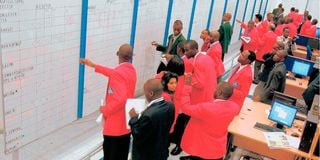
Stockbrokers bid at the Nairobi Securities Exchange (NSE) during the last open outcry trading system in the capital Nairobi, September 8, 2006.

Photo credit: File | Nation Media Group

Three quarters of all trades executed on the Nairobi Securities Exchange (NSE) last year were channelled through the staff of stockbrokers, underlining the role of the market intermediaries even as digitisation allows investors to fully execute trades online.

Only 24.76 percent of the value of all trades on the Nairobi bourse were conducted exclusively online in 2025 according to data from the NSE implying that more than three quarters of transactions went through market intermediaries.
Digitisation of trading platforms is intended to drive online trading with investors having access to brokerage platforms through devices such as computers and smartphones.

Investors including individuals can fully execute trades including buying and selling of shares through digital platforms provided by stockbrokers with such transactions being categorised as online.

Offline trades, meanwhile, describe transactions under which investors channel their buy or sell orders through stockbrokers/traders who then execute the deals on behalf of clients.

The high proportion of offline trades has been attributed to large transactions undertaken by professional investors such as fund managers and institutions who opt for traders mostly to fill large orders that may not be met directly/online.

High net worth individuals (HNWI) including foreigners also prefer trading through brokers adding to the share of offline transactions.

“Fund managers and other institutional investors put in large orders which may not be fulfilled by accessing the market directly and it requires trades to make calls to other traders to fill orders,” said Joseph Muriithi, a Senior Research Analyst at AIB-AXYS Africa- a stockbroker firm.

“High net worth individuals also love giving instructions to traders to execute transactions on their behalf.”

Lack of investor knowledge among individual investors has also been cited by analysts as a driver of offline trades where retail clients turn to the staff of stock brokerages, viewing them as experts in the market.

The buying and selling of shares is fully enabled online for all where investors can view the volume of shares available, bid/ask prices as well as execute trades on their own by either buying or selling stocks.

Secondary bond trading is, however, heavily reliant on stockbrokers/traders as investors lack a full view of the automated trading system (ATS).

In bonds trading, an investor holding a bond via the Central Bank of Kenya (CBK) DhowCSD platform is required to engage a broker to sell the paper in the secondary market where the trader is tasked with matching the order.

Continued innovation within the trading systems infrastructure is widely expected to increase the size of online trades as investors are empowered to fully take over transactions in the market.

The intermediary role of traders is, however, expected to remain given the demand of HNWI and institutional clients.

“We believe there is a scope for growth in terms of online trading but there is a need for traders in the market,” added Mr Muriithi.

The number of equity investors at the NSE closed at 1.31 million at the end of 2025 as per data from the Central Depository and Settlement Corporation (CDSC) including 1.25 million local individual investors.

The number of local corporate investors stood at 40,648, followed by individual foreign investors (7,972) and foreign corporate investors (379).

The number of corporate bond investors meanwhile stood at 3,593. Local corporations made the most trades across both equities and bonds, averaging 69.8 percent and 90.7 percent respectively in three months to December 2025.


Follow our WhatsApp channel for the latest business and markets updates.

PAYE Tax Calculator

Note: The results are not exact but very close to the actual.