Capital A Investment Bank dominated trading in bonds –the largest asset class— on the Nairobi Securities Exchange (NSE) last year according to market data.
The institution oversaw the trading of bonds worth Sh1.06 trillion in 2025, giving it a market share of 19.68 percent as the sale of government securities, especially tax-free infrastructure bonds took root on falling interest rates.
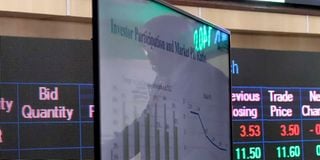
Last year saw records in both equities and bond trading supported largely by a broad share price appreciation and increased prices for listed government bonds as interest rates in the primary market fell.
The value of bonds traded in the secondary market at the NSE hit a historic high of Sh2.7 trillion in 2025, pointing to higher commissions for stockbrokers and the exchange operator.
The bonds turnover was nearly double the Sh1.5 trillion worth of debt securities that were traded on the Nairobi bourse in 2024.
Bond prices rallied as the Central Bank of Kenya (CBK) cut its benchmark interest rate resulting in lower rates in the primary bonds market.
This incentivised investors to jump into the secondary bonds market to buy high-yielding government securities resulting in the record sales as sellers locked in capital gains.
Bond prices usually have an inverse relationship with interest rates where bond prices fall during high interest periods but rise as rates fall.
Standard Investment Bank (SIB), Faida Investment Bank, Absa Securities Limited and SBG Securities were the other top brokers in bond trading, posting market shares of 13.93 percent, 7.55 percent, 6.96 percent and 6.62 percent respectively.
Equity turnover meanwhile reached a five year high of Sh145.4 billion as the volume of shares traded reached 6.33 million, the most since 2018.
EFG Hermes Kenya Limited was the top equity broker, overseeing trades worth Sh60.7 billion to hand it a 20.89 percent market share. Other top equity dealers were SBG Securities, Faida, SIB and Sterling Investment Bank whose market shares closed 2025 at 15.48 percent, 12.36 percent, 7.96 percent and 6.52 percent respectively.
The market capitalisation of the NSE listed stocks climbed to Sh2.94 trillion at the end of 2025 from Sh1.93 trillion in 2024, reaching the highest point on record at the end of a calendar year.
“The market capitalisation expanded to Sh2.94 trillion. Notably, the market valuation crossed a historic milestone of Sh3 trillion, reaching Sh3.044 trillion, driven by a sustained rally in equities,” said the Capital Markets Authority (CMA) chief executive officer Wycliffe Shamiah.
The NSE market capitalisation is set to be re-established inside the Sh3 trillion mark with the initial public offering of the Kenya Pipeline Company (KPC) shares set to add Sh163.5 billion to the stock market’s valuation when they start trading on March 9.
The increased investor participation in the market has helped revive the prospects of stockbrokers through increased trading fees, which form the bulk of revenues.
Stockbrokers normally charge a commission of 0.03 percent per bond trade and between 1.5 and 1.8 percent for equities.
Investment banks and stockbrokers reported a 156 percent jump in net profit to Sh1.1 billion through six months to the end of June 2025 with brokerage commissions jumping by 49 percent to Sh1.46 billion from Sh981 million in the first half of 2024.
The market intermediaries are coming from a lean decade in which their profits tumbled as the NSE fell into a prolonged bear run with depressed trading volumes.
The slump saw some leading investment banks diversify their revenue base by venturing into other services such as fund and wealth management as well as undertaking their own investments.