NCBA rally earns Kenyattas, Ndegwas Sh12.4bn in 5 days

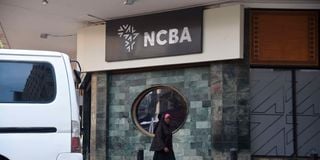
A woman walking past NCBA bank along Mama Ngina street in Nairobi on May 21, 2023.

Photo credit: File | Nation Media Group

The families of retired President Uhuru Kenyatta and former Central Bank of Kenya governor Philip Ndegwa have gained Sh12.4 billion in paper wealth in five days of trading as the share price of NCBA Group surged 38.5 percent amid a buzz generated by buyout reports.

NCBA’s stock climbed to Sh96.25 on Wednesday from Sh69.50 at the opening of the Nairobi Securities Exchange (NSE) last Tuesday when news of its potential acquisition by Africa’s largest bank, Standard Bank Group, hit the market.
This has seen the market valuation of NCBA increase by Sh44.1 billion to Sh158.5 billion in the five days, minting fresh millionaires on the record share price.

The Kenyattas control 13.2 percent of the bank through Enke Investments and have seen the valuation of their stake increase from Sh15.11 billion to Sh20.93 billion in a week, translating to a gain of Sh5.82 billion.

NCBA owners include tycoons and formerly powerful political families from the era of Jomo Kenyatta and Daniel Arap Moi, including the late Ndegwa, businessman Naushad Merali, and former Head of Civil Service Simeon Nyanchae.

The Ndegwas are the top shareholders in the bank, with a 14.94 percent stake through First Chartered Securities. Their stake has surged from Sh17.11 billion to Sh23.69 billion in the review period, reflecting a gain of Sh6.58 billion.

The share price jump followed reports in Bloomberg News that Standard Bank Group has directed its Kenyan unit, Stanbic Holdings, to engage NCBA in buyout talks, intending to conclude the deal in months.

The rally was slowed down by a four-day trading break due to two public holidays and a weekend over the past nine days.

The combined entity would have assets of approximately Sh1.1 trillion, according to their latest filings, which would make it the largest after Equity Group Holdings Plc and KCB Group Plc.

Analysts say investors are betting on a premium offer, which would naturally lift valuations for existing shareholders.

This has triggered increased activity at the counter, with some exiting to profit from the share price jump, while others seek entry ahead of closing the buyout.

NCBA’s volumes—number of shares traded—over the past five days have increased 5.3 times to 1.71 million compared with the 323,803 shares that were traded five days before the news broke out.

“The rally is based on expectations. It means investors are giving a sense of credibility to the news [about acquisition talks] despite Standard Bank terming it market speculation. Investors are clearly pricing in a takeover premium as much as there is no information around how the deal could be priced,” said Wesley Manambo, a senior research associate at Standard Investment Bank, in an interview.

“The rally means that the deal, if it ever happens, may have to factor in the Volume Weighted Average Price (VWAP) over a period of time. However, the deal may also be based on other valuation metrics since the share price does not always reflect a company’s true value. This calls for caution among investors.”

The NCBA share has been on a sustained upward run, crossing the Sh70 mark on the day the report came out and then breaking above Sh80 the following day.

The share closed last week Thursday, trading at Sh83.25 before breaking above Sh90 on Tuesday amid increased volumes.

It gained 15.6 percent on Wednesday to close as the highest gainer, having touched a high of Sh100 during the day.

In contrast, Stanbic’s share has remained unchanged at Sh198.75.

Stanbic Holdings failed to deny or confirm the talks with rival NCBA, which will see Kenya’s eight largest banks target the four biggest lenders.

It is understood that talks are ongoing, and there is no guarantee that a deal will be finalized. Plans are to try and conclude a transaction in the coming months, said the people quoted in Bloomberg.

A successful buyout would see the transfer of a prominent local institution into foreign hands, with the merged entity leapfrogging Co-operative Bank of Kenya into the third-largest lender by assets.

It would mark the return of a powerful foreign-owned player to the top three league of the country’s banking hierarchy — a space that has for the past decade been dominated by homegrown lenders.

Kenya is home to 38 commercial banks and authorities have been urging consolidation to form more resilient lenders with deeper pockets to cater to a rapidly expanding region with a young and growing population.

Stanbic had 310,000 customers and 30 branches at the end of June 2025, compared with NCBA, which had 121 branches serving 415,000 customers in Kenya, Uganda, Tanzania and Rwanda.

NCBA is a product of the 2019 merger between Commercial Bank of Africa (CBA) and NIC to achieve scale and strength.

CBA brought digital strength and retail reach through platforms like M-Shwari, while NIC had strengths in corporate banking and asset finance expertise.

M-Shwari is an attraction to Standard Bank, which owns a 75 percent stake in Stanbic, given its ability to serve the underdeveloped market and people, especially in rural areas still keep their cash in mattresses at home.

The deal aligns with Standard Bank’s strategy to be a top-three player in its African markets, with a current focus on East Africa given growth opportunities.

Standard Bank is the continent’s biggest bank by assets of $166 billion in December or Sh21.4 trillion.

This indicates that its assets are larger than Kenya’s estimated GDP of Sh16.1 trillion and it is nearly three times the size of Kenya’s banking sector at Sh7.5 trillion.

It is a pointer that the lender would not have a problem financing the NCBA buyout.

PAYE Tax Calculator

Note: The results are not exact but very close to the actual.