The Nairobi bourse has notched up the biggest one-week gain on record, capping off a period that left investors Sh220.24 billion richer.
Market capitalisation—the measure of investor wealth—rose by 6.9 percent to a new all-time high of Sh3.419 trillion, largely driven by large counters such as Safaricom, Equity Group, KCB Group and Stanbic Holdings.
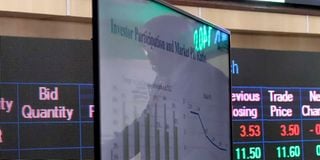
Safaricom added Sh78 billion or 6.1 percent in valuation to Sh1.36 trillion last week, at a share price of Sh33.95.
Equity’s valuation rose 13 percent or Sh33 billion, while KCB and Stanbic added 11.9 percent or Sh25.7 billion and 16.8 percent or Sh13.7 billion respectively.
This has placed the Nairobi Securities Exchange (NSE) on course to repeat last year’s performance that saw it emerge top in investor returns relative to bonds, bank deposits and real estate.
Safaricom gains were attributed to its announcement of a higher interim dividend of Sh0.85 per share the previous week, and investors taking a position on the banks ahead of their full-year financial announcements in the next one month.
Unlike other recent share price rallies, however, small and medium sized stocks also came to the fore, with 21 recording double-digit percentage price gains in the week, which analysts said was a result of increased activity due to the easier access handed to retail investors by the new mobile money trading platform, Zidii Trader.
“We saw the mobile platform bring in a new wave of retail players into the market, significantly increasing the number of deals, and to a lesser extent the turnover,” said Wesley Manambo, a senior research associate at Standard Investment Bank.
“While there were no major earnings updates to warrant the rally, we did see Safaricom’s price being driven by its interim dividend announcement, indicating the market is pricing in such payouts.”
The number of unique deals or transactions carried out in the market more than doubled to 101,284 last week, from 43,564 the previous week, highlighting the immediate impact of the direct shares trading via the M-Pesa platform.
Equity turnover was up 55 percent to Sh7.34 billion on a week-on-week basis, while the number of shares traded rose 81 percent to 225.88 million shares, from 124.84 million previously.
Ziidi Trader is a partnership between Safaricom, the Nairobi Securities Exchange (NSE) and Kestrel Capital. The platform was opened to the public on Thursday last week, following a pilot done from a sample of staff from the three project partners.
Its rollout eases market entry by negating the need for investors to open individual central depository system (CDS) accounts, as investors can access the trading infrastructure via M-Pesa using the mobile platform’s PIN as the only passcode to opt in and commence equities trading.
Shares bought via the Ziidi Trader will sit on an omnibus account managed by Kestrel Capital, with the broker being expected to keep a record of all transactions, including details on individual share ownership.
On its official launch on February 9, the Ziidi Trader platform yielded 7,962 share orders at the NSE, accounting for more than half of the 14,300 transactions conducted on the day.
Increased participation by retail investors has been behind the recent rallies seen on smaller counters at the NSE over the past two years.
The market was coming off a prolonged bear run that saw foreigners dominate trading, concentrating on large cap stocks that had solid fundamentals and the necessary liquidity to support their large ticket trades.
The number of individual investors on the NSE meanwhile remained stagnant during the long bear run between 2015 and 2023, with the absence of new initial public offering listings denying the market new entrants who would have shaken up trading volumes.
Data from the Capital Markets Authority (CMA) placed the number of local individual investors at 1.25 million at the end of 2025, down from nearly two million at the same time in 2022. The Nairobi bourse envisions having at least nine million active retail investors by 2029.
Meanwhile, other investment options such as unit trusts and government securities saw a sharp growth in numbers in the period. CMA data, for instance, shows that the number of unit trust investors in Kenya more than doubled to 2.96 million from 1.29 million in the 12 months to September 2025.
With the higher participation by local retail buyers now coming into equities through the mobile platform, the bourse is anticipating higher volumes and better price discovery across all segments of the market.
In the past week, the top gainers list was led by Sasini at 53.6 percent to Sh30.95 per share, Eveready East Africa at 28.5 percent to Sh1.67, Car & General at 27.7 percent to Sh73.75 and Sameer Africa at 27 percent to Sh20.25 per share.
Sasini and Eveready were partially boosted by corporate news around sales of land and change in business strategy respectively. Kenya Power, CIC Insurance, the NSE, Eaagads, DTB, Equity, Stanbic, KCB, Express Kenya and Limuru Tea also recorded double-digit percentage gains last week.
Others were Kakuzi, I&M Group, Express Kenya, Nation Media Group, TPS East Africa, Britam Holdings, Kenya Re and Unga Group.
In the year to date, the bourse has now added 16 percent or Sh475 billion, keeping it ahead of the pack among major investment classes in returns to investors. The January and February Treasury bond issuances carried annual interest returns of between 12.3 and 14 percent, while fixed deposit returns are now at seven percent.