The National Treasury will publish in advance the size of debt it will restructure through buyback, switches and swaps to bring more transparency in Kenya’s debt management strategy.
The Treasury’s liability management operations mainly involve the replacement of maturing instruments with new debt that features a longer tenure and/or low interest payments.
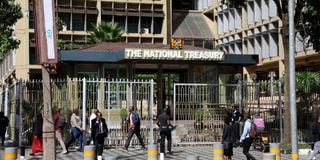
So far, early full or partial redemption of government bonds from proceeds of new securities has been done on a random basis, without prior disclosure of their scale.
Kenya has already deployed some of the initiatives to ease pressure on the debt service costs, including buybacks on Eurobonds maturing in 2024, 2027 and 2028, and most recently, a currency swap on debt taken to fund the construction of the standard gauge railway (SGR).
“The National Treasury shall budget for liability management operations within the national budget and fiscal framework,” said the Treasury.
“A specific LMO (Liability Management Operations) vote line in the annual budget estimates under the public debt management shall be provisioned with adequate estimates every year.”
The liability management policy has also proposed interventions to strengthen institutional and technical capacity, including establishing a liability management unit at the public debt directorate to analyse debt portfolios, plan and inform budgeting for LMOs.
Buybacks have been mostly utilised to ease refinancing pressures on upcoming Eurobond maturities where the Treasury has issued new sovereign bonds to partially refinance expected principal repayments, prolonging the maturities in the process.
The early buyback of Kenya’s debut Sh258 billion ($2 billion) Eurobond maturing in June 2024 was, for instance, crucial in ending investor jitters over a potential sovereign default, which sent the Kenya shilling to its lowest level on record in January 2024.
Kenya partially paid an estimated Sh186.1 billion ($1.44 billion) from the maturing note by issuing a new Sh193.5 billion ($1.5 billion) Eurobond with staggered maturities in 2029, 2030 and 2031.
The Treasury conducted two more buybacks in 2025, making early repayments to Eurobonds maturing in 2027 and 2028 and brought down expected payments to Sh27.4 billion ($213 million) and Sh47.9 billion ($372 million), respectively, at present from Sh116.1 billion ($900 million) and Sh129 billion ($1 billion).
Kenya plans to make further early Eurobond repayments, including through an issuance funded by a debt-for-food security swap, which has a Sh129 billion ($1 billion) guarantee from the United States International Development Finance Corporation.
The early buyback will address the runaway costs of serving Eurobonds, which are estimated at Sh84.73 billion for the financial year running to June 2026.
“The targeted transaction in liability management this year is that we are working on a debt-for-food security swap, which we expect to conclude by the end of this financial year,” said Raphael Owino, the director general at the Public Debt Management Office.
The Treasury has utilised switch bonds to contain domestic smoothing risks associated with maturing domestic debt. A bond switch or swap occurs when investors holding one bond sign up to convert their claims into another security—usually a longer-term paper—that will most likely have a different interest rate.
The Treasury brought its first domestic switch bond in June 2020, offering investors a six-year infrastructure paper in exchange for a maturing one-year Treasury bill.
A second switch bond sold in December 2022 targeted holders of maturing Treasury bills and offered a Sh87.8 billion six-year infrastructure bond, raising Sh47.8 billion.
Last month, investors who held a 10-year bond maturing in August 2026 agreed to rollover Sh26.49 billion into a 15-year bond, the first switch in the current fiscal year.