AFA now lifts macadamia harvesting ban after survey

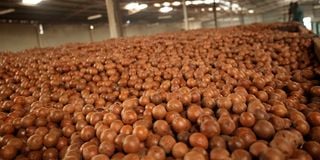
Macadamia nuts at a processing factory in Thika, Kiambu County, on March 8, 2025.

Photo credit: Evans Habil | Nation Media Group

The Agriculture and Food Authority (AFA) has reopened the harvesting and trading of locally produced macadamia from February 1, 2026, after a mid-season survey showed that a significant share of the crop has reached maturity.

The move lifts a seasonal closure that had taken effect on December 1 last year, and which was initially set to run until February 15, 2026, as part of efforts to safeguard kernel quality and protect Kenya’s reputation in premium export markets.
In a public notice on Thursday, AFA Director-General Bruno Linyiru said the decision followed a targeted macadamia maturity surveillance exercise conducted this January across major growing counties.

“The authority continued to monitor crop maturity trends and enforce compliance during the closure period, particularly in response to reported violations in some production areas,” said Dr Linyiru.

“The surveillance findings revealed variable maturity levels across agro-ecological zones. Most nuts in lower-altitude coffee-growing zones had attained physiological maturity, with some mature nuts naturally dropping to the ground."

In contrast, AFA noted, nuts in higher-altitude tea-growing zones were found to be largely immature, reinforcing concerns about premature harvesting.

“In view of these findings, and following requests from stakeholders, the authority will officially re-open the harvesting and trading of macadamia nuts effective February 1, 2026. AFA strongly urges all stakeholders, particularly farmers, to harvest only mature nuts and allow immature ones to develop," AFA said.

Kenya, one of the world’s leading macadamia exporters, has in recent years grappled with fluctuating quality and volatile prices blamed on early picking and unregulated trading by middlemen.

Processors have repeatedly warned that immature nuts result in low kernel recovery, reduced oil content and poor shelf life, undermining competitiveness in export markets that demand strict quality specifications.

Section 43 of the Agriculture and Food Authority Act, 2013, prohibits the export of raw macadamia except with written approval from the Agriculture Cabinet Secretary.

In 2024, processors faced heightened competition from Chinese buyers after the government temporarily lifted the export ban on raw nuts, known as nut-in-shell (NIS), to address a glut that had driven farm-gate prices down from a high of Sh180 per kilogramme to Sh30.

Kenya’s macadamia industry remains a key foreign exchange earner, with exports destined for markets in the United States, Europe, and Asia, where buyers place a premium on consistency and traceability.

According to the Kenya National Bureau of Statistics (KNBS) Economic Survey 2025, Kenya had 11,090 hectares under macadamia production in 2024, producing 51,200 tonnes worth Sh4.95 billion.

Follow our WhatsApp channel for the latest business and markets updates.

PAYE Tax Calculator

Note: The results are not exact but very close to the actual.