China trade surplus with Kenya surges ahead of landmark tariff deal

China imports

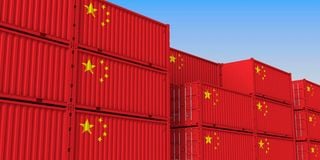
Chinese factories continue to dominate supply chains into Nairobi.

Photo credit: Shutterstock

Kenya’s trade deficit with China widened further in the first half of 2025 to Sh295.80 billion, underlining the country’s continued dependence on Chinese-manufactured goods, even as it pushes to expand exports through a proposed bilateral deal.

Latest data from the Kenya National Bureau of Statistics (KNBS) shows that the gap between exports and imports increased by 21.86 percent from Sh242.75 billion in the same period a year ago.
The widening gap was driven by the growing value of imports from China, which surged past Sh300 billion in the half-year period for the first time.

Imports climbed 18.42 percent to Sh304.65 billion between January and June, up from Sh257.27 billion a year earlier. Exports, on the other hand, nearly halved to Sh8.85 billion from Sh14.53 billion in the same period, highlighting the persistent imbalance that has for decades defined the bilateral trade relationship between Nairobi and Beijing.

Over the last decade, China has tightened its grip on Kenya as a top source market, strengthened after it won a landmark deal to build a modern railway from Mombasa to Suswa near Naivasha and has dominated the supply of machinery, electrical and electronic equipment, construction materials, and other manufactured goods.

KNBS data shows that iron and non-alloy steel products — including automotive frames, panels, and building materials — were among the biggest imports in the first half of 2025, valued at Sh12.53 billion.

Other major imports included telecommunications and networking equipment, such as mobile phones, routers, modems, and optical transmitters, worth Sh4.38 billion in three months to June, and diesel-powered road tractors for semi-trailers, valued at Sh3.51 billion in that period.

This growing inflow of capital and intermediate goods underscores Kenya’s reliance on Chinese industry to power its construction, manufacturing, and logistics sectors.

However, exports to China have narrowed for two years running after the shipment of titanium ores dried up following the closure of the Kwale mines.

Top sales to China included copper waste and scrap, whose value was nearly Sh3.34 billion in six months to June 2025, and tea at Sh1.14 billion.

The depth of the trade imbalance was a key agenda for President William Ruto during his four-day State visit to China in April.

“We have concluded the high-level conversations with China. They have agreed to a reciprocal arrangement between Kenya and China…to remove all the tariffs on our tea, coffee, avocado and all other agricultural exports,” Dr Ruto told business leaders in Nairobi on August 6.

“That I think is a major breakthrough for us. We are now finalising the bilateral instruments so that in the next couple of months, we should be able to take advantage of that huge market.”

The looming bilateral deal, the finer details of which remain confidential, will mark a significant step towards removing long-standing inequities in trade flows between the two countries.

Farmers and exporters will, however, still face challenges in scaling production, meeting stringent certification requirements, and competing on quality in the highly regulated Chinese market, which has a population of 1.4 billion.

Investments, Trade, and Industry Cabinet Secretary Lee Kinyanjui has backed the proposed tariff agreement to transform Kenya’s export landscape.

“If we were to plug into just one percent of that market for our coffee or tea, it would completely change the lives of Kenyans,” Mr Kinyanjui said in August.

“Some of our exporters have been forced to pay up to 10 percent duty to China, while our neighbouring countries pay zero because they are low-income. Others even export through Rwanda to avoid the tariff. With the removal of that, we can now export directly to China, and that will be a landmark deal.”

Kenya’s push for a bilateral trade deal with China aligns with its Integrated National Export Development and Promotion Strategy, an initiative launched in 2018 to diversify exports beyond traditional Western markets.

In the same year, Kenya posted five new envoys to key Far East capitals — Beijing, New Delhi, Kuala Lumpur, and Singapore — to scout for new market opportunities.

Before the Covid-19 pandemic, agencies such as the Kenya Export Promotion and Branding Agency (Keproba) had embarked on aggressive marketing drives in China, including plans to establish promotional centres in Wuyi (Fujian province) and Hunan, major agricultural and tea-growing regions.

PAYE Tax Calculator

Note: The results are not exact but very close to the actual.