Kenya’s imports from the United States fell for the first time in five years, pulled down by lower demand for aircraft and Liquefied Petroleum Gas (LPG), and coinciding with the start of President Donald Trump’s protectionist second term in White House.
Data from the Kenya National Bureau of Statistics (KNBS) show that import expenditure from the United States declined by 9.8 percent to Sh70.39 billion in the six months to June 2025, from Sh78.11 billion in the same period in 2024.
That marked the first half-year contraction since 2020, when the world imposed travel bans and trade restrictions to fight the spread of the Covid-19 pandemic.
The slowdown occurred during a period when the shilling appreciated by 7.84 percent, exchanging at an average of 129.35 units against the US dollar between January and June 2025, compared with 140.36 units in the same period the previous year.
The stronger shilling, combined with weaker domestic demand for capital goods, helped ease Kenya’s import bill from the world’s largest economy.
“Import expenditure from the United States of America dropped by 4.5 percent to Sh35.3 billion in the period under review, largely due to decreased imports of helicopters; turbo jets; soya bean oils and its fractions; and machines for the reception, conversion and transmission or regeneration of voice, images or other data, including switching and routing apparatus,” KNBS wrote in its latest Balance of Payments report for the second quarter ended June.
Orders from America posted a larger year-on-year drop of 14.74 percent to Sh35.04 billion in the first quarter of the year, the provisional data indicate, also attributed to “decreases in imports of aeroplanes and other aircraft and diagnostic or laboratory reagents”.
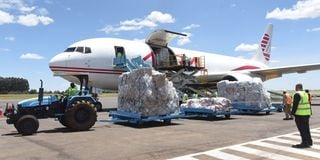
Expenditure on American-made planes with an unladen weight of more than 15,000 kilogrammes — primarily operated by passenger and cargo airlines— dropped 28.73 percent to Sh6.20 billion in the first half of the current year, from Sh8.70 billion in the same period last year.
Aircraft of that size are largely operated by local companies such as Kenya Airways, Astral Aviation (a full-fledged cargo airline), and Fanjet Express Ltd.
The KNBS data shows that petroleum gases and other gaseous hydrocarbons—liquefied butanes—remained Kenya’s top imports from the US, though their value dropped slightly to Sh18.11 billion in the first half of 2025, from Sh18.18 billion in the same period of 2024.
In the first quarter of 2025, imports of liquefied butanes, or LPG, were valued at Sh8.97 billion, followed by other aircraft (including helicopters and aeroplanes) at Sh3.57 billion, while purchases of petroleum coke, bitumen, and other residues of petroleum oils were estimated at Sh1.42 billion, according to KNBS figures based on customs records from the Kenya Revenue Authority.
The pattern was steady in the second quarter, where liquefied butanes again topped at Sh9.15 billion, followed by parts suitable for use principally with aircraft engines at Sh4.32 billion, and aircraft at Sh2.63 billion.
The dip in the value of imports marks a correction after years of sustained import growth from the US, which had risen from Sh31.37 billion in 2018 to Sh78.11 billion in 2024.
Despite the decline, the US remained Kenya’s fourth-largest source of imports, behind China, the United Arab Emirates (UAE), and India, but still ahead of Japan.
America was, however, the only market among Kenya’s top five countries of origin to record a drop in the value of goods supplied in the review period.
Imports from China jumped 18.42 percent to Sh304.65 billion in the first half of 2025 from Sh257.27 billion a year earlier, while purchases from the UAE rose 13.33 percent to Sh178.66 billion from Sh157.65 billion. The value of goods from India increased to Sh139.68 billion from Sh129.67 billion, and Japan’s exports to Kenya climbed to Sh68.74 billion from Sh54.21 billion.
The moderation in US imports comes as both nations continue to pursue deeper trade cooperation through a bilateral trade agreement, the first to be initiated by Washington in sub-Saharan Africa.
President Trump’s administration initiated the trade negotiations with Kenya during his first stint in White House in February 2020 under a comprehensive Free Trade Agreement (FTA), but this was discontinued by the regime of Joe Biden in favour of a lesser US-Kenya Strategic Trade and Investment Partnership (STIP) whose negotiations were not completed.
US Trade Representative Jamieson Greer — a Cabinet member who serves as Mr Trump’s principal adviser and negotiator on trade matters — said in April, after meeting Kenya’s Trade Cabinet Secretary Lee Kinyanjui, that America was keen to continue bilateral trade talks.
“We remain hopeful of a mutually beneficial outcome that secures the interests of both countries,” Mr Kinyanjui said on September 29. "Kenya-USA relations are strong and driven by strategic partnerships built over many years. We expect a reflection of this in trade relations.”