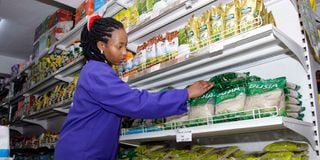
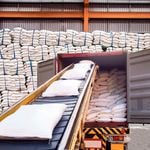
Retail sugar prices posted their biggest month-on-month drop in nearly two years in February in the wake of the government’s decision to lift long-standing import safeguards, opening the market to cheaper supplies from the regional trading bloc.
Data from the Kenya National Bureau of Statistics show that the average price of sugar fell 4.37 percent to Sh166.56 per kilogramme in February from Sh174.17 in January.
This marked the steepest monthly decline in 22 months since an 8.31 percent fall to Sh173.70 in April 2024.
The drop in the average cost of the sweetener last month extended a string of declines that began late last year, pushing the price to the lowest levels in 11 months since Sh166.08 in March 2025.
The easing in sugar prices came after the Kenya Sugar Board (KSB) announced early January that Kenya had exited the Comesa sugar import safeguard regime, ending 24 years of protection from lower-cost imports within the 21-member bloc.
Kenya had since 2001 relied on the Common Market for Eastern and Southern Africa (Comesa) safeguards, which were renewed eight times, to shield its high-cost domestic industry from competition.
Under the arrangement, Kenya was allowed to import up to 350,000 tonnes of sugar annually from the Comesa to bridge local deficits.
The quotas and tariffs were designed to cushion domestic millers, particularly State-owned factories in western Kenya that had fallen into disrepair amid mounting debt, ageing machinery, and erratic cane supplies.
In a bid to revive efficiency and cut costs, President William Ruto’s administration in May 2025 leased four State-owned mills — Nzoia, Chemelil, Sony, and Muhoroni — to private investors.
The government explained the move would inject capital, modernise equipment, and improve management. It is this restructuring that partly paved the way for Kenya’s exit from the Comesa safeguard regime.
A November 2025 joint report by the World Bank Group and the Competition Authority of Kenya found that domestic sugar was significantly more expensive to produce than imported alternatives, a gap that has been widening over the years.
The joint study, for example, found that Kenya’s ex-factory prices in 2022 and 2023 rose by more than 40 percent annually, outpacing cane price increases and diverging from global trends.
Critics have, however, warned that liberalisation could come at a cost to local producers. Saulo Busolo, former KSB chairperson and farmer, has questioned whether leasing the factories has lowered the cost of production. He said most major economies treat sugar as a “sensitive” commodity, heavily protecting their domestic industries.
“Has this leasing translated into a reduction of cost?” Mr Busolo posed in an interview with the Business Daily, casting doubt on the data underpinning the decision to lift the safeguards. “These private millers are being destroyed by these policies.”
The formal exit from the Comesa safeguards clears the way for traders to source cheaper sugar freely from the regional market, a shift that appears to be feeding through to retail prices.
The easing of prices has come despite dramatic swings in domestic production in recent years. The country’s sugar output slumped sharply in 2023 to a low of 472,773 metric tonnes before rebounding in 2024 to 815,454 tonnes, largely on the back of favourable weather and subsidised fertiliser, according to KSB data collated by the KNBS.
Last year, domestic sugar production fell by a quarter (24.81 percent) to 613,169 tonnes, exposing persistent structural weaknesses in the sector.