Why Kenya is emerging in a redrawn global apparel supply chain

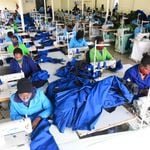
Workers at an EPZ firm in Nairobi.

Photo credit: File | Nation Media Group

Kenya’s garment industry is primed for a key slot in a redrawn global apparel supply chain in 2026, propelled by a shift by top brands spooked by sustained US tariffs and political uncertainty across key manufacturing regions.

Analysis by the Washington-based Gold Institute for International Strategy (GIIS) said Kenya stood a strong chance of emerging as an alternative apparel supply source because its future role in US supply chains would rely less on tariff preferences and more on being a reliable, reform-oriented manufacturing partner as American firms diversify away from China.
“Kenya has emerged as a pivotal production hub in Africa’s expanding supply chain, combining reliability, reform, and innovation to anchor US trade engagement across the continent,” the Institute said.

Kenya already hosts major global brands such as Tommy Hilfiger, Calvin Klein, H&M and Wrangler within its Export Processing Zones (EPZs). Some of the brands, including Tommy Hilfiger, Levi's and LC Waikiki, already have retail outlets in the country.

“The country’s advantage lies in a uniquely skilled, English-proficient labour force; strong vocational training systems; and a manufacturing base rooted in culturally distinctive textiles such as the kikoi and kitenge,” GIIS added in its assessment of the global apparel supply chain.

Kenya is among the major beneficiaries of the African Growth and Opportunity Act (Agoa), which lapsed last September but is being considered by US lawmakers for renewal for three years.

The duty-free access under the preferential trade scheme, which covered more than 1,600 product categories from 32 African countries, underpinned Kenya’s rise as sub-Saharan Africa’s leading apparel exporter to the United States.

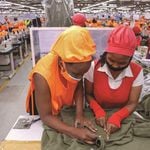
Workers at an Export Processing Zone factory in Athi River. 

Photo credit: File | Nation Media Group

According to a report by GIIS, Kenya exported about $419.7 million (Sh54.12 billion) in apparel in 2024, a 31 percent increase from the previous year, marking one of the strongest recoveries in the region.

The US absorbed roughly 92 percent of those exports, underscoring both Kenya’s deep integration into US supply chains and the risks of market concentration.

Price sensitivity

Kenya has, however, largely concentrated on apparel and garment exports, with limited diversification into products such as macadamia nuts, leaving the sector heavily exposed to changes in US trade policy.

Kenya ranked fifth in utilisation rates for Agoa behind Zambia, Lesotho, the Democratic Republic of Congo and Benin in 2021, according to the latest analysis of the Agoa programme by the US International Trade Commission (USITC).

Without Agoa, the report warns, Kenyan exports would revert to most-favoured-nation tariffs, reaching the mid-teens for cotton garments and exceeding 30 percent for key synthetic products.

Manufacturers said in December that exports to the US have been slapped with full duties ranging from 15 to 42 percent since the lapse of Agoa last September, costs that are higher than earlier projected.

Such duties would rapidly erode margins in a sector where price sensitivity is acute and competition from Asian producers remains intense.

The GIIS report cautions that uncertainty over future access to the American market is already constraining investment decisions in the apparel sector.

While the proposed three-year Agoa extension averts an immediate shock, its temporary nature limits long-term planning by manufacturers and buyers.

This inflection point has pushed Nairobi to pursue a durable, rules-based arrangement with Washington. President William Ruto has made clear that a permanent framework is essential to protect market access and provide long-term stability for investors and workers.

“This inflection point has pushed Nairobi to pursue a durable, rules-based arrangement with Washington,” the report says, referencing indications by the Ruto administration that it plans to initiate talks for a long-term bilateral trade pact, following unconcluded Strategic Trade and Investment Partnership talks by the previous regime.

President William Ruto has made it clear that Kenya is seeking to shift from preference dependence towards a permanent trade framework grounded in reciprocity and predictability.

The GIIS report frames Kenya as a test case for the future of US–Africa trade policy as Washington encourages supply-chain diversification away from China.

It highlights Kenya’s key advantage in energy, with the electricity grid more than 92 percent reliant on renewable sources, cutting manufacturing emissions while stabilising power costs.

The report notes that decarbonisation and cost predictability are becoming decisive factors as global brands face pressure to clean up supply chains.

Labour governance

Labour governance is another pillar of Kenya’s post-Agoa positioning, the report adds, citing US State Department assessments showing that Kenyan labour laws largely meet international standards.

“Workers in EPZs (export processing zones) can form and join unions, collective bargaining is widespread, and anti-union discrimination is prohibited,” the report states.

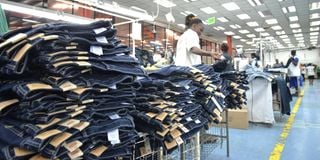
MAS Intimates Kenya staff at work at the Export Processing Zone (EPZ) in Athi River on September 16, 2021.

Photo credit: File | Nation Media Group

“Kenya’s competitiveness is reinforced by strong logistics performance. With over 105 EPZs nationwide (most privately owned and concentrated in Mombasa and Kilifi), the country’s manufacturing network anchors regional trade connectivity and export diversification.”

The Agoa treaty, initiated under the Bill Clinton administration in 2000 to integrate sub-Saharan Africa into the global economy and wean it off donations, was initially intended to last for 15 years from 2000 before being extended for a further 10 years in June 2015.

Maxwell Okello, the outgoing chief executive of the American Chamber of Commerce in Kenya (AmCham Kenya), argued last year that the programme’s success lay in preparing countries like Kenya to compete beyond preferential access.

In an opinion piece published in the Business Daily on December 14, Mr Okello wrote that trade preferences were designed to build capacity and competitiveness, not to last indefinitely.

“The purpose of trade preferences was always to build capacity, strengthen competitiveness, and graduate to more sustainable trade models,” Mr Okello wrote. “Kenya has …built world-class manufacturing capacity that can compete anywhere. The question isn't whether we can survive without AGOA. It's whether we're brave enough to thrive beyond it.”

Follow our WhatsApp channel for the latest business and markets updates.

PAYE Tax Calculator

Note: The results are not exact but very close to the actual.