Some eight kilometres outside of the Nairobi city centre, Kenya’s largest slum, Kibera, buzzes with all manner of business activity in the corrugated iron stalls that line its roads, from fast food joints to general supply shops.
But unlike the glass storefronts in the upmarket Kilimani district it borders, tens of shops in Kibera’s Soweto West area are plastered with orange-and-white stickers that tell you ‘Bitcoin accepted here’. A quiet technology revolution is happening in the low-income settlement, home to over 180,000 people.
Bildad Ouma, 27, has been selling second-hand clothes here since 2024 and is among those who accept the digital currency as a form of payment. He began using Bitcoin in April and now says about four customers a day pay with it.
“I mostly use [Bitcoin] for saving. I like it because it only appreciates,” Mr Ouma told the Business Daily as he took out his Android smartphone to show his crypto wallet on an app called Blink.
At his stall, T-shirts, socks and men’s boxer shorts go for between Sh100 and Sh300. Customers can pay using Sats, short for 'Satoshis,' the smallest unit of Bitcoin. A Sat equals one hundred-millionth of a whole Bitcoin.
Sats make the digital currency divisible and practical for everyday microtransactions, allowing users to deal in tiny, manageable amounts even as Bitcoin's price rises. A Sh100 pair of socks at Mr Ouma’s stall will set you back 880 Sats.
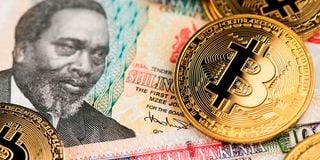
Bitcoin is the first and largest cryptocurrency, created in 2009 in the wake of the global financial crisis as a decentralised digital asset that could act as an alternative method of payment. Others have since followed, including Ethereum and BNB.
The currencies are mostly used like digital assets, as a store of value, as prices have continued rising over the years. Ten years ago, in December 2015, for instance, Bitcoin’s highest price was $463.87 (Sh59,797 at current rates). In May this year, it was trading above $110,000 (Sh14,180,100). It has since gone down to $88,413 (Sh11,397,319) as of December 21.
Down the road from Mr Ouma’s stall, 50-year-old Rebecca Moraa is selling tomatoes and onions. She has also become a Bitcoin crusader after a fellow trader introduced her last year.
“On average, I make an equivalent of Sh500 worth of sales through Bitcoin payments alone,” she said, adding that she now serves about 10 customers daily who pay only through the digital currency.
Ms Moraa mainly uses it for saving and monitors her crypto wallet on both her feature phone, commonly known as mulika mwizi, and her smartphone. “My child helps me navigate it and keep track of my Sats.”
The traders are part of a growing community of over 2,600 Kibera residents who adopted Bitcoin through a mobilisation campaign by the non-profit AfriBit Kibera. The outfit was founded in 2021, initially as a Bitcoin and software development training programme for university students.
“It morphed into using Bitcoin and technology at large to solve some of the long-running problems we had seen in Kibera during our other empowerment programmes,” says Ronnie Mdawida, a social worker and AfriBit’s co-founder.
“One of them was financial inclusion; opening a traditional bank account has many requirements, and the transaction costs can be high for people living on tight budgets here.”
The growing adoption is the road towards what Mr Mdawida calls a Bitcoin circular economy, where Kibera residents primarily earn, save, and spend Bitcoin for everyday goods and services through peer-to-peer transactions. The goal is to minimise or eliminate the need for cash or mobile money platforms such as M-Pesa, he says.
Here, smartphone owners monitor their accounts with Blink, an open-source app where one’s phone number is their account identifier.
Crypto wallets on Blink are non-custodial, so the user (not a third party) has sole control and responsibility over their private keys and Bitcoin.
“I did not have a bank account before, but now the fact that I can save and earn on a platform that doesn’t require me to give these many KYC (know-your-customer) details about myself is freeing,” said Stephanie Obat, a handbag seller in her early 20s.
Feature phone users, meanwhile, have access to their crypto wallets through a USSD platform called Machankura. Those without phones altogether can have a ‘Bolt card’ loaded with Bitcoin to save or pay with.
When buying items, the shopkeeper keys the bill onto a point-of-sale (PoS) terminal, similar to a regular card payment, which the Bitcoin ‘Bolt card’ holder taps.
For smartphones, shopkeepers generate a QR code invoice on Blink, and the buyer scans it with their phone to pay using Bitcoin. The transactions have no charges.
Bitcoin holders can also convert their Sats into stablecoins called StableSats, pegged to the US dollar, to save without being affected by volatility. They can convert them back to benefit from higher Bitcoin rates.
Most adopters say they prefer Bitcoin to mobile money services to avoid transaction charges.
They also cite its decentralised nature (operating without a central authority such as a bank or government) as a key advantage.
“It also has to do with the knowledge that with time, Bitcoin is going to appreciate, and so they are holding it as a form of saving. We view it as holding currency that is a hedge against inflation,” Mr Mdawida said.
When receiving money from people abroad, users can choose how they want to receive it: in the dollar-pegged StableSats or just Sats. On another open-source app called Fedi, the Kibera Bitcoin adopters have access to SataNet, a community satellite internet network provided by tycoon Elon Musk’s Starlink and customised for the community. Daily subscriptions cost the equivalent of Sh20 and weekly Sh120, payable only using Sats.
Additionally, members can send money to M-Pesa accounts instantly at no cost or buy Bitcoin using M-Pesa. Nearly 100 garbage collectors and 60 merchants are now paid using Bitcoin, Mr Mdawida says. “Even the community toilets, you can now pay in crypto to use them.”
For a long time, Bitcoin’s lack of regulation and price volatility have been its biggest concerns. There is a lack of basic consumer safeguards, and the relative anonymity and cross-border nature of cryptocurrencies make them attractive for illicit activities such as money laundering.
President William Ruto, in October, signed the Virtual Asset Service Providers (VASP) Bill, 2025, into law to mitigate risks associated with cryptocurrencies, while also positioning Kenya as a digital finance hub in Africa.
The law put virtual assets and stablecoins under the Central Bank of Kenya (CBK)’s oversight, with the Capital Markets Authority (CMA) regulating crypto exchanges and trading platforms.
“It has the good element of protecting the users, whose lack until now has fuelled scepticism in the sector,” the AfriBit co-founder says. “But it can limit local innovation with all the requirements, making crypto like an exclusive club. The government can improve it.”
For Bitcoin's volatility compared to traditional assets like stocks and bonds, the Soweto West residents told the Business Daily they were not worried. They cited the digital currency’s overall price rise over the last two decades.
“That is a temporary thing,” said Ms Obat, the handbag seller. “I like seeing it fluctuate but still knowing I cannot lose my assets. I am just giving it time.”