Time flies with great content! Renew in to keep enjoying all our premium content.
Prime
Kenyan economy suffers an acute shortage of coins
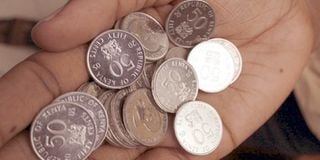
Kenyan currency coins. The CBK has raised the alarm that there is acute shortage of coins in circulation and asked Kenyans to release what they have. Photo/FILE
Where are all the coins?
This is a puzzle commercial banks across the country are grappling with as coin deposits continue to dwindle year after year.
Due to this, Central Bank of Kenya, CBK, is working with the Kenya Bankers Association (KBA) and all commercial banks to organise a ‘Coin Week’ to sensitise the public on the need to regularly use coins.
Further, CBK maintains that it is constantly monitoring the distribution, availability and demand for coins and will work to redress any identified shortfalls.
In 2009 when the Kenyan economy was experiencing a downturn, there were reports of shortage of coins in circulation.
Two years down the line coins have continued to be scarce.
Banks have raised concerns over the shortage of coins to supermarkets who in turn claim that people no longer shop using coins.
The supermarkets claim they give change in coins but they never take the coins back to the supermarkets.
The supermarkets have even put up notices asking customers to bring coins to exchange with notes, but the appeal has yet to yield fruit.
The shortage of coins has left many commercial banks unable to serve clients who need change in the form of coins.
In the past, supermarkets and merchants of different wares would deposit coins in the banks; however this practice is slowly dying off.
According to several bank managers, coins are necessary because people cannot trade with notes in isolation.
It is however the nature of money to circulate, and the bankers cannot tell whether the coin shortage is artificial or not.
Bank mangers concede that while they make orders for coins from the Central Bank, for the past one year the lender has been unable to fully meet their need as the demand for coins far outweighs the supply.
Subsequently, Central Bank has resorted to minting new coins, a process that takes time since they are minted in Britain by De La Rue.
It takes about a month after the request date for CBK to supply banks and even what is supplied is way below what they request since the head lender has to ration the coins among the existing 48 banks.
“If we do not look out for the disappearance of coins then we will continue to incur increased cost of replacement,” one bank manager said.
Among its other responsibilities, CBK supplies bank notes and coins to the economic system in bulk and destroys banknotes and coins that can no longer be used.
It also manages the design and manufacturing of the currency.
It is the Bank’s aim to have only good quality currency in circulation. This is achieved by setting quality standards.
The standards were issued on 14th July 2008 under the Amended Banking Circular Number 4 of 2008.
The coins currently in circulation in Kenya include 50 cents, one, five and 10 Shillings and the larger 20 Shilling and 40 Shilling coins.
The Sh40 coin was the last one introduced in circulation, and is the only one bearing the portrait of the third president of Kenya, Mwai Kibaki.
CBK also has a number of special coins made to commemorate special events. These coins are offered for sale in all the Central Bank branches.
The special coins include silver jubilee with a value of Sh1,000, the coin commemorating 10 years of Nyayo era, which costs Sh500 and the coin produced at 25 years of independence also selling at Sh500.
You need Sh60,000 to buy a gold coin while a pack of silver coins is valued at Sh50,000.
Some bankers suppose that initially the circulation of coins was sustained by the existence of the telephone booths, “People would call using coins then Telcom would collect the coins and deposit the same in the banks, but now the booths are no more.”
Currently, only banks with children accounts are able to serve clients who need coins.
Such banks issue piggy banks, the small containers that children use to save their money, usually in the form of coins.
Despite the scenario on the ground, CBK maintains that it has sufficient quantities of Coins in all denominations across the country and calls on members of the public to bring back into circulation the coins in their possession.
A reply to this writer from the CBK’s communication office dated March 24, 2011 states in part, “The public are hoarding these coins big time in their homes, offices or cars. Considering that trade is a fast moving activity, traders in supermarkets and shops therefore may not be in possession of requisite quantities of coins all the time.”
The letter further suggests that the alternative way to recirculate coins is to deposit them in accounts with commercial banks or exchange them for notes in supermarkets, and other retail outlets.
The letter signed by Prof Njuguna Ndung’u of CBK further assures the public that coins will continue to be issued through the commercial banks’ to fully meet the demand.
Unlock a world of exclusive content today!Unlock a world of exclusive content today!