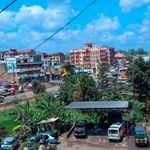
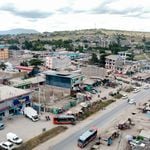
Darius Masenge, who has lived in Katani, a growing middle-class estate near Syokimau off Nairobi’s Mombasa Road, for 13 years, says the area’s transformation has been dramatic.
Even so, he believes growth could have been faster, and more attractive to major developers, had infrastructure improved earlier and quarry activity been less extensive.
When the BDLife visited, Katani’s modest roadside market stood out. Katani Centre, with its tightly packed shops hugging the road, functions as the area’s informal commercial nerve. Beyond the market, the landscape opens into spaciously built homes.
“When we came here, we had few neighbours. I could count about three around us. There was nothing but grass and cactus,” Mr Masenge says. With no good roads, he recalls, it was a period of many challenges, especially when it rained. “You just had to manoeuvre anyhow to find your way to Mombasa Road.”
The soil itself posed additional difficulties. “The soil here is not the best when it comes to infrastructure. If you have a car and it rains, you leave it at home that day,” he says.
Access to electricity was equally challenging. “Getting power back then was an issue because the posts were far away. We had to survive on solar.”
At the time, Katani’s appeal lay in the affordability of land and the promise of future growth. Together with his family, Mr Masenge made the decision to relocate to escape the burden of rent.
Plots measuring 40 by 80 feet were then selling for between Sh350,000 and Sh500,000, depending on location. “The upper side from Syokimau was a bit higher even back then. Currently, the same plot size sells for between Sh1.5 million and Sh1.8 million,” he says.
This appreciation reflects broader changes in the area. Roads linking Katani to Syokimau were eventually built, improving access and triggering steady inward migration.
Housing patterns have also shifted. While Katani remains largely owner-occupied, rental units are steadily increasing.
One-bedroom units, two-bedroom apartments, bedsitters and single rooms are now common, catering to workers employed by companies along Mombasa Road, in Mlolongo and Syokimau.
“It’s convenient for them to stay around here because you wouldn’t encounter any traffic,” he says.
Darius Masenge, a homeowner and resident of Katani, Machakos County, pictured in the area during an interview on January 24, 2026. Bonface Bogita | Nation
Photo credit: Bonface Bogita | Nation Media Group
Public transport, once non-existent, has followed development. “We had no matatus coming here. You had to find your way to Mombasa Road or Mlolongo before getting one to town. Even motorcycles were not available. You had to rely on a neighbour with a car,” he says. “Now we have matatus, taxis and other transport options just like other areas.”
Yet access roads remain a challenge. Katani can be reached from either Syokimau or Mlolongo, but both routes funnel traffic onto narrow, single-lane roads never designed for the volume they now carry.
Construction trucks, private cars and matatus all compete for limited road space.
The area also lacks a central sewer system, forcing homeowners to rely on bio-digesters or septic tanks. For households without bio-digesters, waste must be emptied by vacuum trucks, an added monthly cost residents estimate at between Sh10,000 and Sh15,000. Industrial activity compounds the strain, with more than 30 quarries operating in and around Katani.
Growth without services
Despite these constraints, rents have risen sharply.
“The rent has become competitive. A one-bedroom here is now comparable to any other estate in Nairobi, around Sh16,000,” Mr Masenge says. “Initially, you could rent a three-bedroom bungalow for just Sh10,000.”
As the estate grows, residents are increasingly concerned about the lack of coordinated infrastructure. The Katani Cosmopolitan Residents Association plays a gatekeeping role in development approvals, though challenges persist.
“The association is involved in the initial approval of upcoming buildings to align with what we call zoning zones,” says Fredrick Lutta, the association’s secretary.
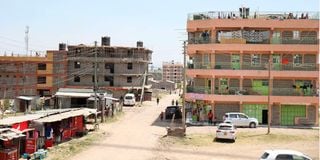
Katani is divided into zones that determine land use. “There are areas designated for commercial use and others where only single dwellings are allowed. Commercial developments are mostly along the road,” he says.
Commercial buildings pictured in Katani, Machakos County, on January 24, 2026. Bonface Bogita | Nation
Photo credit: Bonface Bogita | Nation Media Group
Weak enforcement
Even so, quarry activity remains a major concern. “There are so many trucks using this road, carrying stones and other materials. It is estimated that more than 3,000 trucks ferry material from here to other parts of the country,” Mr Lutta says.
The heavy traffic, residents say, accelerates wear on roads already struggling to support residential growth. “We also lack fresh water. What we have is salty water,” he adds, noting that weak enforcement by authorities has worsened the situation.
Still, interest from land investors is rising, though at a slower pace than in neighbouring Syokimau. “Katani is still growing. Companies have acquired land here, even though many are yet to develop,” Mr Lutta says.
Unlike Syokimau, where large developers are building gated communities with three- to five-bedroom homes, Katani remains dominated by individual homeowners.
Mr Lutta says growth accelerated around 2019 and 2020. “Things really changed during Covid-19, especially when the tarmac road was being done.”
“Currently, households are about 10,000. We had around 4,000 registered voters in 2022, but that number should be much higher now, possibly close to 10,000 in Katani division,” he adds.
Katani Cosmopolitan Residents Association Secretary-General Fredrick Lutta during an interview at Katani in Machakos County on January 24, 2026.
Photo credit: Bonface Bogita | Nation Media Group
Landlocked and underbuilt
From a planning perspective, Katani’s infrastructure limitations are stark. Ronald Omboto, chairperson of the association’s infrastructure subcommittee, describes the area as effectively landlocked.
“The entire Katani depends on one trunk road, which is the only outlet to Mombasa Road,” he says.
A second potential outlet toward Utawala remains undeveloped. “Technically, Katani is landlocked. The growth of feeder roads has been very slow, and some are in a pathetic state. Most are not motorable,” Mr Omboto says.
Poor infrastructure has also slowed development across large sections of the area. “We still have a lot of bare land because of the lack of good roads, sewer systems, water, electricity and proper access,” he says.
Strongest selling points
Paradoxically, these shortcomings have continued to attract homeowners priced out of more established suburbs. Accessibility remains one of Katani’s strongest selling points.
“From Katani to town is about 30 kilometres, and with the expressway you can get there within an hour,” Mr Omboto says.
Privacy is another draw. “Katani is a dead end, you can’t pass through it to another area. That gives residents privacy compared to estates where non-residents cut through,” he says.
“Without infrastructure, however good the value of the place is, nothing will move,” he adds.
Land appreciation
Demand for land has surged. Francis Masawi, a Katani resident of 10 years and a land seller, says buyers are no longer limited to end users.
“Initially, people bought for their own use. Now, with growth, businesses have come in, quarries, schools and institutions,” he says.
The most commonly traded plots range from 50 by 100 feet to an acre. “Back then, a 50 by 100 cost about Sh500,000,” Mr Masawi says.
Today, prices vary widely. “In some areas it’s Sh4.5 million, in others about Sh2.2 million.”
An acre sells for between Sh10.5 million and Sh20 million, depending on intended use. “You might find a buyer who wants to build houses, another who wants to hold for speculation. It’s willing buyer, willing seller,” he says.
Buyers include homeowners, investors and land-buying groups. “There are quite a number of investment circles that have bought land here for their own consumption,” Mr Masawi says.
Increasingly, some buyers prefer completed homes rather than building from scratch, citing the availability of construction materials locally and relatively affordable land prices.