Time flies with great content! Renew in to keep enjoying all our premium content.
Prime
Kenya joins the WHO vaccine technology transfer programme
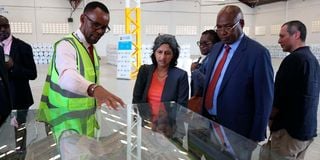
Kenya BioVax Institute CEO Dr Michael Lusiola (left) showing an architectural plan model to the World Bank Vice President for Human Development Mamta Murthi (centre) and State Department for Medical Services Permanent Secretary Harry Mutai when they toured Kenya BioVax Institute in Embakasi, Nairobi on February 7,2024.
Kenya is among six African countries selected to participate in the World Health Organisation (WHO) and Medicines Patent Pool (MPP) mRNA Technology Transfer Programme, an initiative that aims to shift vaccine production from wealthy nations to countries that need them most.
The MPP is a United Nations-backed body that negotiates licensing agreements, allowing lower-income countries to access medical technologies, including vaccines, medicines, and diagnostics for diseases at affordable costs.
Through this technology transfer, the Kenya BioVax Institute will receive end-to-end training covering the full process from research and development through to large-scale production, while the Kenya Medical Research Institute will serve as a key research partner.
“When a country can produce its own vaccines, it can protect its own people without depending on external supply chains that may not always be reliable or accessible. Kenya’s entry into this programme is an important step toward building that capacity, and toward ensuring that life-saving health products reach the people who need them, when they need them,” said Edwin Kojo Ogara, WHO Kenya technical lead for essential drugs and medicines.
The programme was established in direct response to the Covid-19 pandemic, during which lower-income countries were consistently last to receive vaccines, with some waiting years while wealthier nations secured multiple rounds of supply.
“The Covid-19 pandemic exposed our vulnerabilities, highlighting the necessity for Africa to develop its own manufacturing. Investing in local manufacturing not only strengthens our health systems but also creates jobs and stimulates economic growth,” said Ouma Oluga, Principal Secretary for Medical Services.
Local production
The other countries selected for the programme are Egypt, Nigeria, Senegal, South Africa, and Tunisia. Africa currently imports 99 percent of the vaccines it uses, a dependency that the Africa Centres for Disease Control and Prevention is working to reverse through a target of 60 percent local production by 2040.
For Kenya specifically, donors currently finance more than 80 percent of the country’s vaccine needs, and the country is expected to exit Gavi support by 2030, adding further pressure to establish a self-sustaining supply.
Progress at the $120 million (Sh15.48billion) World Bank-backed BioVax facility includes the installation of fill-finish machinery and quality-control laboratories. The facility is designed to meet Kenya’s current annual demand of 16 million vaccine doses, with the capacity expected to rise to 25 million.
When fully operational, BioVax is targeting a production capacity of more than 50 million doses per year, with an initial focus on typhoid and pneumonia vaccines by 2027, and a longer-term pipeline covering tetanus, Hepatitis B, polio, cholera, and Ebola.
“The Kenya BioVax Institute is on course to manufacture locally made vaccines by 2027 and will place Kenya on the world map for health security,” said Charles Githinji, chairperson of the Kenya BioVax Institute Board.
Follow our WhatsApp channel for the latest business and markets updates.