Time flies with great content! Renew in to keep enjoying all our premium content.
Prime
Commercialising smallholder farming
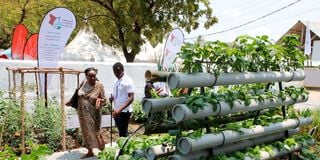
Kenyans Learn various ways of Establishing Smart Farming Units within their homesteads at the National Irrigation Authority Stand during the 2023 Agriculture Society of Kenya (ASK) Mombasa International Show in this photo taken on September 7, 2023.
Meaningfully increasing rural incomes means, at least in part, commercialisation of small holder agriculture. Value addition of agricultural produce, tourism and the digital economy, offer other pathways to higher incomes in rural areas. And, there is no shortage of efforts by governments and non-state actors promoting one model or another for that purpose.
Models focus on changing subsistence farming into market-oriented agribusiness, enhancing farm and farmer productivity through technology, and strengthening supply chains.
These models include farmer service centres, local advisors (extension officers), co-operative aggregation, and digitalised value chains. Their purpose is to boost income by improving access to inputs, finance, and markets.
Last week, I joined colleagues from St Martin Catholic Social Apostolate and Ujuzi na Biashara Trust, two Laikipia organisations that work to improve livelihoods, as we visited a successful small holder farmer at Limunga in Laikipia West.
National winner of the small-scale farm gearing for commercialisation category in 2016, Naomi Ngunyi and her husband Githinji have since received many more accolades and visitors. Going beyond maize and wheat (the most commonly planted crops in Laikipia), they grow sweet potatoes, pineapples, bananas, sugarcane, maize, beans and have high-yielding Holstein Friesian dairy cows.
The farm is well planned and laid out. Both the pineapple fields and the sweet potato vines are on moulds. Other crops and fruit trees are in deep humus filled planting holes. These practices, together with mulching, retain moisture for longer periods.
The family has a wonderfully positive attitude about farming and its prospects. And, nothing goes to waste. They have a bio-gas unit, using cow dung to generate cooking gas.
On-line literature on smallholder commercialisation points to this transition from subsistence to market-oriented farming, as the key trajectory to enhance farmer income, and strengthening food security.
The most common position is that commercialisation requires increased investment in technology (improved seeds, irrigation), access to credit, infrastructure development, and integration into value chains to overcome market barriers.
Key determinants of success include education levels, access to extension services, farm size, and proximity to markets. Increased, sustainable commercialisation often requires shifting to cash crops, using improved inputs, and adopting better agricultural technologies.
However, the interpretation of “cash crops” can be misleading. As we saw with farmer Naomi, all foods can be grown both for subsistence and commercial purposes.
Research from KIPPRA points to key enablers of transformation.
The most crucial of these is collective action. Smallholder farmers benefit from using collective action models such as cooperatives as well as companies. It improves access markets as well as infrastructure and logistics. This includes better transport, storage facilities, and access to urban markets, all crucial for maximising profits.
Support services, such as access to credit, training, and modern inputs such as fertilisers are essential to increase output. But, collective action, which improves that access, is not naturally occurring, it has to be organised through legal and financial structuring. This is a key role for governments.
Kenya Tea Development Agency is by far the most successful of these models. Evolving from the Special Crops Development Authority in 1960, clever legal and financial structuring has made it possible for 600,000 small scale tea farmers to own 71 factories, gain access to all the key enablers, and become global leaders in tea production.
Smallholder farmers are shifting from subsistence to commercialised agriculture. This is driven by inputs, credit, and market access. This transition includes utilising improved seeds, irrigation, extension services, and aggregating produce.
Despite hurdles such as limited financing, land fragmentation, and high costs, commercialisation enhances income and food security.
The likelihood of commercialisation increases with use of irrigation, access to agricultural credit, adoption of improved seeds, and access to extension services.
As the KIPPRA research has shown, commercialization is hindered by low capital, lack of land, and poor access to markets.
Technology has a positive impact - adopting tools such as artificial insemination and de-worming, along with improved market linkages increases profitability.
Aggregation plays a critical role. Smallholders are increasingly aggregating produce to meet the quality and volume requirements of larger markets.
We spoke to a focus group of young people in Nyahururu, who expressed interest in agriculture, but also in technology, and agri-business, particularly processing.
But in a separate discussion with three farmers and an animal feed producer, it emerged that they have difficulties finding reliable employees.
The farmers indicated that they are relying of workers and university students from further afield. This is odd, given high unemployment.
Ndiritu Muriithi is an economist and partner at Ecocapp Capital. He is also the chairman of KRA and former governor of Laikipia County. Email: [email protected]
Unlock a world of exclusive content today!Unlock a world of exclusive content today!