From farming travails to victory

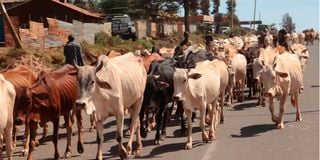
A herd of cattle walk through Marsabit town via the Marsabit-Isiolo highway as they head towards Laisamis in search of water and pasture on April 22, 2019.

Photo credit: File | Nation Media Group

I am a shoat farmer. Sheep and goats are collectively farmed as shoats. Following the drought a few years ago, I learnt the hard way that to be a successful shoat farmer you need to be food secure for at least a year.

What this means is that you should have food storage for your animals to keep you covered for the periods when they cannot get enough food from grazing out in the fields.
So I bought a 1.5-acre field of ready-to-harvest-maize last year and chewed character development for a week of Sundays thereafter as I learnt the hard way about what it would take to convert that maize into a long-term food bank.

Last September, I wrote the following about that harvesting experience:

“Casual labourers were hired and took an entire day to harvest and cut the maize stalks. The full-day rate for local casual labour culture requires the employer to provide tea and a scone at 10am and a meal at lunchtime. If you don’t provide the meal, well, you’ll struggle to get another crew the next day.

Contrary to the popular view that labour supply outstrips demand, in my little village in Laikipia you have to give a 48-hour notice to find a crew as there are quite a number of my fellow Nairobi residents doing large-scale farming around the area.

Then it got interesting. The harvested maize needed to be transported to my farm and I would have to hire a lorry. The only one available was a decrepit, dilapidated truck that was literally held together by screws of hope and strings of prayer. David, the truck owner, was a cantankerous, foul-mouthed diabetic who had no time for the labourers’ requirements for tea and lunch breaks.

Due to the condition of the truck, David would drive painstakingly slow, ambling along the five-kilometre distance with a repurposed dry maize cob as the gear stick holder. He complained every single minute about the two days it took to load the field of maize, transport it and unload it at the farm.

On the second day, he pulled my sunburnt hand to the shade of a tree and told me that I was motivating my labourers the wrong way.

According to him, since the labourers were being paid a daily wage, they would take their time to load up the truck. Next time, he growled, I should pay them per truck that was loaded and I would see a change in their efficiency.

Once the maize was offloaded, it had to be chopped by a thresher and poured into a pit to prepare it as silage.

The thresher was powered by the engine of a tractor and the maize was manually fed into it by two labourers. Three others stood at the thresher exit to distribute and compact the chopped product in the pit. This took another three days. The thresher operator pulled my other sunburnt arm under the shade of a tree and told me that the labourers were moving too slowly for his liking.

In future, I should thresh the maize as it was being harvested and pour the chopped product straight into a tipper truck. The truck would then come and tip the product straight into the silage pit. This would cut both labour and transport costs significantly. Thresher operator was basically validating what cantankerous David had said.”

Because my patience and my telephone farming pockets had been worn thin, this year I decided to listen to the advice given.

After planting my own acre of maize, we found a one-size-fits-all resource. This friendly gentleman—let’s call him Gabriel—comes with his own labourers who cut the maize, feed the stalks through a thresher that has an overhead chute straight into the back of a tipper lorry that then transports the cut silage straight to the storage site where it is compressed using Gabriel’s tractors.

Do you see how the entire process fits into one sentence? It cost me 39 percent of what last year’s experience cost and was executed in one day. I want to tell cantankerous David and the thresher operator that they were one hundred percent correct, I appreciate their generous advice and won’t be needing their labour-intensive services again.

Meanwhile, Gabriel has to be booked way in advance, as his order book is populated by other Laikipia farmers who saw the commercial light a long time ago.

Are you a telephone farmer fed up with local labour shenanigans? Do your research assiduously, the solutions are right there on the ground.

The writer is a former banker and a corporate governance specialist. X - @carolmusyoka

PAYE Tax Calculator

Note: The results are not exact but very close to the actual.