Save Nairobi from planning law breaches

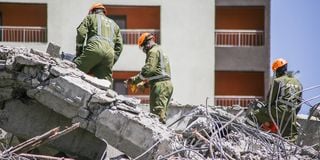
Search and rescue operations continue in South C, Nairobi, following the collapse of a multi-storey building under construction on January 2, 2026.

Photo credit: Billly Ogada | Nation Media Group

Somebody should go to jail for the deaths caused by collapse of the 14-storey building under construction in Nairobi’s South C. This was not an accident. It was a foreseeable, preventable outcome of a city where capital has outrun the law—and where planning rules have become negotiable suggestions rather than binding safeguards.

Let me begin with personal experience. When I moved to South C in the early 1990s, homeowners were buying into a low-density, gated residential neighbourhood.
We invested on the basis of clearly defined zoning rules, planning approvals and infrastructure assumptions. These were not vague expectations; they were the legal and economic foundations of our decisions.

The original developers—the family of the late property tycoon Lalit Pandit—went so far as to reserve space within the gated community for a children’s playground. That playground was part of the deal.

Today, our neighbourhood committee is in court fighting to save it from a “new” developer who has suddenly emerged to claim ownership. The danger of losing it is real. Winning court cases against wealthy, aggressive developers in Kenya has become increasingly rare.

Just outside our gate, another developer is constructing a large shopping mall on land excised from property belonging to—and situated within the compound of—the state-owned Kenya Industrial Research and Development Institute (KIRDI).

What was once a quiet, low-density estate is now hemmed in by high-rise concrete blocks and commercial developments. The consequences are visible and severe.

Roads designed for single homes now serve hundreds of households. Sewer lines groan under impossible loads. Sunlight is disappearing. Residents lose safety, amenity and property value. Developers accumulate billions. The city pays the price.

The collapse of the South C building is, therefore, not an isolated tragedy. It is the predictable outcome of a system in which planning law exists largely to be waived, bent or ignored.

Yet public discussion of these frightening trends remains shallow. When buildings collapse, attention gravitates to familiar culprits: corrupt county inspectors, rubber-stamp approvals by the National Construction Authority, weak enforcement by Nema.

Sections of the political elite—some clearly blinded by Somali xenophobia—have latched onto a new distraction: the so-called Minnesota scandal. These narratives barely scratch the surface.

The more uncomfortable question is this: why are certain developers able to defy zoning rules, environmental standards, community resistance—and, tragically, basic structural safety—with apparent impunity?

Nairobi’s construction frenzy is not merely a story of rogue inspectors and regulatory lapses. What we are witnessing is something deeper and more dangerous: capital-driven urban violence, enabled by opaque financial flows, political patronage and the systematic erosion of residents’ rights.

The dominant force reshaping Nairobi today is opaque capital inflows. The city is in the grip of a property boom powered by vast amounts of cash, much of it diaspora-linked, rapidly channelled into high-rise buildings and shopping malls.

It is no coincidence that diaspora remittances are on the brink of overtaking horticulture, tea and coffee as Kenya’s largest source of foreign exchange.

Another tell-tale sign lies in banking data. Mortgage uptake bears little relationship to the frenetic pace of construction. Anecdotally, the money is clearly coming from elsewhere.

This is not an argument against diaspora remittances. Their growth is, up to a point, something to celebrate. But in a country where virtually every Financial Action Task Force risk assessment concludes that oversight is weak and financial transparency thin, such inflows also present classic money-laundering risks.

Contemporary anti-money-laundering literature is blunt: high-rise real estate is a preferred vehicle for sanitising large sums of money. It absorbs capital quickly, disguises ownership, legitimises wealth through physical assets and overwhelms inspection regimes—especially in politically compromised cities.

What is unfolding in South C—and in Kileleshwa, Kilimani, Lavington, Rhapta Road, Westlands, Parklands, Pangani, Eastleigh and beyond—is therefore not simply densification. It is a failure of the Kenyan state to regulate modern capital flows.

Add political patronage and the incestuous relationships between developers and powerful elites, and the result is a perfect storm: speed without scrutiny, height without safety, growth without accountability.

Nairobi’s future cannot be secured by treating planning law as an inconvenience and anti-money-laundering safeguards as optional. Development that kills is not growth.

The paradox could not be starker. Even as the state pleads fiscal distress—borrowing aggressively and taxing the formal economy to exhaustion—billions of shillings are being sunk into speculative real estate that contributes little to the tax base, almost nothing to public infrastructure, and largely accumulates non-tradeable assets. The upshot is a city where private wealth rises as public systems fail—and where citizens ultimately pay with their lives.

PAYE Tax Calculator

Note: The results are not exact but very close to the actual.