Time flies with great content! Renew in to keep enjoying all our premium content.
Trump’s Board of Peace may be a good diversion
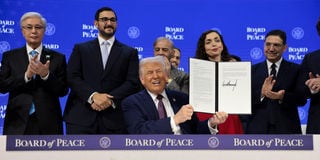
US President Donald Trump, alongside Kazakhstan’s President Kassym-Jomart Tokayev, Bahrain’s Minister of the Prime Minister’s Court Shaikh Isa bin Salman bin Hamad Al Khalifa, Pakistan’s Prime Minister Shehbaz Sharif, Kosovo’s President Vjosa Osmani, and Morocco’s Foreign Minister Nasser Bourita, takes part in the announcement of the charter for his Board of Peace initiative aimed at resolving global conflicts, during the 56th annual World Economic Forum (WEF) in Davos, Switzerland, on January 22, 2026.
A new body has added to the currently complex geopolitical landscape. The Board of Peace was formally launched in January 22, when American President Donald Trump signed its charter at the 57th World Economic Forum in Davos.
Supporters see it as an agile alternative to collective action by the UN Security Council to facilitate reconstruction planning in Gaza. Critics, however, view it as means to sidestep existing multilateral system or to redirect funding from UN organisations. Others also think of it as a 'pay-to-play' club of world leaders to avoid collective decision making.
Launch of the board is a potentially profound point at which global governance takes an unexpected turn especially considering the influence held by its architect.
Emerging from a US-brokered framework welcomed by the UN Security Council, the board is being positioned as a pragmatic response to institutional paralysis, particularly around Gaza’s reconstruction.
But beneath the language of efficiency and agility is silence on what this new architecture means for developing nations within the rules-based international order in representation and access to collective solutions.
Multilateralism is such a practical necessity for several countries in the Global South that they tend to drag their feet whenever a new idea comes in.
Institutions such as the UN provide smaller and less powerful states with a forum where their sovereignty can be strongly argued, even if it just an illusion. It is also where international law offers at least some insulation.
Outside this formal process, the board may inadvertently reinforce a world influenced by financial muscle and executive-level diplomacy.
Proponents argue that the board’s appeal lies precisely in its speed and flexibility in getting things done. They argue that traditional multilateral bodies are slow-moving and hamstrung by vetoes and bureaucratic inertia.
From this perspective, the board represents a necessary innovation, a way to mobilise resources and political will when conventional channels stall. The irony, however, is that the US is one of the veto wielding superpowers.
History offers sobering lessons about externally driven reconstruction efforts that prioritise donor interests and a nation’s financial might.
The scepticism expressed by close US allies such as France and the UK mirrors broader nervousness a majority of nations have with a highly fragmented global governance.
If powerful states increasingly favour tailored coalitions, developing nations get sidelined from decisions that directly affect their existence.
The “pay-to-play” perception already raises fears that access to peace-building platforms could become contingent on economic or political alignment rather than international norms.
More fundamentally, the Board of Peace challenges the principle of collective legitimacy. The UN system, for all its flaws, derives authority from universal membership.
Its resolutions, agencies and peace-building frameworks carry moral and legal weight because they emerge from a broad multilateral consensus.
Coming at a time when the US is withdrawing from several international organisations, the new body is projecting an image of peace as a premium product that is designed and delivered by a narrow group of global power brokers.
If it becomes a template for resolving complex global crises, it is likely to accelerate the intentional undermining of UN efforts for specialised interventions.
Countries with specific interests or even individuals with Nobel Peace Prize ambitions can disrupt global order at will. This means reduced leverage and fewer safeguards for developing nations with a more aggressive transactional global order.
However, it is not all gloom and doom for developing nations. This moment presents an opportunity for the Global South to take advantage of the diversion to pursue reform of existing multilateral structures.
The fact is that the board is almost a personal initiative of Trump. Its influence may just go as far as his tenure and may be deprived of funding should another president, possibly a Democrat, take over in America in three years.
This is enough time for emerging economies to organise diplomatically, build coalitions across regional blocs and push for long-overdue reforms within the UN system especially around UN Security Council representation and development financing.
Unlike long-standing international organizations whose mandates and budgets are enshrined in treaties and sustained through successive administrations, the Board’s funding and US political backing could rapidly evaporate if the presidency switches hands.
The board’s charter explicitly centers Trump as its chair with exceptional control over membership, decision-making, structure and succession, features that make it structurally dependent on his continued influence and political clout.
A future administration, especially one opposed to Trump’s vision, could withdraw diplomatic support and reduce or eliminate funding. Thus, stripping the Board of both its operational resources and the symbolic weight that comes from American leadership.
In essence, the Board’s survival beyond Trump depends less on its formal mandate and more on political continuity which is not guaranteed once the architect of the initiative exits the global stage.
The writer is a Strategic Communication & International Relations Professional.