Time flies with great content! Renew in to keep enjoying all our premium content.
Prime
Broker gets Sh1bn bonus for hitting KPC IPO target
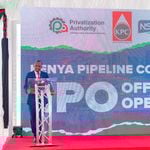
Kenya Pipeline Company Managing Director Joe Sang (Centre), Faida Investment Bank Lead Transaction Advisor Dr Belgrad Kenne (left) and Public Investments and Portfolio Management Director General Lawrence Kibet during the Kpc initial public offering (IPO) media roundtable at Sarova Stanley Hotel, Nairobi on January 20, 2026.
Faida Investment Bank is set for a Sh1.16 billion fee windfall for successfully leading the Kenya Pipeline Company (KPC) initial public offering (IPO) to a full subscription, highlighting the lucrative returns for intermediaries who handle mega capital raising deals.
Faida, which was the lead transaction advisor for the Sh106.3 billion IPO, qualifies for a payout equivalent to one percent of the gross proceeds of the offer, which translates to Sh1.06 billion, after it was oversubscribed.

A success fee is a performance-based commission paid out to an underwriter or advisor upon the successful closing of a deal, incentivising them to market the transaction.
The IPO received a 105.7 percent subscription rate, raising Sh112 billion against the State target of Sh106 billion after Uganda and local institutional investors saved the offer from collapse.
Lower valuations by some banks, an extension of the offer period and reports that investors were apathetic shadowed the IPO amid fears over its success.
For the KPC offer, the government had set a minimum threshold of Sh53.1 billion and at least 250 investors for the sale to be considered a success and to proceed.
Contacted for comment on whether the terms of the success fee have been fully met, the investment bank’s team lead for the IPO, Belgrad Kenne, referred the Business Daily to the offer’s information memorandum, which set the fee at one percent plus 16 percent VAT on gross proceeds of funds raised.
“Please refer to the information memorandum on transaction costs,” said Dr Kenne.
He had earlier highlighted the extent to which the Faida team went in marketing the IPO to potential investors, including holding at least four meetings with oil marketing companies (OMCs) to convince them to participate in the offer.
Ultimately, however, the OMCs largely sat out the IPO, citing court cases that threatened to block the sale, concerns about the offer’s valuation, delayed approvals from home markets of multinational players and disagreement over whether to invest individually or as a group.
Holding such roadshows and investor meetings form part of the wide responsibilities of an IPO lead adviser, as per the Nairobi Securities Exchange (NSE) listing rules.
These include preparation and distribution of the information memorandum and other relevant documents, offering guidance on the pricing of an offer, and coordination of the activities of the other advisers in an offer.
Dr Kenne said he also chaired the allocation committee of the IPO, which determined the volumes of shares apportioned to each investor category, and the reallocation in case one or more failed to hit their set quota.
But the success of the offer has masked the apathy towards the IPO among foreigners, retail investors and oil marketers, who many believed considered Kenya Pipeline a strategic investment.
Local retail investors bought shares worth Sh4.1 billion against their allocation of Sh21.2 billion stocks while foreigners spent a measly Sh32.7 million compared to their target of Sh21.2 billion.
Oil marketers took shares worth Sh22.9 million or 0.14 percent of the Sh15.9 billion stocks allocated to the dealers who rely on the pipeline to feed the market.
Besides the Sh1 billion bonus, Faida will also be paid Sh98.6 million for acting as lead transaction adviser, and could also bank additional millions through placement fees that are paid per broker depending on the value of IPO shares they process.
The cumulative placement fees are capped by law at 1.5 percent of the offer size, meaning the 22 stockbrokers and investment banks enlisted to handle the sale will be sharing a maximum of Sh1.59 billion in such fees.
The lead adviser is also responsible for preparing the issuer on how to meet the Capital Markets Authority’s continuous listing requirements after joining the bourse. The information memorandum shows that the government will spend a total of Sh3 billion in fees on the IPO, excluding the conditional success fee to be paid to Faida.
The fees include a Sh2.75 million payment to market intermediaries Dyer and Blair Investment Bank and Francis Drummond for acting as lead sponsoring broker and as co-sponsoring broker respectively for the IPO.
Image Registrars, which acted as the data processing agent and registrar of the offer, is being paid a total of Sh70.35 million, of which Sh28.3 million is advisery fees and Sh42.05 million is reimbursable costs.
The offer enlisted three receiving banks, whose fees were set at Sh16.35 million. Co-operative Bank of Kenya will earn Sh9.96 million, KCB Bank Sh3.6 million and Stanbic Bank Sh2.78 million.
The fee for the transaction’s legal advisers TripleOKLaw Advocates and G&A Advocates LLP was set at Sh31.9 million, while PriceWaterhouseCoopers LLP has been paid Sh13.45 million as the reporting accountants for the IPO.
Apex Porter Novelli (APN) and Belva Digital were tapped as the public relations and advertising agencies respectively for the offer, at fees of Sh42.13 million and Sh12.26 million.
The Treasury also spent Sh40 million in advertising fees, Sh6.25 million in proofing fees and Sh12.5 million as other fees. It also paid the CMA Sh30 million in IPO approval fees, and the NSE Sh1.5 million in listing fees, both being the maximum allowed as per the CMA’s listing and public offers rules.
The charges levied by these other advisers were, however, dwarfed by what Faida stands to earn, setting the firm for a boost on its bottom-line at a time when the investment banking segment has seen increased competition for brokerage commissions and advisery fees.
Faida reported a net profit of Sh216,107 in the year ended December 2024, turning around a net loss of Sh14.28 million in 2023. It earned Sh123.22 million in brokerage commissions, and Sh50.21 million in advisery fees in 2024. The firm will release its full-year 2025 financials by the end of this month.
The company was established in 1995 as Kenya’s seventh stockbroker by Bob Karina, who previously worked as a government statistician. It later ventured into Kigali in 2009, trading as Faida Securities Rwanda.
In 2025, the firm was ranked third in value of equities trades handled at the NSE at Sh35.97 billion, giving it a market share of 12.36 percent.
The top two equities brokers were EFG Hermes at Sh60.8 billion or 20.9 percent of the NSE’s total shares sales and purchases, and SBG Securities at Sh45.05 billion or 15.48 percent.
In the bonds market, Faida was also third in market share at 7.55 percent, having traded securities worth Sh409.34 billion (combined sales and purchases). The segment was led by Capital A Investment Bank at Sh1.06 trillion or 19.68 percent market share, and Standard Investment Bank at 13.93 percent or Sh755.1 billion.