Oil marketers, individuals keep off oversubscribed KPC IPO

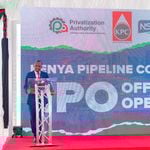
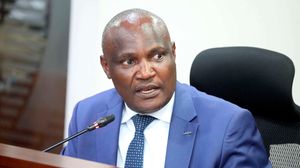
 Kenya Pipeline Company CEO Joe Sang during the company's IPO launch.

Photo credit: Pool

Foreigners, local retail investors and oil marketers shied away from the oversubscribed Kenya Pipeline Company (KPC) initial public offering (IPO) that was saved by Uganda and local institutional investors.

The offer received a 105.7 percent subscription ⁠rate, raising Sh112 billion against the State’s target of Sh106 billion.
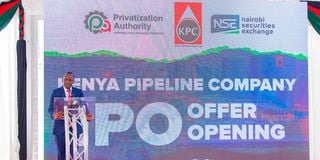
But the success of the offer has masked the apathy towards the IPO among foreigners, real investors and oil marketers, who many believed considered KPC a strategic investment.

Local retail investors bought shares worth Sh4.1 billion against their allocation of Sh21.2 billion stocks while foreigners spent a measly Sh34.8 million compared to their target of Sh21.2 billion, says records provided by the Treasury Cabinet Secretary, John Mbadi.

Oil marketers took shares worth Sh23.1 million or 0.14 percent of the Sh15.9 billion stocks allocated to the dealers who rely on the pipeline to feed the market.

Lower valuations by some banks, an extension of the offer period and reports that investors were apathetic shadowed the IPO in Kenya’s first big deal since the sale of Safaricom shares in 2008.

The government priced the Kenya Pipeline IPO at Sh9 per share for the offer that opened on January 19 amid a split on views over its valuation.

KPC’s expected reduction in its dividend payout ratio and future capital expenditure commitments (Capex), including laying a new pipeline between Mombasa and Nairobi, led to investor scrutiny of the offer.

But 465 local institutional investors led by National Social Security Fund (NSSF) and the Public Service Superannuation Fund (PSSF) and Uganda’s State-owned oil company, Uganda National Oil Company (UNOC), snapped up the shares that other categories of investors had left on the table.

Without a strong showing from Uganda and the few high-net-worth investors, the IPO would have collapsed and hurt the State’s drive to diversify its sources of revenue from taxes and public debt.

The IPO needed to raise at least Sh53.1 billion from more than 250 investors for it to proceed.

Uganda, under the East Africa category, bought shares worth Sh34.7 billion against their allocation of Sh21.2 billion.

Local institutional investors splashed Sh67 billion on the offer, surpassing their allocation of Sh21.1 billion by 216 percent.

The lead transaction advisor, Faida Investment Bank, said the concentration of local institutional investors and UNOC implies that the IPO was largely seen as a long-term strategic investment.

“The participation by institutional investors is an endorsement of the offer. These are long-term investors, which means that they buy and hold the stock over a long period,” said Kenne Belgrade, a team lead at Faida Investment Bank, on the deal.

He linked the poor show of the oil marketers like Vivo Energy on a cocktail of issues, including fears on the valuation of the offer, delayed approvals by their respective boards and a lack of consensus on whether to participate in the offer as a group or as individuals.

The marketers will have a chance to build their ownership via buying opportunities in the secondary market from Monday, when the market valuation of KPC will be clear.

KPC

“OMCs wanted to own a stake in KPC, and we held meetings with them on at least four occasions. We are hopeful and confident, based on that engagement, of their participation in the secondary market,” said Dr Belgrade.

The number of individual investors who applied for shares stood at just 73,000, which pales in comparison to Safaricom, which attracted over 800,000 retail investors.

Employees of KPC bought shares worth Sh99.1 million against an allocation of Sh5.3 billion. But they bought more shares than foreigners and the oil marketers.

Mr Mbadi termed the IPO a success and transparent.

“We were accused of having identified some foreigners out there to buy KPC. That was not the case. We were also told that we were selling State assets for a song by the same people who deemed the offer overpriced,” he said.

He added that Kenya Pipeline has a petroleum products movement and storage monopoly in the region and receives payments in dollars, helping protect it from currency volatility.

These competitive advantages attracted strong institutional demand, he said.

The shares will start trading on the Nairobi bourse on March 9, with proceeds earmarked for the national infrastructure fund to support highways, railways, ports and energy projects.

KPC’s share sale offer documents show the firm will reduce its average dividend payout from 94.5 percent of profits to 50 percent.

Analysts at Standard Investment Bank (SIB) issued a buy recommendation to investors with a long horizon on KPC, arguing that there was less attraction for short-term-oriented investors.

Burdened by high national debt, limited room to raise taxes and annual loan repayments that consume 40 percent of government revenues, the Treasury has sought new funding models, including divestiture from State companies.

Of the total KPC stake on offer, 15 percent was reserved for oil marketing companies, five percent for employees and the remainder will be allocated to local retail, local institutional, East African and foreign investors, with each category receiving 20 percent.

The government will retain a 35 percent stake.

“In cases of under subscription, valid applications in the affected category will be allocated in full, with remaining shares reallocated in the order of local retail, local institutional, East African investors, international investors and oil marketing companies (OMCs),” the KPC investor memorandum says.

“In cases of oversubscription, Kenyan investors will be given priority.”

Uganda and local institutional investors exceeded their allocations.

Uganda required the 20 percent ownership of KPC to be guaranteed two board seats in the firm and the right to veto future hiring and firing of the chief executive officer.

The Ugandan threat would have denied the IPO nearly Sh30 billion from Kampala and sparked the collapse of KPC's stake sale, which struggled with targets.

This sounded the alarm bell in Nairobi, which yielded to Uganda’s demands and forced the revision of KPC’s articles of association to guarantee the 20 percent ownership.

Uganda says its participation in the IPO is a deliberate strategic decision aimed at strengthening regional energy cooperation and safeguarding national interests.

Over half of the fuel cargo that goes through KPC’s network is for exports, with Uganda taking up an estimated two-thirds of it.
Eastern Democratic Republic of Congo (DRC) takes 19 percent, South Sudan 15 percent and Rwanda 15 percent.

On service fees, UNOC is the sixth largest customer of KPC, paying for charges of Sh1.2 billion in the year to June, with Vivo Energy the leader at Sh4.94 billion.

The Kenya Pipeline IPO comes amid a sharp rally at the NSE.

Follow our WhatsApp channel for the latest business and markets updates.

PAYE Tax Calculator

Note: The results are not exact but very close to the actual.