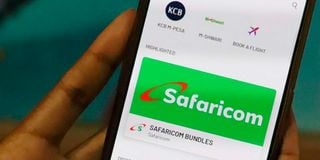
Safaricom has restored allocations of the popular mobile data bundle packages it quietly slashed over a week ago.
The telco has reinstated its ‘No Expiry’ package rates, whose halving from October 22 effectively doubled the cost of data, sparking uproar among customers. It blamed the cuts on a “technical issue.”
‘No Expiry’ package offers indefinitely valid bundles at fixed or customisable prices, and Safaricom said it is refunding the remaining data for customers who bought the bundles at the slashed rates.
“It was a technical issue, and customers who got less data have been refunded the remaining amount,” a spokesperson for the company told the Business Daily on Monday.
"The data offered now is more, especially for amounts from Sh11."
SMS notifications sent out to affected customers on Sunday and Monday read: “Dear customer, the issue with your non-expiry bundles is fixed and extra bundles added. We apologise for the inconvenience.”
Before the data rates revision, Safaricom subscribers got 255MB of non-expiring data with Sh51. However, the allocation was slashed by more than 50 percent to 102MB in the past week.
Customers only got 200MB for Sh100, with 500MB costing Sh250. As of Monday, a spot check showed that Sh250 got 500MB of non-expiring data, while Sh250 gave 1.25GB.
Kenya’s largest telco had previously alluded to an “issue affecting the awarding of data bundles” amid customer complaints on social media over the revised pricing.
“We are aware of the issue affecting the awarding of data bundles and a resolution is underway. Apologies for the inconvenience,” the company said on October 23 on social media platform X.
The telco had declined to officially comment on the matter at the time.
Safaricom’s mobile data and fixed internet businesses have emerged as key sales drivers alongside its mobile financial service M-Pesa.
As per its 2026 half-year financials, the Nairobi Securities Exchange (NSE)-listed company’s revenue from mobile data in the six months to September rose 18.2 percent to Sh44.4 billion.
Safaricom has a leading market share in both mobile and fixed internet services in Kenya, holding a dominant 62.8 percent in mobile broadband and 34.3 percent in fixed internet as of June 2025, according to the Communications Authority of Kenya.
Airtel is its main competitor in the mobile broadband sector. A comparison of some of the two telcos’ popular bundles shows that Airtel offers 1GB valid for one hour for Sh15, while Safaricom’s 1.2GB bundle with the same validity period goes for Sh20.
For the 24-hour bundles, Sh20 gets one 200MB on Safaricom, while a similar offering for Airtel gets one 300MB. For Sh3,000, Airtel offers a 50GB monthly bundle, while Safaricom has a 25GB monthly bundle for Sh2,000.
Safaricom has been aggressively fighting for a larger share in the data business, ramping it up with more investments in 4G and 5G networks to offset a decline in mobile calls.
In the six months to September, the voice business recorded a 0.5 percent decline in revenues to Sh41 billion, marking a big shift as mobile data for the first time overtook sales from calls.
This was partly due to saturation and rival online texting and calling platforms like WhatsApp.
Meanwhile, to maximise revenue, telcos across the world have been adopting a dynamic pricing model for services like mobile data and call minutes, where costs are adjusted in real-time based on factors like demand, consumer usage patterns and network congestion.
The model, based on big data analytics and in some cases artificial intelligence (AI), is a departure from traditional models, where shilling-per-minute or shilling-per-MB rates are fixed across all customers.