Telkom woes deepen as 1m more customers flee, extending last year’s trend

telkom1

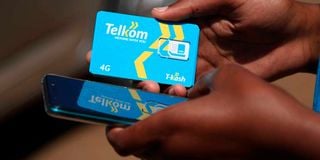
A subscriber holds a Telkom SIM card.

Photo credit: File | Nation Media Group

Kenya’s third largest telecommunications company, Telkom Kenya, shed over one million customers in the 12 months to June this year, new disclosures show, extending a trend observed the previous year when the firm lost 899,458 customers.

An analysis of official data from the Communications Authority of Kenya (CA) shows that the telco had 1.48 million customers at the close of June 2024, representing a 41.4 percent dip from the 2.5 million subscribers recorded as of June 2023.
During the year under review, Telkom was one of the only two telco firms to lose a portion of its customer base, alongside Finserve, which shed off 48,882 users, representing a 3.3 percent dip, to stand at 1.45 million subscribers.

Jamii Telecommunications Limited (JTL), on the other hand, gained at the fastest pace of 43.4 percent during the period, adding 178,559 new SIM card holders to stand at 590,108 customers, followed by Airtel which gained 2.2 million new users, representing 12.3 percent jump to 20.3 million.

Market leader Safaricom, on its part, gathered a marginal 2.6 percent in fresh users, to bring its total subscriber base to 45.1 million up from 43.9 million as of June last year.

“Active SIM (Mobile) Subscriptions refer to those SIM Cards used at least once in the last three months and have generated revenue through making or receiving a call or carrying out a non-voice activity such as sending or receiving an SMS, accessing the Internet, airtime top-up, transacting using mobile money and mobile banking),” wrote CA in its latest sector statistics report.

“Activities that do not result in revenue generation such as balance inquiry, unanswered calls, and password resets, amongst other free services, do not qualify a customer account as active.”

Telkom’s woes trace their genesis to the beginning of April 2022, when the industry regulator started switching off SIM cards that were not regularly registered, being the most recent of an exercise that has been frequently undertaken since 2013.

In the drive, telcos were required to re-register their subscribers by updating their details with a digital passport-size photo of the customers.

CA said at the time that irregularly registered SIM cards were being used to perpetuate crime, including in the forms of money laundering, kidnapping, malicious calls, cybercrime as well as mobile money fraud.

Telkom has over the years struggled to keep pace with Safaricom and Airtel in the race for the local market and the sustained dip in active customers, is set to significantly dent the firm’s revenues from a range of services that include calls, SMS, and mobile money, among others.

PAYE Tax Calculator

Note: The results are not exact but very close to the actual.