Time flies with great content! Renew in to keep enjoying all our premium content.
Prime
Father-son turns shoe repair shop into bags export business
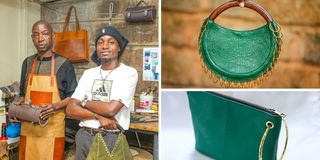
Co-founders of Kisero Nairobi, Josephat Abwova (left) and Creative Director Kevin Abwova, with the Charme statement piece bag (top right) and a Kipenzi bag, at a workshop in Rongai on February 7, 2026.
Kevin Abwova never really wanted to run a business with his father. His father was a shoe repairman turned into a shoemaker, who later ventured into luxury bag-making.
After finishing high school, Kevin hustled for a few years, chasing whatever jobs came his way. Eventually, he joined his father in the family shoe repair shop, and together they began making school shoes, though at first, it was little more than a small, homegrown business.
While Covid-19 forced many businesses to close, Kevin and his father saw a silver lining: an opening in private labelling, helping companies produce goods under their own brand names when in-house staff were limited.
For three years, they focused on private labelling, making bags for other companies. Eventually, they took the leap, launching their own brand, Kisero Leather, and selling products under their own name.
“Our initial capital was our labour; we came with our own skillset and manpower. What we needed to spend on was machinery and rent. Before I joined my father, I had worked and saved some money for three years. I used the money to buy one machine, and my father bought the other sewing machine,” he says.
It didn’t take long for Kevin to realise that his father could make just about anything—shoes, bags, you name it.
“I tapped into his skillset and came up with bag designs and ensured functionality. They became a hit. He stitched the bags, I was his casual help and creative director,” he says.
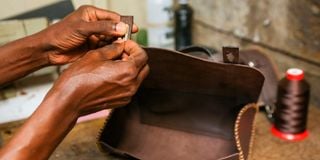
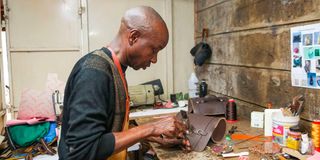
Kisero Nairobi co-founder and designer Josephat Abwova crafting a bag at the Kisero workshop in Rongai on February 7, 2026.
Photo credit: Billy Ogada | Nation Media Group
Soon, the business grew. They hired eight people.
“When it was just a shoe repair shop, my father was pulling in about Sh20,000 a month, and for him, that was good enough. In 2024, the earnings rose to Sh5.4 million,” he says.
The revenue not only comes from making bags, but also through private labelling, including for companies in France.
Moving to a new location, he says, will likely push our earnings even higher. “As my dad says, you cannot dry yourself in the same place you took a shower. We started here as a shoe repair business, which we no longer are; we are now an export-quality company. For us to be strategic, we have to move the shop to Kitisuru and create an experiential store where our customers will get to witness the whole process, from the beginning of our production to the final product,” he says.
Kevin says a large chunk of their products, 65 percent, are sold in Kenya. “The remaining 35 percent go to the UK, Italy and the US. It’s easier to sell a bag going for Sh15,000 to Sh50,000 abroad than in Kenya,” he says.
Leather challenges
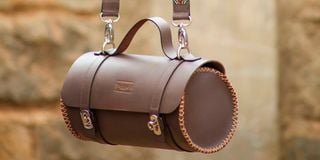
Jenny Satchel bag at a workshop in Rongai on February 7, 2026.
Photo credit: Billy Ogada | Nation Media Group
For leather products, raw materials remain a challenge.
“We outsource our leather locally from different tanneries such as Alpharama in Athi River, Mas Tanneries in Nairobi’s Industrial Area and Sagana Tanneries. For most of our corporate clients, we get our leather from Sagana. For the clients for whom we make exclusive products, we buy our leather from Alpharama and Mas tanneries. Each tannery specialises in different grades and ranges of leather,” says Kevin.
Competition in the leather bags market is unforgiving, crowded with imports, fast fashion, and copycat designs.
“One way of determining a good leather product is the pricing,” he says, “You will not find a good leather bag come cheap, if someone sells you a leather bag for say Sh1,500, there is a high probability you are not getting an authentic product because good leather, even before it is processed, cannot be bought for Sh1,500.”
“We don’t price bags according to the competitors. In our new collection, for instance, we are working with elements like wood, horn and brass, handwoven and hand-printed lining. All these natural materials come at a cost, and the craftsmanship behind them takes a considerable amount of time. What we charge, it is the cost of us producing these masterpieces, not what the market dictates. We are not cheap, but we are also not expensive because there are brands that sell higher than us,” he says.
“As an entrepreneur, one needs to have a really thick skin. My dad and I were once employed before we started our business, and when we started it, I thought I would have freedom, it wasn’t to be so. One needs to be strategic and also be very good with money,” Kevin says.
“Back then, we struggled with cash flow and debt management, which was a result of pouring loans into the business that later evolved into bad debts that put the business in a pretty precarious situation. For someone who doesn’t have an accounting background, the best decision I ever made was getting myself an accountant and someone who deals with the taxes.”
Kevin has been to the UK and Italy, where he has showcased their products, but he believes that the future is in Africa.
Kisero Nairobi co-founder and designer Josephat Abwova crafting a bag at the Kisero workshop in Rongai on February 7, 2026.
Photo credit: Billy Ogada | Nation Media Group
“I have showcased in Italy in a quiet town called Ancona and in Milan. It was a collaboration with a fashion school. Recently, I exhibited at the African Fashion Show in London courtesy of the British Council. This weekend, our products were at one of Nairobi’s biggest fashion events called Tribal Chic,” he says.
“Before I went to Europe, I thought that it was the market, but before long, I’ve come to realise that Africa is the new market. Currently, we are stocking in shops in Uganda, Tanzania and looking to enter Zimbabwe and South Africa. In Morocco, Egypt, Nigeria and Ghana, there is a huge rise in spending too,” he adds.
Balancing family and business
Kevin says much of their success has come from drawing a clear line between family and business. Working with his father required building a professional relationship that was different from the one they had at home.
“That separation has helped us manage conflict,” he says.
One of the biggest challenges, Kevin says, was navigating the generational gap. He and his father come from very different worlds, Kevin from a fast-moving, design-driven generation; his father from a slower, more deliberate one shaped by years of craft.
“The balance,” he says, “is that I lead on creative direction, and he anchors the work as a craftsman.”
Money can be a minefield in family businesses, but Kevin says they made an early decision to keep things strictly professional.
“We are all employees of Kisero Leather—that’s the bottom line,” he says. “Everyone earns a salary, and as shareholders, we receive dividends at the end of the year based on our shares. What we earn depends entirely on what we bring to the business.”