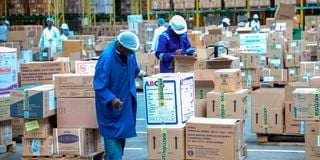
Primary health facilities in Kenya waited an average of 24 days to receive essential medicines and medical supplies in the year ended June 2025, forcing patients to either buy drugs from private pharmacies at a higher cost or go without treatment.
Supply delivery time or lead time is the total duration from placing an order with a supplier to actually receiving the goods or services, encompassing order processing, production, shipping, and final delivery.
Essential medicines are those that satisfy the priority healthcare needs of the population.
Latest data shows that the order turnaround time—the number of days between when a facility submits an order and when supplies actually reach the facility, more than doubled the official 10-day target increasing by 14.2 days in the financial year 2024/2025.
This represented about a 43.2 percent increase from the 16.9 days recorded three years earlier.
This worsened to 20.1 days in 2023/24, representing a 10-day delay, before reaching 24.2 days in the year ended June 2025.
The 14.2-day delay represented a 142 percent deviation from the target, signaling systemic problems rather than isolated operational challenges.
“Targets were not met due to low on-time order integration, especially for program orders that led to long order processing,” said the State Department for Medical in its sector report.
Consequently, the product availability, measured by the fill rate—the percentage of ordered items that Kenya Medical Supplies Authority (Kemsa) actually has in stock and can supply when facilities place orders, fell below the planned targets.
The performance data shows that only 55 percent of ordered items were supplied to facilities, far below the 90 percent national benchmark.
From 66 percent in 2022/23, already 24 percentage points below target, performance dropped to 62 percent in 2023/24 and jumped to just 55 percent in the next financial year.
This represented an 11-percentage-point decline over three years, with performance at barely half the benchmark that health planners considered essential for functional service delivery.
“Though the order fulfillment rate for Kemsa Capital essential commodities has been decreasing, this can be attributed to low stock availability occasioned by long supplier payment times, due to strained cash flow/lack of adequate capitalisation,” read the report.
It also said the low tracer commodity availability to the county was due to underfunding and debts owed to Kemsa by county governments, highlighting systemic financial management problems at the devolved level.
According to the State Department for Medical Services, pending bills owed to Kemsa by the Ministry stand at about Sh1.9billion.
As a result, the availability of essential medicines at the facilities stood at a low of 40.3 percent, meaning that fewer than half of essential medicines were available at health facilities when patients sought care, despite the billions spent on procurement and distribution.
Over the three years, the Authority successfully procured Health Products and Technologies worth Sh113.28 billion and delivered commodities totaling Sh115.11 billion across the country.
These supplies reached an average of 11,540 healthcare facilities and testing sites spread across all 47 counties, ensuring national coverage.