NTSA adds 1,000 traffic cameras amid instant fines push

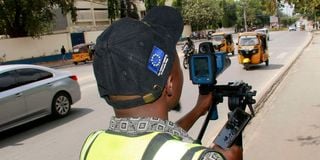
A National Transport and Safety Authority (NTSA) officer with a speedgun checks the speed of motorists driving along the Nyerere Avenue in Mombasa in this photo taken on December 22, 2025.

Photo credit: Kevin Odit | Nation Media Group

More than 1,000 new smart cameras are to go live on Kenyan roads to catch drivers performing illegal manoeuvres under a private-public partnership aimed at curbing speeding and ease execution of instant fines.

The network will comprise 700 fixed cameras to be mounted at strategic locations along major highways and high-risk corridors and 300 mobile units targeting speeding hotspots and accident-prone zones.
The cameras will detect the traffic offences and automatically relay the breach to the National Transport and Safety Authority (NTSA), which link the violation with drivers profile under the smart driving license.

NTSA on Tuesday said the cameras form part of a transport modernisation programme that includes smart driving licences, an integrated instant fines system and a mobile digital licence wallet, which allows for prompt payment of the penalties.

The project, approved last December by the Cabinet, is structured as a 21-year PPP deal with KCB Bank Kenya and Pesa Print, marking one of the most ambitious technology-driven enforcement reforms ever attempted in Kenya’s chaotic transport sector.

The project’s initial investment is estimated at Sh42 billion over the first two to three years, funded through private debt and equity provided by the KCB-led consortium.

The consortium will finance, deploy, and maintain the enforcement and licensing infrastructure.

Motorists captured breaking traffic rules will face instant fines for speeding, failure to wear seat belts, using a mobile phone while driving, operating vehicles without valid inspection certificates, and other offences listed under the Traffic (Minor Offences) Rules.

The violations will trigger penalties through the automated instant fines system, with offending motorists required to pay via USSD, mobile money platforms such as M-Pesa or banking channels.

“Kenya’s road transport and safety record is characterised by high levels of road fatalities, road indiscipline, poor driver licensing systems and weak enforcement of traffic violations,” the NTSA wrote in the notice on Tuesday.

The authority says road accidents, which resulted in more than 5,100 fatalities in 2024, impose an estimated Sh450 billion economic burden, factoring in medical care, lost productivity, property damage, and social costs.

The regulator has blamed the weak enforcement under the current system largely on a lack of adequate speed enforcement cameras, red-light cameras and detection systems as well as low enrolment of drivers into smart driving licensing systems due to inadequate kits and centres.

NTSA data shows that about a quarter, or 1.3 million, of estimated 5.0 million drivers in the country have acquired the smart driving licences.

The authority has further cited absence of real-time merit/demerit evaluation and lifecycle management of drivers as well as rampant bribery and corruption as weak links in enforcement of traffic rules under the current officer-led checks system.

The PPP targets to deliver five million polycarbonate smart driving licences every three years, targeting full migration from legacy documents.

To accelerate uptake, the project will establish more than 102 enrolment centres nationwide and deploy over 392 enrolment kits, promising 24–48 hour licence production timelines.

Drivers applying for issuance, replacement, or duplicates of the electronic driving licence (e-DL) will pay a fee of Sh3,000.

NTSA has backed the automation to not only improve detection of violations but also address long-standing concerns about bribery and corruption in roadside enforcement.

Offences captured by the cameras will feed directly into an automated instant fines system, allowing motorists to receive and settle penalties electronically without human interface.

The system will be integrated with a mobile driving licence (MDL) wallet, enabling drivers to carry a digital version of their licence, access offence records, and track their status under a new merit/demerit points’ regime.

NTSA officials say the merit/demerit framework will introduce real-time evaluation of driver behaviour, replacing a largely reactive enforcement culture.

The smart driving licences and associated services project has been transitioned from the government to a PPP vehicle after the NTSA repeatedly struggled to meet issuance targets for chip-based driving licences.

The transport sector regulator has issued less than half of the targeted five million licences in eight years, blaming the latest shortfalls on motorists’ growing preference for cheaper electronic alternatives.

In the financial year ended June 2025, NTSA printed 342,492 smart driving licences against a target of 400,000, falling short by 14.38 percent.

The result marked a reversal from the previous year, when intensified enrolment drives helped NTSA surpass a lower target of 350,000 licences, with 369,155 motorists acquiring chip-based DLs.

“The target was not achieved due to preference for a yearly electronic driving licence as opposed to the three-year smart driving licence,” NTSA said in its latest budgetary report to the Treasury.

The smart licence programme traces back to March 2017, when NTSA inked a three-year, $21.09 million (about Sh2.1 billion at the time) contract with the National Bank of Kenya (NBK) to supply, instal and maintain five million second-generation licences.

NBK has since been acquired by Access Bank Plc, but the project was transferred to KCB --the previous owner. Under “a Deed of Novation between NBK and KCB Bank Kenya, the latter undertook to perform all the roles expressly allocated to NBK in the project. Despite NBK supplying millions of blank cards, NTSA’s issuance pace remained sluggish.

By June 2025, the smart driving licence project had consumed nearly Sh1.83 billion in taxpayers’ money, with NTSA reporting implementation progress at 85 percent. Audit findings have painted a troubling picture of inefficiencies in recent years.

In her report for the year ended June 2024, Auditor-General Nancy Gathungu noted that NTSA had printed 1,637,930 smart licences out of more than four million blank cards delivered by NBK.

The audit further revealed 572,674 unprinted cards valued at Sh176 million lying unused in NTSA stores, with no clear deployment plan.

“The uptake for the cards is still slow and the management did not demonstrate efforts to improve the situation,” Ms Gathungu wrote. “In the circumstances, the value for money could not be confirmed.”

Follow our WhatsApp channel for the latest business and markets updates.

PAYE Tax Calculator

Note: The results are not exact but very close to the actual.