Time flies with great content! Renew in to keep enjoying all our premium content.
Prime
Forest restoration plan saves Aberdare and boosts incomes
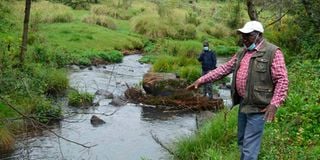
Joseph Mwaniki Njuguna, chairperson of Mkungi Kitiri Water Resource Users Association (WRUA), at a rehabilitated river on July 28, 2021. PHOTO | FRANCIS MUREITHI | NMG
As she turned on the tap outside her homestead for the first time to clean her face, the expression of joy on Teresia Njoki’s face was visible.
"I used to fetch water from the dirty streams five kilometres away from my home. The daily grind made me late for daily household chores, and I fell sick more often,” says.
Today, Njoki, 32, near full term in her second pregnancy, is both relieved and happy as she has a water connection at home for household duties and basic cleanliness. She gets water round the clock.
" Women no longer have to spend hours collecting water. The water also tastes much better," says Beatrice Kinyua.
"Collecting water used to be a huge problem,” recalls Anastasia Muthoni, 48, mother of five in Kiburu village.
These are some of the hundreds of women who are members of the Abderare Kiburu Community Forest Association (CFA), in Njambini location, Nyandarua county benefitting from improved water supplies thanks to the restoration of degraded Aberdare forest.
Easier access to safe drinking water for their families is just the beginning of improved livelihoods for their efforts to conserve one of Kenya's most important water towers by planting trees.
The community is benefiting from the immense forest resources available as provided for under the provisions of the Forests Act. The Act allows local communities to enjoy tangible benefits from the adjacent forests.
Women and youth have developed small enterprises by selling seedlings so they can become more sustainable.
Patrick Mwaniki a member of the Karandi Youth group says constant trekking to collect water using a donkey spurred him on to play a pivotal role in mobilising youths to join Community Forest Association and they have been allocated 20 hectares of the forest land to plant trees as they grow potatoes.
"We plant trees in the degraded part of the forest and grow potatoes as we take care of the trees and watch out for illegal encroachers. This has helped us to get income and we have started a merry-go-round group where we burrow money uplifting ourselves. We hope also to buy the trees when they mature," says Mwaniki.
Besides planting potatoes and trees, the CFA also earns income from indigenous trees seedlings nurseries.
"We sell seedlings to individuals and non-governmental organisations like World Wide Fund (WWF-K). So far we have earned Sh1.2 million from the sale of the seedlings since this project started a year ago," says CFA chairman James Kariuki Karanja.
WWF-Kenya, a conservation organisation is undertaking several projects with CFAs to improve agriculture and forest production systems.
Apart from raising tree seedlings, the Abderare Kiburu CFA also engages in other activities such as beekeeping, eco-tourism, and fish rearing.
Regaining lost glory
Karanja, whose CFA has 400 members, says their group is playing its part in helping the government increase the forest cover from 7.2 per cent to 10 per cent by 2022.
"When we started this programme, the forest was degraded but today with a partnership with WWF-K it is slowly regaining its lost glory as we have rehabilitated 100 hectares," notes Karanja.
This catchment is a source for Turasha, Kariahu and many streams draining to Lake Naivasha and since the CFA started the rehabilitation work, water flowing to the lake has increased.
"This degradation was a result of community encroaching and cutting trees. We thought the forest belongs to government but now we have realised it is our forest and it is our responsibility as a community adjacent to it to guard it jealously as it is our source of livelihood, the fresh air we breathe and the clean water we drink," adds Mr Karanja.
According to Caroline Njiru, the WWF-Kenya Naivasha Landscape programme is crucial to stopping further deforestation in Aberdares.
"The Lake Naivasha sub-landscape, in the Aberdares ecosystem, is one of the WWF-Kenya priority landscapes," she notes.
Aberdare is one of the critical water towers in Kenya serving more than six million residents of Nakuru and Nairobi counties.
The Abderare Kiburu Community project could contribute to Kenya commitment to the African Forest Landscape Restoration Initiative (AFRI100) initiative of restoring 5.1 million hectares by 2030, with each of the 47 counties expected to commit and adequately contribute to the attainment of the national target.
Guidelines on incentives and benefits
In Nyandarua the county government is expected to jointly with the National Alliance of Community Forest Associations (NACOFA) rehabilitate 500 hectares of mixed forests and destroyed farmlands, 100 hectares of farmlands and reclaim 40 kilometres of River Malewa riverine ecosystem.
Specifically, the ambitious project seeks to improve livelihoods through increasing income for forestry and agriculture value chains for at least 400 community members in Aberdares, by 20 per cent.
The project is co-implemented by NACOFA and involves working with three CFAs and forest blocks including Geta, North Kinangop and Aberdare Kiburu and Water Resource Users Associations (WRUA) to restore 500 hectares of Bamboo and mixed forest and 100 hectares of degraded farmlands.
"It has four modules and the first is the policy and we work with NACOFA to establish the gaps that restrict the communities living around forests from gaining more. This year the emphasis is on guidelines on incentives and benefits sharing in the forest sector," says Ms Njiru."
She adds that WWF-Kenya is working closely with Nyandarua County to come up with policies that will help inject more money into its budget to restore forest cover by enacting laws.
"We want continuity in this work and the best way is to partner with the county government so that they can continue with the work after the end of our programme. We have brought an expert and held meetings with the Executive and hopefully by September Nyandarua will be the second county to have restoration strategy after Makueni," notes Ms Njiru.
She adds: "The strategy is not focused on tree planting alone. A clean environment is one of the constitutional requirements. Once it is up and running it will be a big boost in terms of biodiversity around Aberdare catchment area as wildlife like elephants, will have a safe place to move on while birds will have a habitat they can stay."
The official said WWF-K has crafted a business module to help the community start a fruit farming venture.
Success story
"We are working with agriculture experts to establish which kind of fruit trees can grow in this area and have good market outlets. We want farmers to have a ready market, unlike in the past where they could plant any verities of fruits without knowing the market demand. The community should not be frustrated due to the lack of markets. With proper planning, we shall involve youths and women to ensure this business module is a success story."
WWF-K is also working with water resource users groups like Mkungi Kitiri Water Resources to plant bamboo along with the riparian land that borders rivers that drains in lake Naivasha by buying seedlings from CFAs.
"In total, we have three CFAs in this project and each will get Sh3.6million each year from the purchase of seedlings. We also provide them with fruit trees to plant in their farmland," she offered.
Due to the increasing level of pollution along Lake Naivasha, WWF-K is supporting smallholder farmers to plant nappier grass to reduce the usage of pesticides that pollute the rivers.
"We hope that by the time the programme ends in 2024, the pollution levels would have gone down.
"When clean water flows into lake Naivasha it takes care of fauna and flora. This basin is critical as it is a wetland of international importance and a Ramsar site and a bird area," she offers.
The organisation is working with more than 1,000 farmers to restore farmlands as part of the carbon project aimed at producing about 73,000 verified emission reduction certificates.
Carbon footprint
"We hope community engagement in the farming land forest would be able to contribute to the restoration of this basin. The project is an eight-year project and ends in 2025. We want to improve on carbon footprint emissions. Trees are carbon sink and therefore the number of trees community would have grown on their farm would contribute in terms of increasing the carbon sink."
To ensure farmers participate in monitoring the project, they have undergone training on how to do the monitoring.
"We have come up with a real-time monitoring tool and dashboard where the farmers are trained to collect trees survival through open data key platforms and farmers send data direct to WWW-K servers. Through this initiative, we can see the survival rate in real-time and do the replacement. This has enhanced the survival of trees and ownership by the communities. Monitoring trees is important as the project is registered under goal standards guidelines."
Apart from the massive restoration of the degraded forest land, the programme's third module targets 300 hectares of mixed forest and already so far 75 hectares have been planted or restored with trees while additional 200 hectares have been planted with bamboo.
The last module is sharing of lessons with Zambia and Tanzania farmers where local farmers meet and learn ideas on conservation efforts from other countries.
Unlock a world of exclusive content today!Unlock a world of exclusive content today!