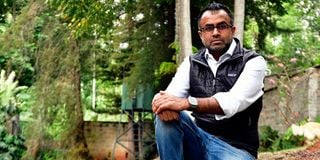
Ritesh Doshi doesn’t talk, he whirs—like a very fast motor. Conversing with him is like standing next to a fan on full blast—a fan of words. Landing back in Nairobi from Jordan, sunburnt and restless after his stint as an international manager at HSBC, he decided the city needed a pizza delivery service. People told him it wouldn’t work. Which is precisely the wrong thing to tell Ritesh. He rang up franchises around the world; most said no, except for one obscure outfit in the US.
Naked Pizza opened in 2012. It rose, it floundered, and in 2016 he sold it to Pizza Hut. “I overestimated the market,” he admits. “I was a gung-ho entrepreneur.”
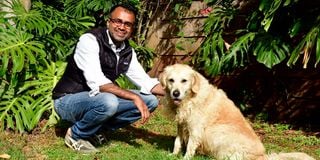
After the sale, he retreated to a tiny café in Spring Valley, where two brothers ran the counter and their mother baked in the back. For 20 months, he’d sit there each morning with his dog, Bailey (now deceased), asking himself existential questions about who he was beyond the business. He was 35—a strange age: young enough to start again, old enough to wonder if he’d already missed his chance.
He liked coffee, and he liked entrepreneurship, so he ended up buying the café. Spring Valley Coffee was born. He then multiplied it to nine branches in Nairobi and, six months ago, opened one in London. They also supply world-class coffee equipment to hospitality establishments.
We met him back where it all began, in the small room where a wounded entrepreneur once sat with his dog.
How did this business idea come about?
In 2017, I was sitting at a café in New York and bought a bag of Kenyan coffee—227 grammes for $22.50 (about Sh2,900). I remember thinking, ‘that’s expensive’. Coffee auction prices are public, so I called a friend back home to check what farmers were earning that week.
It turned out the farmer was getting less than 9 percent of that price. That shook me. It meant 91 percent of the value was staying outside our market, while we’re struggling with youth unemployment. Something was clearly broken.
I came back, spoke to the owners of this café, and when they said they didn’t want an investor, I asked a different question—would they sell? They did. The focus wasn’t scale, it was taste. I also discovered this area - Spring Valley - used to be coffee estates, and even the landlord is a coffee cooperative. Everything pointed back to coffee. It was a great fit.
Did you know anything about running a coffee shop?
Not really. The vision was never to be in the café business—it was to roast coffee, add value here, and take it to the world. I've lived all over and had a strong global network, so that was the plan. We opened the shop with no money—literally used wood from coffee delivery pallets to build it.
And that Village Market store changed everything. Suddenly the brand was visible. Diplomats, UN staff, embassy folks found us, and it just exploded. We've since grown to nine branches in Nairobi and one in London. What's interesting is that we still don't have a sales team. Hotels and restaurants kept calling after tasting the coffee, asking if we could supply them. That's how that side of the business took off.
What’s your mantra of doing business?
Good question, which I will answer in a different way. I get asked a lot whether I will sell this business like I did Naked Pizza. My answer is never say never, but right now, I have no intention. I love what we’re doing—growing from seven people to over 120, plus farmers and the supply chain. So many problems to solve.
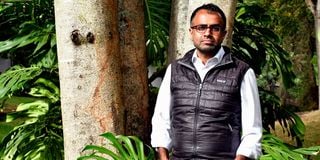
Spring Valley Coffee CEO & Founder Ritesh Doshi after an interview on December 10, 2025.
Photo credit: Francis Nderitu | Nation Media Group
My mantra is simple: listen to the market—but remember, sometimes customers don’t know what they want until you show them. I’m obsessive about quality: sourcing cups from Australia, grinders from Italy. We’re not the cheapest coffee, and we don’t want to be. Our mantra: incredible coffee, delightful hospitality.
Authenticity matters. Coffee is the product, community is the point. We didn’t plan to sell machines, but when a customer asked, we did it—at zero profit initially.
Now it’s a full division. I’ve learned not to be blinded by a plan. We’ve opened and closed stores. Some didn’t work. That’s okay. The singular focus is coffee, everything else grows from listening, risk, and learning when you get it wrong.
What’s the hardest thing you’ve ever had to do?
Selling Naked Pizza to Pizza Hut. It was my baby, and I ended up taking a lower price to make sure everyone had guaranteed employment for a year. That was hard—my identity was so tied to being “the Naked Pizza guy.” I had to step back and ask myself, who am I beyond this business? That period forced a lot of reflection. I started meditating, became more spiritual, and spent about 20 months thinking deeply about who I am and what I want. It was challenging, but it shaped how I approach everything now.
What else are you as passionate about besides entrepreneurship?
I didn’t know my “why” until I was 42. I’d read Simon Sinek’s Find Your Why multiple times, tried to work it out, and finally it became clear: to be a catalyst for connection and to empower transformational change. I’m passionate about running. I started in 2012— so13 years ago. I’ve run multiple half marathons, two full marathons, London two years ago, Amsterdam six weeks ago. It’s the only time in my day I’m not surrounded by anyone.
Spring Valley Coffee CEO & Founder Ritesh Doshi after an interview on December 10, 2025.
Photo credit: Francis Nderitu | Nation Media Group
I’m also deeply passionate about dogs and animals. When we open a café, the dog bowl goes out before the coffee machine—every dog gets water first. Running marathons has also let me support causes like KSPC and Daphne Sheldrick.
What kind of breed of dog would you be?
That’s a tough one. I have a golden retriever now and used to have a Cavalier King Charles—one of only two in the country. People say dogs reflect their owners, and my wife says I’m like the golden retriever: everyone’s friend, full of energy even before my first cup of coffee, and tremendously loyal.
What have you discovered about yourself through meditation?
Since 2017—I remember it clearly, November 2017—that’s when I really started. I’m not religious, but I’ve become very spiritual. And I follow a rigid routine now. I wake up before 5am. I don’t touch my phone—my phone charges in another room. I use an old-school alarm clock with bells on it. No tech.
I start with at least 10 minutes of reading—something uplifting. I’ve read The Daily Stoic by Ryan Holiday every day for years. Then I’ll read something deeper—business, coffee, or just whatever I’m obsessed with at the time.
Right now, it’s ice cream and gelato. I’m still obsessed with pizza too. It began as my “10-10-10”: 10 minutes reading, 10 meditating, 10 journaling. Now it’s more like 20-20-20, sometimes 30-30-30, especially on weekends. I write every morning. I affirm my purpose. I set my intention for the day. And I write three things I’m grateful for—every single day. Sometimes it’s big, sometimes it’s tiny.
The day after we met, I wrote that I was grateful I’d bumped into you. When I came back from London last week and it was minus one, I wrote that I was grateful it was 22 degrees in Nairobi. It’s simple. But it grounds everything.
What’s the purpose of writing?
It’s so easy for your day to just pull you in every direction. So after the gratitude, I write the three most important things I want to accomplish that day. Do I always get them done? No. Some days I get all three. Some days, like yesterday, I got none because life threw a spanner in the works. But I still set the intention.
Then I free-write. A page, sometimes two—whatever’s in my head. Because once it’s on paper, it’s no longer occupying brain space. It’s out of me.
At the end of the day, I write again about three amazing things that happened. I review the three things I wanted to do, whether I did them or not. And I always write one thing I would have done differently. Just one.
What scares you now at 44?
I’m at halftime. So what have I actually done with the first half? And what do I still want to do with the second? Because there are things I’ve always wanted to do that I haven’t touched yet.
Mortality feels closer now. We’re still young—but it’s nearer. People I went to school with have died in the last few years. And it changes the temperature of your thinking.
People always say life is short. I don’t agree. Life isn’t short. Life is finite. It will end. Yours, mine, everyone’s. That’s not pessimism—that’s just the terms and conditions.
The real question is: what are you doing inside it? So, how do I live each day fully? Some days that just means working—proper work. Other days it means not working at all. The problem is, I find it hard to switch off. My mind is always on.
You have children?
No children. It is intentional—yes. We decided quite early on. A lot of our decisions are interwoven with how we live. My wife is an impact investor and for us, the same three ideas keep showing up everywhere: people, planet, profit. They guide Spring Valley, they guide what she does, and they guide how we live. There’s one planet. There’s one human race. And for us, we chose not to have children.
A lot of people have children and still do meaningful things....
Of course they do. And there are already so many children in the world. We have plenty of nephews and nieces. There are so many children who don’t have parents. And we said to ourselves: having children is an irreversible decision. Not having them isn’t.
If in five years I wake up and feel that something is missing, we can adopt. That door never really closes. But if you have a child you can’t exactly say, “Sorry, this isn’t working out for me.” There’s no reset button.
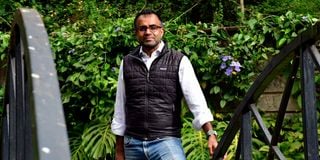
Spring Valley Coffee CEO & Founder Ritesh Doshi after an interview on December 10, 2025.
Photo credit: Francis Nderitu | Nation Media Group
We’re also aware of the privilege it gives us. The flexibility. The freedom to push boundaries. To not be limited in certain ways. And to take risks. My risk profile is completely different because of that.
One of my closest friends in London—his appetite for risk changed overnight when he had children. I’m not saying it’s good or bad. It just changed. I can take risks.
If I lose everything, I’m not lying awake worrying about school fees. I’m not worrying about feeding someone else. If things go properly sideways… I only have to land on my own feet.
Have you always been sure that you don’t want children?
No. Not always. We actually got married very young—26. And we’d known each other forever. Since we were 16. My thinking shifted properly when some very close friends of ours had children. I absolutely adore their children.
We’re godparents to some incredible children here and in the UK. But somewhere in watching that life up close, I realised—this just isn’t ours. It’s not a popular decision. It’s not a normal decision.
And as Kenyans, there’s a very loud expectation from parents, from aunties, from the whole ecosystem: you will have children, and you will have many of them. But for us, this was the honest answer.
What have you struggled with this year now that it is ending?
We opened in London six months ago, and the hardest part has been the sheer absence of work–life balance—actually, it’s not balance, it’s work–life integration, and this year it’s been all work.
I’ve spent over 70 percent of the year abroad, constantly traveling to the UK, taken just six days off, and that kind of distance takes a toll—being away from my wife, my dog, my parents, my community.
London has meant building a new community, often alone in a flat, while trusting the team back here to run the business without me, which has meant letting go of control. It’s been a year that’s stretched me in every direction.