Time flies with great content! Renew in to keep enjoying all our premium content.
Prime
Bank card payments rise to Sh297bn on increased uptake by merchants
In a trend that signals a steady shift in how consumers settle everyday purchases, the number of card transactions in 2025 grew 4.1 percent to 61.7 million up from 59.3 million in 2024.
The use of bank cards to pay for goods and services at formal retail outlets climbed to a fresh high to hit Sh297 billion last year on merchants uptake as the number of point-of-sale (POS) machines rose to 54,454 by the close of December 2025 up from 48,653 as at the end of 2024.
Data from the Central Bank of Kenya (CBK) shows that the value of card-based payments at POS terminals rose to the new level last year from Sh291.9 billion in 2024.
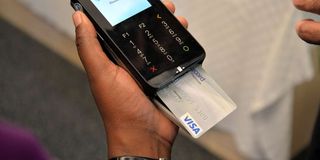
In a trend that signals a steady shift in how consumers settle everyday purchases, the number of card transactions last year grew 4.1 percent to 61.7 million up from 59.3 million in 2024.
The growth extends a long-running upward trend in card usage, even as mobile money and cash continues to dominate payments, underscoring the gradual entrenchment of plastic money in retail payments more than a decade after the apex bank started recording usage data.
Consumers using cards are not charged a fee, with the merchant absorbing the bank and interchange charges.
With the exception of 2020, when economic activity was disrupted by Covid-19 restrictions, the value of card payments has risen every year, reflecting expanding merchant acceptance and wider card issuance.
In 2020, the value of card payments dipped to Sh157.7 billion from Sh177.3 billion in 2019 as lockdowns, reduced mobility and business closures sharply curtailed in-person retail activity.
As the economy reopened, card usage rebounded with the value of transactions rising to Sh194.3 billion in 2021, setting the stage for sustained growth in subsequent years as consumer spending normalised and digital payments gained renewed momentum.
The usage of bank cards in Kenya, however, remains modest when compared to hard cash and mobile money, which still account for the bulk of retail and person-to-business payments, particularly among small traders and informal businesses.
The 2024 FinAccess Household Survey, for instance, showed that cash still dominates as a mode of payment when footing daily expenses at 79.8 percent, followed by mobile money at 13.1 percent. Paying using cash is free but carries risk of theft or loss of funds. Mobile money brings convenience though it attracts charges paid by consumers and merchants in some cases.
CBK data shows that while the value of cash handled by mobile money agents declined last year, the number of transactions continued to rise, pointing to a shift towards smaller, more frequent transactions.
Last year, the value of cash handled by mobile money agents fell 5.3 percent to Sh8.2 trillion, down from Sh8.7 trillion in 2024, as the volume of transactions rose 2.5 percent to 2.6 billion from 2.5 billion the previous year.
The contrasting trend hints at growing competition between payment channels, as consumers increasingly choose between cards and mobile wallets depending on convenience, cost and acceptance.
The value of POS transactions has grown from a low of Sh43.6 million in 2010 when the CBK published the first full-year data, and has expanded over four-fold in the past decade alone from Sh70.7 billion in 2015.
This growth has been driven by a combination of factors including aggressive merchant onboarding by banks and the gradual spread of POS machines beyond large supermarkets into everyday retail outlets such as pharmacies, fuel stations and hotels.
Banks have also invested heavily in upgrading card technology, rolling out chip-and-pin cards, contactless payments and other improved fraud controls to boost consumer confidence in card-based transactions.
For retail merchants, card payments offer reliefs such as reduced cash-handling risks, faster reconciliation and easier integration with accounting systems, factors that have supported wider adoption over time.