China loans to Kenya hit 8-year low on Africa shift

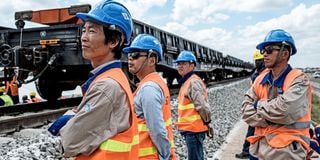
Chinese workers at a construction site during an inspection of the SGR project by former President Uhuru Kenyatta on June 23, 2018.

Photo credit: File | Nation Media Group

As former President Mwai Kibaki neared the end of his term, Kenya owed China just Sh61.2 billion in mostly yuan-based borrowings to finance ICT and geothermal projects.

An explosion in lending from Beijing followed. But more recently, the boom has turned to bust as China slowed down lending to developing countries like Kenya on increased risks of debt distress.
Kenya’s outstanding loans to China are set to close 2025 at an eight-year low as Beijing freezes new lending on repayment jitters.

Outstanding borrowings to China as at the end of September 2025 stood at Sh620.3 billion, the lowest level since the end of 2017 as loan repayments by Kenya grow faster than fresh disbursements.

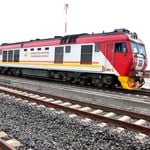
Financing for the standard gauge railway (SGR) during the first term of the Uhuru Kenyatta administration was the primary driver of borrowings from Beijing.

The lending was also conspicuous as China moved from dishing out loans in its renminbi/yuan to US dollars.

Kenya borrowed Sh655 billion ($5.08 billion) from the China Export-Import Bank in the 2014/15 financial year for the construction of the SGR from Mombasa to Nairobi and later to Naivasha.

The facility drove debt owed to China to a peak of Sh939.8 billion in December 2023 but the outstanding amounts have moved downhill since.

Terms of the facility were wrapped in secrecy, prompting activists to fight in court to have all contracts, agreements and studies related to the construction and operations of the SGR to be made public.

New lending by China to developing countries such as Kenya has slowed down in the aftermath of default concerns, which were exacerbated by the outbreak of the Covid-19 pandemic in 2020.

According to reporting by the Financial Times, Beijing-based lenders including China Eximbank (the financier of Kenya’s SGR project) and China Development Bank, the country’s two main policy banks, have adopted increasingly hardline lending terms.

At the November 2021 triennial Forum for China-Africa Cooperation, China's President Xi Jinping said the country would cut the headline amount it disburses to Africa by a third to Sh5.1 trillion ($40 billion) while redirecting new funding from large infrastructure to small and medium enterprises (SMEs) and green projects.

“China is moving from this high-volume, high-risk paradigm into where deals are struck on their own merit, at a smaller and more manageable scale than before,” the Financial Times quoted Chatham House --a UK think-tank.

The pivot left China’s 2013 Belt and Road Initiative, a massive global infrastructure and investment strategy, in limbo, and the consequence has been little to no new lending to countries like Kenya.

Beijing’s flagship project in Kenya –the SGR— has been impacted in what has consequently forced the government to seek alternative financing to extend the line to the border town of Malaba after China expressed little interest in funding the extension this year.

The Ministry of Roads and Transport is eyeing a 15-year mega bond worth Sh390 billion to finance the project.

Investors in the bond will be paid using proceeds from the Railway Development Levy (RDL), set at 1.5 percent of the customs value of imported goods, with the collections marked for securitisation.

Kenya will, however, still need additional financing for the extension project.

“We have a good stream (of income) from the Railway Development Levy, which is ring-fenced to build the railway. But if you look at it from a cash flow perspective, it’s not enough to build the project within two or three years,” said Roads and Transport Cabinet Secretary Davies Chirchir.

China is still funding infrastructure projects in Kenya but not by debt.

The 27-kilometre Nairobi Expressway, which runs from Mlolongo to James Gichuru Road on Waiyaki Way, was for instance a public-private partnership (PPP) deal involving the China Road and Bridge Corporation (CRBC), which will recoup its investment through the collection of road tolls.

CRBC is also undertaking the construction of the Rironi-MauSummit Highway and the Talanta Stadium in Nairobi, the former being a PPP project and the latter a project funded through a Sh44.7 billion bond.

As China freezes lending, the bulk of Kenya’s new external financing is coming from the World Bank Group and the International Monetary Fund (IMF). Meanwhile, new commercial borrowing is only undertaken to settle existing obligations.

The trend is similar in other developing countries, with Sydney-based Lowy Institute terming China a debt collector.

The think-tank estimates that debt repayments to China by developing countries will amount to $35 billion where $22 billion is to be paid by 75 of the world’s poorest countries.

“For the rest of this decade, China will be more of a debt collector than a banker to the developing world,” Al Jazeera quoted the report’s author, Riley Duke, saying.

The transformation of China from a lender to debt collector has rattled the West, which has pushed Kenya to swap currency on dollar debt owed to Beijing amid concerns that that the country is spending freshly acquired dollars to pay down debt to China.

The conversion has, however, carried concessions allowing Kenya to extend the tenure of three Chinese loans used for the construction of the SGR by five years to 2040.

The SGR loans were initially to be repaid by 2035.

The extension of the loan tenure, which also includes a four-year grace period, will make the repayment of the SGR loans manageable in a period when debt servicing costs are consuming over half of government revenues.

President William Ruto’s top economic adviser, David Ndii, revealed in October that the multilateral lenders were disturbed by the use of their dollar loans to pay China instead of supporting the country’s budget and infrastructure projects.

“The Western lenders queried why they should be supporting us while other lenders are taking out money,” he told the Business Daily in an interview.

“That’s why they put pressure on countries to restructure debts so that the money they put in stays in the country and does not go to pay other lenders”

Debt to Beijing is expected to decline further in coming years on higher repayments as China latches on PPP deals to fund infrastructure projects instead of debt.

PAYE Tax Calculator

Note: The results are not exact but very close to the actual.