French bank saved from paying Kenyans in US embassy attack

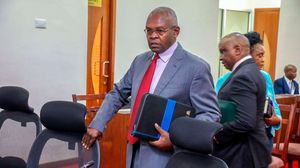
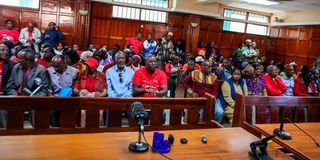
Survivors and families of victims of the 1998 US Embassy Bomb Blast follow proceedings at the Milimani law courts ahead of the judgment of their compensation case on January 28, 2026.

Photo credit: Billy Ogada | Nation Media Group

Kenyan victims of the 1998 bombing of the US embassy in Nairobi have lost the legal battle to compel the Attorney-General to pursue compensation from top French bank, BNP Paribas and Sudan.

The High Court on Wednesday found no legal basis to force Kenya to seek reparations from the bank, Sudan, Iran, or assets linked to al-Qaeda in a verdict that eased a diplomatic storm.
The compensation relates to al-Qaeda’s 1998 bombing of the US embassies in Kenya and Tanzania that killed 224 people.

The judge found that the suit did not meet the legal threshold to hold the State liable or mandate foreign litigation.

The victims, through the Katiba Institute rights group, had petitioned the High Court for an order directing Kenya to seek compensation from the French bank and Sudan.

The victims tied their suit to the bank’s admission in a US court of violating economic sanctions against Sudan, which was accused of harbouring al-Qaeda, mostly during the 1990s.

They cited a US court’s finding that without Sudan’s support, al-Qaeda could not have perpetrated the attacks.

Close links between Khartoum and BNP Paribas--which has been accused of operating as the “central bank for the government of Sudan,”—had landed the French lender in trouble, forcing it into a $8.9 billion (Sh1.14 trillion) settlement with US authorities.

Some of the money went to people harmed by Sudan, but excluded victims of the 1998 US embassy bombings on a legal technicality.

“Whether the government of Kenya should take legal action against Sudan, Iran, France, or BNP Paribas for their suspected involvement in the 1998 bombing requires delicate consideration of political and diplomatic consequences,” said the judge.

The victims also sought compensation from Kenya for negligence.

The High Court reckoned that US court judgments against Sudan could not establish Kenya’s negligence.

“I find no instance where American courts faulted the Kenyan government,” said the judge.

The court further declined to grant an order for Kenya to sue BNP Paribas, Sudan, or Iran, ruling that such actions involve political and diplomatic considerations beyond judicial mandate.

In 2021, it was announced that Sudan had paid $335m (Sh43.2 billion) as compensation for victims of past attacks against US targets.
But the deal - a key condition set by the US for Sudan to be removed from its list of State sponsors of terrorism - compensated families of victims or those injured who are US nationals or US embassy workers.

The majority of the estimated 5,000 people injured in the twin bombings of the American embassies in Nairobi and Dar es Salaam on August 7, 1998 did not get any money. Neither will the families of the more than 200 locals who died in the blasts be compensated.

Each American victim or family of the US embassy attacks was to receive $3m (Sh387 million), while locally employed staff got $400,000 (Sh51.6 million), according to earlier US media reports.

In total, 85 survivors or families of victims will be compensated.

Official records show that 12 Americans died in the Nairobi and Dar es Salaam blasts.

Sudan admitted culpability in the attacks after being accused of giving al-Qaeda and its leader, Osama Bin Laden, technical and financial support in the 1990s.

Its removal from a US blacklist allows the country to get badly needed debt relief, foreign investment and loans from international financial institutions.

The French banking giant faced multiple suits and inquiries into its financial dealings with Sudan.

In 2020, Paris prosecutors opened an investigation into BNP Paribas over allegations of complicity in crimes against humanity in Sudan.
The probe came after nine Sudanese plaintiffs, who said they had been victims of rights abuses by the ousted Sudanese President Omar al-Bashir’s government, filed a legal complaint against BNP Paribas.

The plaintiffs allege the French bank was complicit in crimes against humanity because it provided financial services for the Sudanese government.

They argue that in a US sanctions violations case the US Department of Justice described BNP Paribas as Sudan’s de facto central bank from 1997 to 2007 because it gave the Sudanese government access to international money markets, and the means to pay staff, the military and security forces.

Follow our WhatsApp channel for the latest business and markets updates.

PAYE Tax Calculator

Note: The results are not exact but very close to the actual.