16 Days of Activism: How theatre amplified 2025 fight against Gender-Based Violence

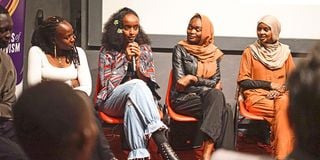
Mary Tariku (second left) of The Kamp Kakuma film collective, with other members including director Chichi Ramadhan (second right), discusses her experience with digital violence featured in their documentary at Unseen Nairobi on November 26, 2025

Photo credit: Thomas Rajula | Nation Media Group

Art has always been used as a tool to approach uncomfortable topics in society directly, triggering dialogue for change. This year, theatre spoke boldly during the 16 Days of Activism against Gender-Based Violence (GBV).

“What can start small, on screens – a message, a comment, or a post – can quickly spiral into a torrent of threats and violence in real life. Private photos are stolen without consent. Lies spread in a matter of seconds. Locations are tracked.
AI is weaponised to create deepfakes designed to shame and silence women,” read a statement by UN Women during the 16 Days of Activism against GBV that culminated on December 10 with the #No excuse for online Abuse.

This year, the Italian Embassy, Italian Agency For Development Cooperation (AICS), and the Italian Cultural Institute Nairobi ran a campaign throughout the 16 days dubbed Activate Nairobi. The campaign was carried out through different art forms (film, dance, theatre, and an art gallery).

They started with an art exhibition at the Kenyan National Library’s Maktaba Kuu on Ngong Road, which is where the National Gender And Equality Commission is headquartered.

Artworks displayed on November 21, 2025, at the Maktaba Kuu building of the Kenya National Library on Ngong Road, marking the launch of the Activate Nairobi campaign.

Photo credit: Thomas Rajula | Nation Media Group

Next was the screening of The Kamp, a collective of filmmaking refugees from Kakuma. The documentary was based on one of the group’s members, Mary Tariku, a refugee from Ethiopia whose photos were taken from her social media accounts to create a scamming account that solicited unknowing victims for money.

She was discontinued from serving as a Sunday School teacher as a result of the identity theft. A woman also once approached her and threatened her with physical harm for “taking money from her husband and leaving the family to suffer.”

The film’s director Chichi Ramadhan said most crime documentaries tend to focus on the perpetrators rather than the victims and they decided to make Mary the focal point because they wanted to show the toll cyber bullying takes on victims.

“This is her story. We want people to remember her as she also represents other women who’ve undergone digital violence,” said Chichi, adding that the refugee camps are not so different from the rest of the world.

Mary tried reporting her issue to the authorities, but they stopped following the case barely a month later.

“I end the documentary by saying, ‘It is very painful, but you must smile again. You must smile again because this is your right and your right is your power’,” says Mary, who heads a community-based organisation that gives talks to teenage girls.

A dance at Sarakasi Dome in Ngara by Taa Arts Organisation tackled physical violence and the socio-economic restrictions that hold women back.

Members of Taa Arts Organisation, a visual and dance collective, perform a dance inspired by excerpts from Italian novelist Sibilla Aleramo on November 28, 2025, at Sarakasi Dome, Ngara.

Photo credit: Thomas Rajula | Nation Media Group

Janice Nyadida, from the organisation that deals with both visual and performing, expressed that they got inspiration from writings by Italian novelist Sibilla Aleramo, who broke ground by openly writing about women's struggles, patriarchal oppression, and the need for female liberation in early 20th-century Italy.

Rosaline Gikonyo, project coordinator at Taa Arts, says internalising the excerpts and then putting them into body movements took a lot of time. “The dancers have to understand what the story is about and who is going to take which role and what they should be showing with their movements. I have to take on that emotion so that everyone can see what I’m going through.”

You need to first have an inspiration before creating a storyline, according to Janice, a visual artist who equated preparing the dance performance to painting.

Janice explained that where scenes became heavy or intense, they would take breaks and have talks where the performers were free to express if these weren’t comfortable for them and request someone else to take over a part.

“There is debriefing that needs to be done but it happens during the process, you get to feel your feels and have group hugs afterwards. It was very therapeutic. Initially, I was supposed to be the orator, but I noticed when I started reading the poem I was very triggered. Especially for the part where the lady is violated, you feel like fighting; but who are you fighting? Then you realise you maybe have past wounds that you haven’t processed, unpacked or resolved,” said Janice.

Wakio Mzenge’s performed a one-woman show on November 30 that explored trauma, grief, identity, and healing through playing 12 characters. Wakio’s performance, Elements, written by John Sibi-Okumu was Staged at Macmillan Library in the CBD. It was symbolic of breaking the cycle and announcing that the activism period was not business as usual.

Wakio Mzenge performs the one-woman show Elements, written by John Sibi-Okumu, at Macmillan Memorial Library on November 30, 2025.

Photo credit: Thomas Rajula | Nation Media Group

Her main character, Dana, is a successful author. She finds ways to sneak her experiences into her characters as a form of exorcism but ends up becoming an alcoholic because she doesn’t want to admit the things that happened to her, including sexual abuse from her father, undergoing forceful FGM performed by her aunts with her mother’s consent, and physical violence from men in her life.

“This play was written specifically for French body movement actress to showcase cultural integration between Europeans and Africa. Yes, it was written by a man, but men also live among women; it’s very hard to talk about women without a man and also children,” says Wakio.

Wakio says that she’s learnt that most times, through trauma, victims carry the burden on themselves and it ruins their relationships, careers, chances at motherhood, even making them sick while the perpetrators walk free and enjoy their lives.

“And she said, “I’m going to let it go for me. I don’t need to confront this person because they’d better deal with their own demons. I’m not going to allow this to be my personal demon.’ It doesn’t that perpetrators should be allowed to walk away Scott-free, but it gives us authority to walk confident in our own skin with our experiences,” she sums, adding that men should show their children how to treat women well, not just telling them how, with the way they interact with all the women in their lives.

“Men are taught as children to care for their sister, mother and aunts. That’s why you’ll find someone who’s very narcissistic with his wife loves his mother to bits and treats his sisters like queens.”

PAYE Tax Calculator

Note: The results are not exact but very close to the actual.