Why Kenyans spend much to renovate their rented houses

Interior Designer and Personal Stylist Candy Nabwrire’s sitting room, pictured at her house in Ruaka, Kiambu County, on September 17, 2025. She is known for her Afrocentric aesthetic. 

Photo credit: Bonface Bogita | Nation Media Group

In the quiet northern suburb of Ruaka in Kiambu County, Candy Nabwire has transformed her two-bedroom rental into a space that defines her identity as an African woman.

"People hesitate to decorate rental properties because they don't own them. But decorating isn't about ownership; it's about creating a space where you feel comfortable and happy," says Candy. "I look at it this way: This is my space, my sanctuary. I live here, so why not make it feel like home?"
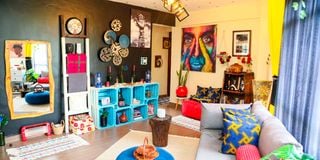
The 32-year-old has made her time in Ruaka memorable and intends to cherish those memories for a long time. The monthly rent for her house is Sh32,000, but the money she has spent on it is much more than that.

Her house tells a story of creativity, heritage and bold expression. She identifies as a maximalist, and a quick look around confirms it.

"Growing up, my grandmother wove beautiful baskets. I don't want to forget where I come from. African art is not just decoration; it's a way of expressing identity. My biggest inspirations are nature, the texture of leaves, and calming scents. I try to bring all of that indoors," says Candy.

She has a shoe station made of smooth river rocks that reminds her of her time in Embakasi. Candy's neighbour frequently hosted visitors, and as a result, many pairs of shoes would end up scattered around the shared outdoor area in front of the houses.

"One tenant got so frustrated that she poured water on the shoes. That experience inspired me to create a beautiful, functional indoor shoe station," she shares.

As a professional interior designer, Candy's décor blends fashion and interior design, with prints, fabrics and accessories.

Her walls are adorned with over 15 handwoven baskets, many of which are Rwandan Tonga baskets.

To Candy, the Tonga baskets are not just ornaments; they are vessels of meaning that symbolise generosity, continuity, and union.
Alongside the Tonga baskets are locally made baskets, which demonstrate her support for Kenyan artisans. They range in price from Sh800 to Sh1,000 at Kariokor market.

Candy Nabwire a Kenyan interior designer and personal stylist known for her Afrocentric aesthetic during an interview at his house in Ruaka, Kiambu county on September 17, 2025.

Photo credit: Bonface Bogita | Nation Media Group

"Most people think African art is expensive, but honestly, it's affordable. Much of it is handmade locally, and I work with technicians who make unfinished furniture. I also buy from local artisans. For example, my baskets are locally made. I do a few DIY projects, too, but I usually prefer to work with professionals who can bring my exact vision to life," she says.

Lighting plays a crucial role in transforming the space. The warm glow of floor and table lamps casts yellow shadows on the black walls, creating a welcoming atmosphere. Reused wine bottles serve as candleholders, filling the air with soothing scents that welcome her home.

Her favourite area is the TV room, which she affectionately calls her "little woman cave" or "escape room."

"I even designed a graffiti wall to remind myself that art doesn't have to be perfect or confined. Imperfection is beautiful," Candy says.
Inside the room is a locally made chair-bed that is low and wide with thick cushions in vibrant prints.

The mood continues in her bedroom, but with a different tone. The bedding is matte black with subtle, shiny pillows. At dusk, she draws the curtains, allowing the light to fade and transforming the room into a nest. "This is where I rest my spirit," she says softly.

Her most prized possession is her 5-by-6-foot bed, which is simple yet comforting in design.

“I wanted something that would last and have sentimental value. It cost me Sh32,000 which is reasonable considering the craftsmanship and uniqueness," she says.

Her handbags, which are displayed on an open rack in her bedroom, serve as accessories and décor.

"These bags are more than just containers. They're portable works of art that convey stories of heritage and identity, just like my home," she says.

Candy's approach to design is practical as well. She believes she has finished decorating, as every wall and surface is filled with pieces she loves.

"I don’t need anything else. I feel full and satisfied," she says.

Unlike Candy, 36-year-old Molly Wasonga has taken a different approach to her rented three-bedroom apartment in Lang'ata.

Over the past six years, she has invested over Sh400,000 in permanent renovations that she cannot take with her when she leaves. She lives in the apartment with her niece and nephew. Given the nature of her work, she hopes to stay there for as long as possible.

"I travel a lot and don't have the luxury of moving houses now and then. Also, the children are accustomed to this environment. Moving them from one school to another would be harmful to them," says Molly.

Molly Wasonga, a resident of Langa'ta area. Over the past six years, she has invested over Sh400,000 in permanent renovations in her rented house.

Photo credit: Pool

She clearly remembers how the house looked when she moved in back in 2020.

"I loved the house, but it was very basic. The walls and basic fixtures were boring. I couldn't stand looking at those boring walls anymore, so I decided to take a risk to make myself feel more comfortable.

First, she replaced the standard hinged doors with a small sliding glass door, which cost her about Sh75,000. She also upgraded the bathroom with a rain showerhead and a new toilet for Sh45,000 and built custom kitchen shelves.

"My landlord was hesitant at first," Molly admits. But I showed him the designs, assured him that I would use quality materials, and promised to maintain everything. Eventually, he agreed."

In her nephew's bedroom, she painted the wall blue and drew Spider-Man, his favourite character. For her niece, she painted the wall a striking pink and frequently changes the cartoons on the wall to display her latest favourites.

"The next tenant will enjoy what I paid for, and my landlord will have a renovated unit that he didn't spend anything on. I am currently negotiating with my landlord for either a rent reduction in acknowledgment of the improvements or compensation for some of the permanent fixtures."

Candy and Molly represent a growing desire among renters to create homes that feel truly their own, even if only temporarily.

But what do property professionals make of this trend? What risks should tenants be aware of before investing their money in spaces they don't own?

Festus Mwangi, a realtor, has encountered several situations in which tenants have decided to remodel rental houses. He says the reasons vary, with many tenants simply looking for a more modern or stylish living space than what the landlord originally provided.

"People want homes that feel comfortable and aesthetically pleasing. If a landlord hasn't provided the features they're looking for, some tenants are willing to pay for upgrades themselves just to enjoy the space while they live there," Festus says.

However, from a property owner's perspective, this can be a red flag, as most landlords do not encourage customisation.

Interior Designer and Personal Stylist Candy Nabwrire’s bedroom, pictured at her house in Ruaka, Kiambu County, on September 17, 2025. She is known for her Afrocentric aesthetic.

Photo credit: Bonface Bogita | Nation Media Group

"What a tenant likes may not be what the landlord prefers. When tenants start making adjustments, they might interfere with the structure or damage parts of the house. Then, when they move out, they sometimes want to demolish those additions and leave the house as it was, which can cause even more damage,” Festus says.

He notes that landlords generally prefer to keep their properties in their original condition. In most cases, tenants do not have the right to upgrade a rental property without permission.

So, what should tenants know before doing a makeover? First, they must understand that these upgrades are not refundable. In fact, they might even lose their deposit. If the landlord did not approve the changes, they can use the deposit to remove the additions and restore the house to its original state. Even something like a gypsum ceiling may have to be taken down, and the tenant would bear the cost,” Festus explains.

Another important point is that landlords may secretly appreciate an upgrade but will never admit it. Officially, they will say, “I never asked you to do that.” Therefore, tenants shouldn't expect recognition or compensation.

There's also the issue of rental pricing. In affordable housing, lower rents often reflect lower finishing standards.

"Some landlords prefer to keep those standards low to justify the rent level. If a tenant upgrades the house significantly, it changes the property's perceived value. In a way, the tenant influences the property's value without the landlord's consent, which can create tension," he says.

Festus says the better option for tenants who want a modern house with better finishes is to look for a rental that already meets their expectations, even if it costs more, rather than altering someone else's property.

"For tenants who still insist on doing a makeover, they should keep it minimal. Basic painting and very minor adjustments are usually less of an issue,” he says.

PAYE Tax Calculator

Note: The results are not exact but very close to the actual.