183 indoor plants: The Nairobi home that has more plants than furniture

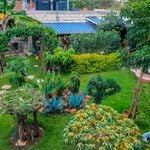
A variety of plants pictured at Michelle Mashauri’s home in Ruaka, Kiambu County on January 15, 2026.

Photo credit: Bonface Bogita | Nation Media Group

While many people fill their homes with furniture, Michelle Mashauri has sacrificed comfort for plants. In her small apartment in Nairobi’s Ruaka, she owns only a small three-seater couch and a coffee table that serves more as a plant stand.

“I got rid of big seats so my plants could fit. When I move to a new house, I look at windows first, then furniture,” she says.
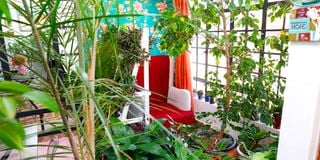
Bloodleaf plants display their dramatic burgundy foliage in her house. Pothos vines fall from the shelf like waterfalls.

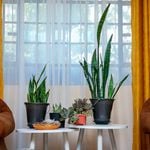
An African palm spreads near the window, while a peace lily stands with glossy leaves. Snake plants stand in clusters throughout. There is barely a path to walk through.

The dining space has been completely reimagined. Where a table and chairs might once have stood, there is now a dense plant collection.

An asparagus fern sits on a white shelf. Monsteras thriving, its split leaves creating dramatic shadows. Calatheas show off their intricate patterns.

Her very first plant still sits in the corner of her living room windowsill. “It’s a cactus,” she says, but I call it Pete.”

Pete is named after her nephew. “But most of my plants are girls,” she says, laughing.

One of the most special is a date palm she named Raila. “When Raila Odinga passed on, I bought an orange planter and planted a date palm in it. That plant is Raila. I really loved him."

In her bedroom, Michelle is literally competing for oxygen with plants at night. Another date palm stands just beside the bed, its branches nearly brushing the ceiling.

The kitchen is functional, but on the windowsill sits another collection of succulents. She has 10 plants in her kitchen.

Michelle Mashauri at her home in Ruaka, Kiambu County, where she keeps a variety of plants on January 15, 2026.

Photo credit: Bonface Bogita | Nation Media Group

The study room is where Michelle works from home, and even here, plants have claimed territory. A spider plant thrives next to her desk. These are her office companions, colleagues who never complain or interrupt.

She has about 183 plants, not counting the smaller ones—the tiny succulents clustered on window sills, the propagations suspended in glass bottles of water. Most are tropical varieties that thrive indoors.

She buys them from everywhere: roadside vendors with makeshift nurseries, professional sellers with greenhouses, and sometimes even sneaks cuttings from cafés. “If I see it and I love it, I take it home,” she says. “That's really it.”

What guides her when buying? “My eyes. If I fall in love with it, I buy it.”

Her most expensive acquisition was a tree she bought already potted. “I trimmed it because it was too long, but with the pot and everything, it cost me about Sh6,800.”

She has no intention of slowing down. “I still have too few plants,” she says, her eyes travelling to the ceiling and floor.

Plant care takes serious time. “Watering and cleaning take a whole day,” Michelle says. She waters once a week, testing the soil with her fingers, watching for drooping or yellowing.

Then comes the cleaning, wiping every single leaf with a damp cloth, removing dust that blocks the tiny pores through which plants breathe.

“It takes me about four days to clean the entire house because there are plants in every room,” she says. Four days. Not four hours—four days.

The hardest part? “Pests and cleaning. Sometimes I find insects, and I just scream and call the caretaker.” Spider mites, aphids, fungus gnats, the tiny invaders.”

“I've lost hundreds of plants over the years,” she admits. “These ones you see are just the strong soldiers.” One of the hardest losses was a large elephant ear that her parents planted for her.

 Plants inside Michelle Mashauri’s home office in Ruaka, Kiambu County, on January 15, 2026.

Photo credit: Bonface Bogita | Nation Media Group

“My mum was holding it, and my dad was adding soil. It got root rot and died. I replaced it with a tree, but that one hurt the most.”

People often think Michelle is strange. “Some think I'm into dark stuff; others think I'm crazy,” she laughs, saying she has always loved plants, even as a child.

“During Covid-19, I suddenly had so much time. That's when I really started collecting plants. I kept adding and adding, and here we are,” she says.

Caring for plants has taught her one important virtue. “Patience,” Michelle says. “And tenderness. You try, you fail, you try again.”

For most “plant parents” living in rental apartments, the challenge is finding the right location that would not be in conflict with the homeowner.

Drilling or installing shelves can eat up the deposit fees or cause problems with landlords.

Michelle had the same fears. “I can't drill or fix things on the wall, so I use movable planters,” she says.

At one point, the landlord complained about plants outside her veranda. But Michelle was adamant about removing them.

“I even told them they could give me a notice to vacate. I wasn't removing my plants.” The owner eventually visited. “She walked in and said, ‘Wow.’ After that, she was okay with my balcony gardening.”

But now, Michelle is worried about one thing: the fear of moving day.

“They are fragile. Some will break. Some may die,” says Michelle.

She recalls a time when her plants were temporarily moved to a friend’s house, and many died due to mishandling.

“That was very painful,” she says. The thought of moving again haunts her.

PAYE Tax Calculator

Note: The results are not exact but very close to the actual.