As far as New Year’s resolutions are concerned, Joyce Wangeci plans to add 100 new plant species to her already thriving garden, instal 15,000 litres of rainwater harvesting capacity, and open her sanctuary to community tours.
It's an ambitious plan that will cost her least Sh680,000. An investment she says is absolutely worth it as she transforms her once bare, dusty land into a thriving sanctuary of over 700 plants.
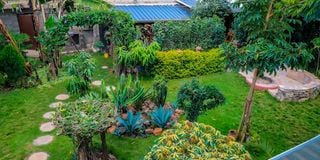
Standing in the shade of mature palms that have transformed her Kajiado property, Joyce surveys what she's built and what she plans to build next.
"I want the garden to evolve into a learning and healing centre," she says. "This year is about expansion of plants, of space, of purpose, and of community."
First, she wants to focus on exotic indoor varieties, rare palms, additional bonsai specimens, and native Kenyan species.
"Every other week, I'm still buying plants," she says. "I know all the sellers now. Some plants cost over Sh3,000."
She buys most of her plants from local vendors.
Second, she will be supplementing her current 8,000-litre rainwater tank to reach 15,000 litres, reducing reliance on piped water that costs around Sh2,000 monthly.
She also plans to install drip irrigation, build shade structures from repurposed materials, and create pathways using collected stones. "For me, water remains the biggest challenge in this area. We rely on piped water that proves to be so unreliable at times," Joyce notes.
Third, Joyce is committed to deepening her botanical expertise. She is already an active member in about 70 online plant groups.
"I'm still learning propagation techniques, studying plant families, and experimenting with natural pest management," she says. "I use ash, cinnamon, and hydrogen peroxide for pests. No pesticides, no herbicides ever."
Perhaps most personally challenging for someone who struggled with social anxiety, Joyce plans to host quarterly garden tours and small educational workshops.
"I've already had groups of up to 30 people here, including friends, church groups, and children," she notes.
But she's clear about the terms. "I don't cook for them. I offer space, not service. This is still my sanctuary," she says. "I've never cooked ugali in my life. When people come here, they bring their own food, or we order in."
Lastly, she is dedicated to maintaining the garden as a refuge for creatures that have returned.
"From the safari ants that once drove us out to the chameleons that now live here, wildlife has always been part of this story," she says. "I'm not conquering this land. I'm sharing it."
At her home, Joyce has divided her plot into three distinct sections, each approximately one-eighth of an acre in size.
"One section hosts guest rooms, this middle one is where we live, and the last section is for my friends, where I host gatherings," she explains. Beyond the jade plant at the gate, over 700 living plants create a green oasis across the three sections.
The palm collection forms the backbone, providing crucial shade. From her first ornamental palm planted during grief in 2020 to newer acquisitions, these trees have transformed the property in a way that amuses her.
"Before these palms matured, the heat was unbearable," Joyce recalls. "Now, there are pockets of coolness where even delicate plants can survive."
The duranta shrubs sprawl wildly, intertwining with neighbouring plants. She runs her fingers along their leaves and reflects, "This one grows wildly, intertwines with everything. It reminds me that resilience doesn't mean standing alone. It means connecting."
The bonsai collection sits in a shaded corner—miniature trees requiring daily attention and years of patience.
"These teach me about time," she reflects. Her Indian Rose holds special significance. "This one comforts me when I touch it," she says. Nearby, Peace Bone plants cluster in shade. "They taught me that not everything needs to be in the light to thrive."
The succulent and cacti collection? These are survivors of hardship, and they were her first teachers back in 2020.
More unusual specimens dot the landscape: insect-eating plants, ornamental cassava, ponytail palms, string-of-beans, and Monsteras. Some arrived as seeds from Spain. Others came from her mother, carrying family memory.
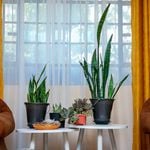
Different kind of flowers and plants outside the home of Joyce Wangeci in Kiserian, Kajiado county on December 17, 2025.
Photo credit: Lucy Wanjiru | Nation Media Group
"Every plant has a story," Joyce says. "Some I bought because I needed them. Some because they needed me."
But the garden is structured by more than plants. Her mother-in-law's old wheelbarrow now overflows with succulents.
Old tyres serve as planters. Timber from her mother-in-law's former house forms trellises. Stones form pathways.
"Nothing goes to waste," Joyce notes.
As the plants matured over the months, wildlife returned. Birds nest in shrubs. Sunbirds hover around flowers. Butterflies dance. Chameleons patrol branches. Even the once-terrifying safari ants now coexist peacefully.
"The beetles came first," Joyce remembers. "Then the bumblebees. Then one day I saw a squirrel. I actually cried. These creatures don't need permission. They just recognise home when they see it."
Creating this haven hasn't come cheap. Over the past two years, Joyce has poured more than Sh1 million into her sanctuary.
Labour costs alone, including mowing, watering, weeding, and cleaning light tents after rain, have exceeded Sh500,000. Monthly water bills hover around Sh2,000.
As part of taking care of her garden, Joyce remains deeply hands-on about most tasks she calls sacred.
"No one waters my plants but me. Not my husband. Not my children. Not helpers," she says firmly. "Watering is sacred. It allows me to disappear, observe, communicate, and connect."
Every morning at 6:30am, she's out here among the leaves and branches, carrying water like prayers to each plant. It's a ritual born from grief, sustained by purpose, and now expanding toward legacy.
But this sanctuary didn't begin as a green garden.
“This place was the perfect description of a desert, and the ground felt impossibly barren. There was no electricity, no piped water. Safari ants drove residents from their homes,” she recalls.
About her house? No, they did not build it. The house literally arrived hidden inside a truckload from Eldoret in 1992.
Joyce was a newlywed that year, when ethnic clashes erupted after elections, forcing her and her new family to relocate to her mother-in-law’s ancestral land, where she now lives.
That small structure still stands today. "From the outside, it appears small," she says. "But inside it works. I learnt early that space is about intention, not size."
Joyce lived here with her mother-in-law in the early 1990s, raising her two children, managing survival rather than beauty. Born and raised in Nyeri, where greenery filled spaces, Joyce couldn’t relate to the climate at first.
“Here, there was only dust, heat, and waiting,” she says.
Then came 2020, the year that changed everything. Joyce lost her father, and then the country shut down due to Covid-19.
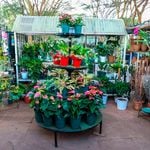
Different kind of plants outside the home of Joyce Wangeci in Kiserian, Kajiado county on December 17, 2025.
Photo credit: Lucy Wanjiru | Nation Media Group
Grief, isolation, and silence filled the space where routine used to exist. In that compounded sorrow, Joyce planted her very first plant, the ornamental cypress.
"It remains my most sentimental plant," she says quietly. "It grounds me emotionally and spiritually."
A year later, her mother passed on. The garden became her way of processing the loss of both parents.
"After losing both my parents, the garden helped me through emotional upheaval and profound solitude," Joyce shares. "It gave me something to wake up for—6:30am every morning, watering, observing, learning."
She began buying more plants, starting with succulents and cacti—survivors of hardship. "I related to them," she admits.
Gardening became deeply personal. "There was a time I dug out a cave in the garden, a private place where I would sit and cry," Joyce recalls. "Over time, everything in the garden grew on me, including myself. I learnt self-respect, patience, and presence."
By March 2023, Joyce's relationship with the land had moved beyond mourning. She even cleared a section of the land that had vegetables and began planting flowers.
She started reorganising extensively in July 2024. This is when the garden truly became a sanctuary—not just for Joyce, but for others. She's created not just a garden, but proof that resilience doesn't mean standing alone. It means connecting, intertwining, and growing where you're planted, especially in the dust.
"I see myself as a protector of nature, of the plants, of the birds that have been neglected, of the insects that matter, and of the air that must remain fresh," she says.