“My routine includes a morning and evening session, each lasting about 10 to 15 minutes. In the morning session, I do movements that awaken my body and allow blood flow, then in the evening I do more of the breathing practices, which allow me to calm down, let go of the day, and get into rest mode,” he says.
He adds: “And then for three days in between the week, I do complete one-hour sessions as part of my fitness regimen, which also involves gym workouts and things like walking.”
“Those things are for women,” some said. “It’s a cult,” others declared. But Samuel was not moved. Having tested and tried yoga, he didn’t argue. Instead, he introduced the practice to them slowly, over time.
“We would do our normal cardio and boxing workout, then for the cool down, I would bring in yoga stretches.”
It took a while, but eventually, they started to recognise how flexible they were becoming. Taking advantage of their excitement, Samuel decided to switch up their training regimen and add one complete class of yoga.
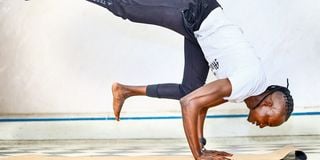
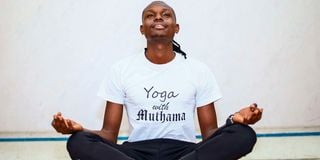
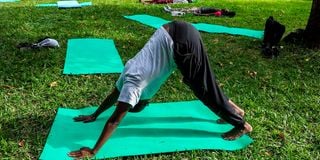
Samuel Muindi Muthama, a certified yoga trainer, demonstrates a yoga pose during an interview in Nairobi, September 19, 2025.
Photo credit: Wilfred Nyangaresi | Nation Media Group
“Since they were all men and fit ones at that, I intentionally made that first class the hardest I could, and incorporated cardio into the yoga,” says Mr Muthama, who is now a certified yoga teacher.
Nowadays, he says, men have so many options to choose from in terms of the types of yoga to do.
“The poses might be the same, but other movements are added to them that make the flow different,” he says.
One of his go-to types is Yin yoga, which involves holding a pose for three to five minutes to stretch a targeted muscle.
“It’s mostly physical, but during the process, it becomes more mental and emotional because holding a pose that stretches something like your groin or glute for about five minutes is not a joke.”
Other types include vinyasa flow, which is a faster-paced, dance-like flow between poses; hatha, which is a fun in-between where poses are held longer than in the vinyasa flow, but for a shorter period than in the Yin yoga; And cardio yoga, which is fast-paced, physically demanding, and involves cardio movements.
“But yoga is not just about physical practice,” Mr Muthama adds. “The word simply means unity. The unity of the mind, body, and soul, but also the deeds that bring people together.”
Poses like the hip openers helped him to let go of a lot of bottled-up emotions and taught him to be calm, listen more, and control his temper.
“It is said that we hold a lot of emotions around the hip joints, so when you release and work on your hips, you let go of a lot of these emotions.”
Additionally, he’s experienced more flexibility as well as confidence in himself.
Elsewhere, Kiuri Mburathi, a 49-year-old architect, also attests to the benefits of a regular yoga practice.
“My mum practiced yoga,” he says, but it wasn’t until 2017, when he was asked to organise a month-long yoga event, that he finally took it seriously.
“I did it faithfully every day for that entire month and saw my body transform. I lost some weight, toned up, and became much stronger. That’s when I realised the power of yoga and decided to keep up the practice.”
Now, Mr Mburathi doesn’t miss a day. “I do different kinds of yoga, there’s the physical yoga, which I try to do two to three times a month, and then there’s my daily practice, which is a spiritual yoga.”
For physical yoga, Mr Mburathi joins a free yoga class that happens at Nairobi’s John Michuki Park every Sunday from three to four o’clock.
“I do it for my health, and I also like it because we have really good instructors. But the true power of the class is in the fact that it happens out in nature - there are birds, a lot of greenery, a breeze, and when you look up, you see the blue sky.”
Mr Mburathi also claims self-confidence, emotional release, and flexibility as major yoga benefits.
“I’ll also add that for men, it makes a really big difference physically. I realised that one of the reasons we have potbellies is because our hip joints are so tight that it affects the ease of digestion. And this causes a build-up. It also affects the functioning of the lymphatic system, which in turn hampers the immune system,” he says.
“Yoga is a body-fixing exercise that aligns the body and helps its systems to function optimally. And past a certain age, that’s really important because it determines how well you can use your body.”
Giving an example, he notes that a lot of the older people walk with a shuffle because their hip joints are not strong enough to lift their feet. Claiming a general lightness and agility, he vouches for yoga, naturally handling that.
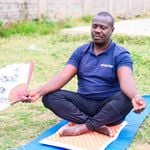
For Victor Karanja, a content creator who also runs a digital agency, yoga gets one day every week.
“I work out for four days each week, then take one day off to do yoga. I do it mostly to stretch because if you lift weights, a lot of the time you’re very stiff. You’re bulky, yes, but you’re not functionally fit, and yoga helps with that.”
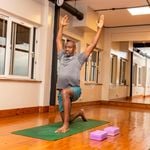
Kiuri Mburathi practices a low lunge yoga pose at Michuki Memorial Park, Nairobi, on August 31, 2025.
Photo credit: Lucy Wanjiru | Nation Media Group
Consistent since last year, the 34-year-old’s sessions last for about 45 minutes. His first interaction with yoga was in 2020.
“I thought it was a feminine thing at first, especially because some of its poses are weird, but I wasn’t going to be the party pooper,” he says. “Funny enough, I ended up enjoying it. I had so many pains in my body, but after the session, all I felt was relief.”
Mr Karanja also testifies to strength and balance.
“A lot of people think it’s just this nice, graceful thing, but it’s hard. It builds a lot of strength and also, for me, it creates balance in my life. You see, when you do yoga, you have to clear your mind and focus. It connects the physical to mindfulness, and this helps to centre you on what’s important.”
If you want to relieve stress, Mr Karanja says, play some nice music and try yoga, “And then you’ll see.”
To men who would want to try yoga but feel intimidated, Mr Muthama says,
“There comes a point where you have to put yourself first. It never matters what others think of you, only what you think of yourself. So if you’re willing, try it and find out if it’s good for you or not,” he says. “Also, when it comes to the human body, there’s no practice that was created specifically for one gender. It’s all just one body.”