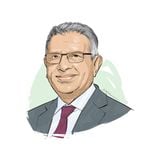
Outgoing BAT Kenya MD reflects o his 25-year tenure at the cigarette maker

BDcrispinachola16mar23

Outgoing BAT Kenya managing director Crispin Achola. 

Photo credit: Joseph Barasa | Nation Media Group

The outgoing BAT Kenya managing director, Crispin Achola, has an obsession with words, carefully cherry-picking them and cobbling them together into phrases that any journalist would readily turn into a headline.

His latest line, when we asked him to reflect on his time in the C-suite of BAT Kenya, was how, over the years, the cigarette maker had become “the dividend king on the Nairobi Securities Exchange” due to the exceptional returns the company has consistently forked out to its shareholders.
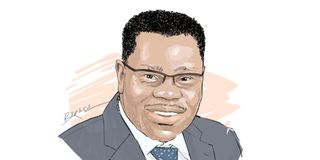
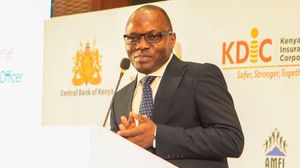
We sat down with Mr Achola for an interview just days before the announcement of his departure and that of BAT Kenya Chief Financial Officer Philemon Kipkemoi.

Having been in the role for six years, rumours had already been swirling that he would soon be leaving the corner office on Likoni Road.

However, when asked to reflect on his tenure as CEO of BAT Kenya, Mr Achola was quick to insist that this was not an exit interview.

Nonetheless, he did offer some reflections on the company’s commercial performance, BAT’s diversification journey as women broke the glass ceiling and paired with their male counterparts at the management level, as well as the reintroduction of smokeless products as the regulatory environment gradually improved.

But it is on commercial performance that he had some interesting pick-up lines.

“So if you look at BAT Kenya over the past five years, I would say we have been dividend king on the Nairobi Securities Exchange,” said Mr Achola.

He said the firm’s dividend yield this year has been somewhere between 13 and 13.5 percent, just as last year.

Dividend yield is the return investors earn from a company’s dividends relative to the price of its shares, usually expressed as a percentage.

With a dividend yield of 12.43 percent by the end of trading on Thursday, BAT was only second to Standard Chartered Bank, whose dividend yield was 12.67 percent.

That is better than what most money market funds give.

Such impressive dividend yields, which he reckoned to be above money market funds or even government bonds, are “a real testimony of shareholder value creation”.

“And I’m really happy that as an organisation, we have been able to look after our shareholders.”

The company, which is listed on the NSE, announced a dividend payout of Sh7 billion to its shareholders, more than the net profit of Sh5.25 billion that it made in the year ended December 31, 2025.

In 2024, BAT Kenya distributed a dividend exceeding its Sh4.48 billion net profit, maintaining high rewards for shareholders—including its parent company, British American Tobacco UK, which holds a 60 percent stake in the company.

According to Mr Achola, payment of such bumper dividends is possible because the firm has no immediate plans to undertake major capital investment after shutting down its nicotine pouch machinery, a move that has freed up cash for the shareholders.

The second success story from his stint in the corner office at BAT includes increased diversification and creating an environment that allows women to develop their talents.

About 45 percent of BAT’s management staff are female, an achievement Achola attributes to creating conditions where women’s talent can thrive. In fact, women represent about two-thirds of his leadership team. He insists it is not about giving females advantages.

“I think it was just about creating conditions where female talent can thrive, and not necessarily giving them an advantage or affirmative action. We’re not an affirmative-action organisation.”

Mr Achola exits the company after six years at the helm, having etched his name in its history books as the first Kenyan to lead BAT Kenya in more than three decades.

When he returned to lead an expanded BAT East and Southern Africa business spanning 26 markets in January 2021, his ambition was to steer the company beyond its traditional identity as a tobacco maker and transform it into a multi-category consumer goods enterprise.

Between 1999 and 2017, he had been at BAT, managing various clusters, including being the MD of the Sudan subsidiary, before he left for three years.

He counts this among his third achievement. Yet the jury remains out on whether BAT has truly succeeded in embedding alternative, non-combustible products at the heart of its business.

In BAT’s attempt to introduce nicotine pouches into the Kenyan market, Achola’s famed command of words would be put to the test as the Ministry of Health insisted that the products be regulated under the Tobacco Control Act.

To the government, there was little distinction between combustible cigarettes and the new generation of non-combustible alternatives. But honchos at BAT insisted that there was sufficient scientific research to back up their claims that non-combustible cigarettes were not as harmful as combustible cigarettes.

Eventually, Mr Achola and his team seemed to have lost the semantics battle, and in 2024, BAT sold the plant after it had remained idle for five years due to regulatory headwinds.

The company said it would instead rely on imports once it got the nod to bring the pouches back to the market.

The equipment had remained dormant for close to five years after the government suspended the marketing, sale, and consumption of nicotine pouches, which BAT insists are less harmful than cigarettes.

Now, as he exits, Mr Achola believes there are ‘green shoots’ on a business model on which BAT’s very survival is hinged. He says the government has gone through a massive learning curve, and their thinking has shifted, which is why they have been able to bring back the smokeless products.

Collecting new words from the many books he reads and trying them out appears to be a pastime he picked up while growing up under the wings of his father, a sociology lecturer, he said in an earlier interview.

His father, who is still a professor, is a wordsmith himself. Mr Achola described him in a past interview as a narrator who has a good command of English and writes poems.

The son does not write poems but is an ardent collector of words, just like the father.

Married with a 21-year-old son, Mr Achola is what was known in street parlance as a “babi”, admitting in a past interview that he has never known want.

He said he was raised in a house of testosterone and competition. That is because he grew up in a family of four brothers, with the first and last born separated by six years.

They lived in the US for 11 years while their father was there for his studies before moving to Zambia, where the elder Achola would be teaching at the University of Zambia. He came back to Kenya in high school at Strathmore in Lavington before joining the University of Nairobi, where he studied a business degree.

He certainly values family and is content with his one son, to whom he has aspired to imbue the best of himself.


PAYE Tax Calculator

Note: The results are not exact but very close to the actual.