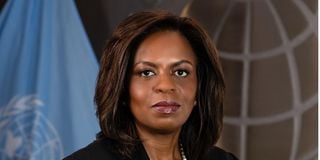
By the time she got the gig as the Assistant Secretary-General; CEO & Executive Director of the UN Global Compact, Sanda Ojiambo’s world, and in extension, the whole world had been thrown into, to appropriate a pandemic buzzword, “quarantine.”
The deal was, she had to move to New York, “the epicentre of the pandemic,” as she remembers it now. Not that it fazed her. She may have been restricted, but Ms Ojiambo possesses an energy that can't be contained.
So she moved, she did what she had to do, weighing the privileges against the deprivations, the checks and balances of success.
Now leading the world’s largest voluntary corporate sustainability initiative, Ms Ojiambo’s career began in 1997 with CARE International in Somalia. From there, she joined the United Nations Development Programme (UNDP), also in Somalia, before relocating to Nairobi to work at the Africa Regional Office of the International Planned Parenthood Federation (IPPF).
In 2008, she crossed into the private sector, joining Safaricom as Senior Manager of the Safaricom and M-Pesa Foundations, where she led a series of public–private partnerships between Safaricom and UN agencies.
Two years later, she was appointed Head of Sustainable Business and Social Impact at Safaricom, the trampoline from which she bounced to the UN. “Does it matter that I was here?” she asks, an appraisal of a 20+ years career riveted together by her guiding refrain: “Just say yes to opportunities.”
What question are you hoping I don't ask you today?
Is this part of the interview? [chuckles].
Can you believe it is?
Haha! Well, I love interviews because they're also a moment for introspection. I mean, every interview for me is a moment of growth.
How does it feel to be, and I say this loosely, chilling with the big boys?
I wouldn't use the word chilling because there's no moment that is a steady state. This role has brought me so much exposure to what life and work is at the global stage and the dynamism of it is absolutely incredible.
I've been in this role for five years and I guarantee you no one day has been the same. It's been a learning and exposure curve, and just seeing the world from a different vantage point.
It's a real privilege, to be honest, to see how this interplay of global business, politics, civil society, and dealing with world issues functions.
I doubt anyone is chilling. We're in a complex state of the world, but I'm just really honoured to play my small part in terms of what we do in the private sector.
What small thing/issue keeps you up at night?
I wouldn't say it's small, but I think every human being asks themselves the question, does it matter that I was here? This is how I end my daily reflections, and how I wake up in the morning. And it's small vis-à-vis the large universe in which we act, the energy we expend trying to shape it every day.
But to your question, the small thing for me is, has it mattered that I was here today? And what I plan to do tomorrow, or when I get up, is that going to matter? It's very grounding, helps me understand that I'm just a small cog in many things that are going to happen in that day.
What kind of dreams get one to get to where you are?
[Long pause] I don't think you have to dream it, you just need to figure out how to make it real. From a younger age, having spent time with family, I was rooted in the country, in my home community, in the village.
We used to go every holiday, as families do, back to the village. But also, I had parents who were both nationalists and globalists at heart, I got to see it all.
Through it all, the problem that I always wanted to understand and solve was something around inequality. Why do some people have and others do not have, and why is the system set up like that? Because we live in a world where you see immense wealth, wastage and want at the same time.
That was probably the question that inspired me around my career choices, conversations, education, and ultimately, choosing the spaces and places where I'd like to work, and I guess where I'd like to matter.
Dreams are great but the world needs actors. Getting from idea to feet on ground, doing and solving.
What do your parents say about you now?
My dad passed away in 1997. What I find most amazing is that my father, and also another family member worked at the United Nations, so I had early exposure to the UN. I hope that my dad feels really proud of what I do.
I love the relationship with my mother because it's still a very typical mother-daughter relationship and she's one of my greatest role models.
But there's also immense, what should I say, aspiration and ambition? There's always a constant challenge—we engage a lot intellectually as she works in the development and politics area.
Let’s pull that thread. Now that you work for the world, so to speak, do you still think you belong to your parents?
I think they let my siblings and I go early in life. My parents were public servants and in academia and we lived a very communal life. At a very young age, we all went to boarding schools.
Then as we grew older, we interacted, travelled widely independently. I think they firmly believed that the world was the oyster, but they always gave us the base which was home and the village.
Do you approach the world the way you were raised?
One always has to have roots, and where you see your roots at any point in time is important. I am a proud Kenyan and African serving the world.
I've had great world exposure, and I bring those lessons to every single element. There's still a lot more to learn and see. In a role like this, you know, you're here really to serve the world.
What is the most important decision you made early on in life that has guided you in sustaining a high-level career?
Say yes to opportunity. Just say yes. And then from there, figure out who is the mentor, the coach that you need, or what skills do you need to have to get there.
I've said yes to many things career-wise, and then been able to surround myself with a good enough support system or people to bounce ideas around or be close enough to role models who can assist.
Especially for young career women, it's important to say yes, not to judge themselves too harshly. Get in there, but also make sure that you have that support system. You don't have to know everything, but it's important to know where you can get the information that you need.
You never know what's going to happen when you say no, but when you say yes, at least you know what has happened, and then you can make a choice whether to go forward or not.
Has anyone ever made you feel small?
Several times. It's a difficult world out there. First, women are not always equally regarded as leaders when they step into a room. Secondly, the world as a whole is a complex place. So, you know, we don't always enter rooms as equals in many ways.
One of the ways I've always tried to overcome it is by reminding myself that no one can make you feel small unless you allow them to. So, the corollary for me is, even if I'm going to unfamiliar territory, everybody's there for a reason. In this moment, I tell myself, you matter.
So, when you walk into that room, what is that one unique thing that you're going to bring to the table? And therefore, you're not small. Maybe I would phrase that feeling differently: it’s probably inadequacy.
Sometimes people call it imposter syndrome. But I think one of the opportunities you have in leadership is to really work on how you prepare. Everybody has something unique to contribute, but I'm not always prepared.
What is that one Sanda thing that no one can take that you brought?
My career has spanned a number of sectors. I studied public policy and I wanted to work in a policy think tank. To be honest, I couldn't get a job. I tarmacked (job searching) for about a year and couldn’t get the job that I wanted at a decent salary. I wanted to work in the US and be in a policy think tank. It didn't work out.
I came home and got a short-term job to work in development, which was the beginning of close to 10 years spent working in development. I worked in the corporate sector for about 12 years. And now I work at the UN.
So, I believe if there's anything unique about my trajectory, it's the multi-sectoral work that I've done across the African continent, blending private, public, and development sector experience.
What are you chasing or perhaps running away from?
Oh, how do I answer that one? [chuckles] What am I chasing? Wow. Good question. I don't know that I'm chasing anything. I'm anxious, I'm optimistic, I'm uncomfortable with the state of the world.
Those same things that I saw in my much younger days, I definitely see progress, but also a re-emergence of the same problems. I'm optimistic, I'm curious, I'm psyched because I really want to make sure that I've made the best possible difference that I can. That's what I'm chasing. And it'll never end. I still have that fire in me to see how I can contribute differently.
When you get to where you're going, where will you be?
I don't believe I'll get there. The world is complex. I mean, we're all striving for a more harmonious, integrated, inclusive, and balanced world.
I don't necessarily know that I'll see it in my lifetime, but I'd love to be able to see children around the world, no matter where they are, have equal opportunities.
What has your bill from success looked like?
Everything calls for sacrifice or choices. I wouldn't call it a cost, but there's definitely been decision points and I have had to weigh them carefully. I had to judge what's most important to me, to my loved ones, and sometimes I weighed consequences, trade-offs between decisions.
I got the job offer bang in the middle of the Covid-19 pandemic. That meant I had to move to New York. There was so much uncertainty around the pandemic. I had to leave my loved ones. It's not the kind of relocation where you can go with family, because at that point, New York was also the epicentre of the pandemic.
What consideration tipped the scale?
Everybody I asked said, Go, what are you waiting for? Like, what an opportunity. Just take it. It'll work out. The support that I had around, even from my former employer, from family and friends, was crucial.
Even my colleagues on this side here in New York, even though they knew that we would not physically see each other or be in contact, were so supportive around making this change, this transition as smooth as possible.
As was my boss, the Deputy Secretary-General, Amina Mohammed. You need that circle of people to bounce your fears, questions and get inspired.
There is a lot of protocol involved with your office. Where do you go or what do you do when you want to be that little girl from the village?
Haha! A couple of things. First, home is a sanctuary for me, where I retreat and can you see my art pieces? This is a Lamu artist. The things that are important to me are the small things: a cup of Kenyan coffee or tea, and I like our food, I come home and cook. With a job that has travel you have to recreate home or what it is in many different ways.
Second is friendship. A good circle of authentic friendships and for this I am grateful for technology for you can send quick messages, because sometimes leadership is lonely and you can’t do this without a good group of friends and family, and not Yes-people, but people who will tell it as it is.
What do you hope the art that you put in your home says about you?
[Chuckles] Warmth, our content and world. All my artwork has a lot of colours and vividness, it is almost like a melting point of what the world is, but it’s all very warm.
It reflects my idea of optimism, of cultures coming together and just what a good warm positive future would look like. A lot of it is East African in nature, but I am now collecting more global type artefacts.