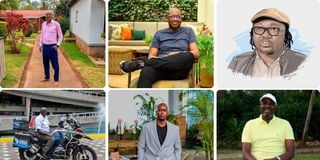
During the interview, Andrew Mwanyota Lewela, the self-styled barefoot CEO of KeNIC (Kenya Network Information Centre), will attempt to persuade me to remove my shoes, but will fail. It’s not that he’s starting a cult or flirting with some earth-aesthetic religion, though it’s a shame, for he could work a congregation. The man just loves walking barefoot.
He has dabbled with Buddhism, had a pas de deux with Jewish kippahs. How then do you define him? He rejects, in many ways, the very premise of the question. There is, he says, no way to pigeonhole him.
To define is to limit, he says, and when it comes to aphorisms to live by, he understands it’s pretty hard to beat Eliud Kipchoge’s, ‘No human is limited.’
Ever the eccentric, he rocks up in pink socks to match his pink shirt, anchoring a blue suit. He got a job at Safaricom despite, or perhaps because of, his happy socks. During that interview, Bob Collymore, the late CEO, saw them and was like, “You are a crazy guy, Andrew.”
Then, like a showboating evangelist, he peels off his pink socks and leads me outside for a walk.
Behind his handsome residence, at the edge of a quiet garden, under his large, elegant gazebo, Ken Njoroge often mulls over the questions that cling to quiet minds. “I generally don’t think that human beings have changed for generations. Instruments have changed, though,” he reflects, before launching into a dense and thoughtful anthropological diagnosis of the world — and what it all means for the ground beneath his feet.
Ken builds companies. First, Three Mice, a web development firm, started with friends. Then his crown jewel — Cellulant— the financial technology company that began as an idea sketched on a serviette.
Cellulant went on to become a pan-African success, offering digital payment solutions in dozens of countries across Africa. In 2021, he burnt out and stepped down soon after. “There is a deep internal solitude you feel when you’re carrying something heavy no one else can fully understand.”
Now, energised, he is onto his new venture: PANI — focused on supporting, coaching and investing in African founders. One of PANI’s flagship initiatives, Komini — a coaching programme built for founders by founders — is designed to help founders “arrive together.”
He recently turned 50—a good age to “sit with the weight and lightness of it all, to look back, and to seek better answers.”
Arthur Oginga, the Group CEO of Old Mutual East Africa, is not a big fan of interviews. He prefers to live a quiet, private life, which can be tricky for someone in the public eye. He is not a recluse, though.
He just enjoys spending time reflecting, sometimes alone in his garden, other times with friends, in that same garden that looks out over a forest. He is simply taking time to slow down and enjoy life.
“I hope that my family and close friends can enjoy me as much as I enjoy them,” he says.
You may not know this, but not many men take the time, every (other) day, to engage in philosophical debates, with a plate of nyama choma, or a glass of something, with their close friends. That's not something most men have.
Mr Oginga does, and then some. It’s an image of friendship and brotherhood, the apogee of a life well lived. Was it not the poet, Ralph Waldo Emerson, who observed, ‘A friend may well be reckoned the masterpiece of nature.’
If there is anything to sum up James Ayugi Panaito—the man behind the government’s eCitizen platform—then it is a post on his Facebook page on Friday, February 28.
Just after the Business Daily published a story titled Shadowy firms earn Sh1.45 billion on eCitizen, Mr Ayugi took to his Facebook page and posted “This is very little money for what government is getting in return. We actually need more.”
That is the man. Ambitious. Cautious about his public image. Go-getter.
For starters, the Business Daily story reported an audit that queried a Sh1.45 billion payment to the eCitizen vendor, part of the payment (Sh591.9 million) being from a Sh50 charged on every transaction Kenyans seek on the platform called ‘convenience fee’.
It later emerged from interviews that eCitizen is currently being run by a consortium of three firms—Webmasters Kenya, Pesaflow and Olivetree—all associated with Mr Ayugi.
But just how did the 40-year-old find his way to the centre of a system that is now the government’s engine of public services, processing upwards of 22,000 services and while at it, pocketing hundreds of millions?
George Otieno Ototo, the man at the centre of a suspected multibillion-shilling heist at Kenya Union of Savings & Credit Cooperatives (Kuscco) wonders why his ‘diligent’ service as the managing director at the Sacco’s umbrella body should go unrewarded.
While he is starting the week on the radar of crime investigators who want to take him to Milimani Law Courts to answer charges including money laundering, stealing, and uttering false documents, he is also in the Employment and Labour Relations Court where is suing his employer for Sh120 million compensation.
In the court papers, the man who a forensic audit links to a Sh13.3 billion heist, claims he served Kuscco “diligently” and “dutifully” and all he wants is the Sh120 million benefits to enjoy a “peaceful retirement period.”
However, that is now dependent on how he argues the case facing him as the Directorate of Criminal Investigations (DCI) sleuths comb through a 208-page forensic audit that uncovered years of financial improprieties at Kuscco.
Pastors don’t look like pastors anymore. Sometimes they also often engage in unrecognisable, unpastoral, things. [To mean, fun things].
Take Senior Pastor Nick Korir of Nairobi Chapel, for instance. He spends his free time on a Yamaha XT 600, half bike-half beast, with a band of his like-minded brothers, off to an ambitious journey around the coastline of Africa.
This year, on his bike, he reached the four extreme points of the continent; Al-Ghīrān Point, Tunisia, to the north. Cape Agulhas, South Africa, to the south. Xaafuun (Hafun) Point, near Cape Gwardafuy (Guardafui), Somalia to the east, and Almadi Point (Pointe des Almadies), on Cape Verde (Cap Vert), Senegal to the west.
That’s 40,000 kilometres if anyone is counting. Most were spent under helmets riding during the day and finding somewhere to rest their heads after sunset.
As an ardent motorcycle rider (he is the founding chair of Motorcycle Kenya), his objective is to raise funds for scholarships for needy students in high schools and universities in Kenya through Nairobi Chapel’s LOGOS Scholarship Fund.
His two passions—youth and biking—have found a tangent. “One of the biggest frustrations I have had as a pastor,” he says, “is meeting the spiritual needs of a young person and leaving them in a state of poverty, of hopelessness.”
Edgar Kitur studied at St Andrew’s Turi. At 17, he went to the University of Manchester. At 32, he was appointed the General Manager of Bolt Food Kenya.
Did going to St Andrew’s Turi give him an advantage, an edge on the ledge where he flew when others would have plummeted, I ask. “I think education is essential to anybody and the foundations they are given there. Also, the relationships you have in school transcend to real life. Besides, boarding schools are better than day schools because they allow you as a child to focus and finally sports, playing and watching.”
Murgor and Murgor Advocates is located in a commercial building owned by a bank.
If you're looking for irony there, you won't find any. Up a 15-floor elevator ride, the hushed offices of the law firm feature multiple doors—one belonging to Cherono Murgor, and at the end of a short corridor, to Senior Counsel Philip Murgor (with a single L, as you'll be politely reminded).
He's astute in mannerism, speech, and reputation. His office, featuring all the trappings of a successful career, showcases 30 years of an indomitable body of legal work, including a stint as Director of Public Prosecutions.
Beneath the studious veneer, under the suit, lies a dedicated weekend farmer.
Neither a drinker or smoker, he frequently climbs the 15 floors to his office when gym time proves elusive. Golf was abandoned years ago after a moment of reflection: "I asked myself, what am I doing playing golf? So I stopped and filled that time doing my Master's."
Now, after a long hiatus from the greens, he's making his return, hoping the sport will become his "retirement exercise". Good for him because he says he is often accused of not knowing how to relax and have fun. “I’m never unhinged.”
Kamotho Waiganjo is 61 and still asking questions he once assumed time would answer. About God. About faith. About suffering. About whether some things in life simply remain unresolved.
There was a season when he believed experience would clarify everything—that age would sand uncertainty into wisdom. Instead, it has done something more unsettling. It has taught him that some questions deepen rather than disappear, and that learning to live with them may be the real work of maturity.
He is also acutely aware of his privilege: a village boy who grew up in relative obscurity, but with a deep conviction that there was something more out there, even though he had been exposed to so little.
Law was not a passion at the beginning. "If you did well, you did law," he says. Over the years, Waiganjo has occupied rooms where ideas harden into policy.
He has practised law, helped shape it, argued it, reformed it and stepped back from it. He has moved between private practice, civil society, constitutional reform, and government, while keeping his feet firmly planted in practice as a partner at KMM Advocates.
Two weeks ago, he knelt and was conferred with a Doctorate of Philosophy in Law — less as a coronation than a continuation. Teaching, mentoring and the quiet work of shaping individuals now preoccupy him more than professional ascent.
Dr Hillary Wachinga's office on the 15th floor of Nairobi’s Reinsurance Plaza is a loud splash of colour and power, evoking an aura associated with a State-owned enterprise.
A Kenyan flag stands behind his ostentatious desk, and another small one on his desk. The lounge seats are deep plush leather, dark like a generational secret.
However, this noisy decor is in great contrast to Dr Wachinga, the Group Managing Director of Kenya Reinsurance Corporation. He talks in such a low tone. His voice barely disturbs the air, a whisper that seems to navigate invisible currents of authority.
He narrates about being an altar boy all his young life, about 'being fat' once upon a time then losing the weight, talks about the social calling of service, his sons ("the brothers I never had"), about his 18 years in risk management, compliance and audit. And God.
Why does he walk so much? “It's a habit that I picked up during Covid when I was trying to lose weight. I weighed 91 kilos. My BMI was 71.5. I was always sweating, panting. I was really fat. However, after eight months of walking and dieting (one meal a day) I was down to 63kgs. Then I got addicted to walking, and I still walk. It's now beyond exercise, beyond the need to maintain weight, it's mental, it's more to build what's inside not what's outside.”
Follow our WhatsApp channel for the latest business and markets updates.
Unlock a world of exclusive content today!Unlock a world of exclusive content today!