Time flies with great content! Renew in to keep enjoying all our premium content.
Prime
2, 453 individuals splashed Sh39bn in Safaricom bond
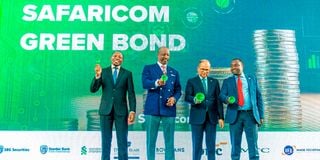
Dilip Pal, Group Chief Finance Officer, Safaricom PLC (second right), is flanked by David Warutere, Director, Market Operations, Capital Markets Authority–Kenya (far left), Kiprono Kittony, Chairman, Nairobi Securities Exchange, and Frank Mwiti, Chief Executive Officer, Nairobi Securities Exchange, as they mark a milestone moment during the Safaricom Green Bond NSE bell-ringing ceremony at the Nairobi Securities Exchange offices in Westlands.
About 2,453 wealthy individuals offered Safaricom Sh39.9 billion for the concluded green bond in a span of 11 days, reflecting the millions in the hands of retail investors amid a recovering economy.
Safaricom disclosures show that individual investors placed 96 percent of the Sh41.86 billion for the bond, putting an average offer at Sh16.2 million per person.
The individual investors’ appetite reflects Safaricom’s appeal among retail investors, echoing the interest it received in 2008 when the telecom firm listed at the Nairobi bourse via an initial public offering, which buyers oversubscribed theirs by 670 percent.
But in a recovering economy, the placement of bids worth tens of millions within 11 days offers a sneak peek into Kenya’s growing income inequality, where wealth is concentrated in the hands of a small segment of the population.
Kenya's economy has grown on average by 5.0 percent annually over the past decade, but the benefits have not been equally distributed, and the gap between rich and poor is rising, analysts argue.
The number of super-rich in Kenya is among the fastest growing in the continent, yet the economic benefits have not trickled down to the majority of Kenyans quick enough.
This also mirrors the measly share of 0.65 percent of all bank accounts, including those linked to corporate companies, which hold more than Sh500, 000.
“Obviously you want a bond issuance to be successful, but you also want that success to be in a way that makes you feel that the issuance was broad-based. If we had a wish list, we would have wanted retail investor participation to be more than the rest,” Dilip Pal, Safaricom Plc chief finance officer told the Business Daily in an interview on Tuesday.
“Safaricom has in the past done that with the equity issue. We are also inching towards the same level of participation for bonds.”
This emerges in a period when retail investors have upped their investments in government papers and unit trusts, like money market funds.
Retail investors including individuals, private companies and self-help groups piled a record Sh1.44 trillion in government bonds and unit trusts at the end of August, up from Sh580.45 billion in August 2023.
This underlines the growing flight to passive investments over starting businesses in an environment where startups are strolling to survive.
The number of Kenyans investing in unit trusts more than doubled to 2.96 million in a year to September 2025, highlighting the scramble for collective investment products.
The assets under management in unit trusts reached a record high Sh679.6 billion in the period from Sh316.4 billion a year earlier.
The Central Bank of Kenya (CBK) revealed that individual investors controlled more than three-quarters of government bonds trading accounts.
CBK latest data showed that individual investors held 73,585 accounts or 79.4 percent of the 92,677 total DhowCSD accounts opened as of September 6, 2024.
Safaricom green bond received bids worth Sh41.6 billion, representing a 177 percent oversubscription from the targeted Sh15 billion. The telecom operator accepted Sh20 billion from the offers by exercising a Sh5 billion green shoe option.
Investors participating in the offer will receive a tax free interest rate of 10.4 percent per annum for the five-year paper expected to mature in December 2030.
The notes were listed on the NSE on Tuesday, allowing investors to buy and sell the green bond.
Safaricom said it would use the Sh20 billion to finance new green projects and refinancing debt tapped earlier for sustainable developments.
The planned green projects include solar installation and the modernization of data centres, legacy infrastructure and network. The projects are restricted in the Kenya market, with financing for the Ethiopia subsidiary done outside the green bond.
Safaricom will issue a second tranche of the Sh40 billion bond and the firm did not issue a schedule on when it will raise the remaining Sh20 billion.
“The programme allows flexibility to also refinance eligible investments under the sustainable finance framework, but we are yet to decide on the quantum of debt to be refinanced at this point,” added Dilip Pal.
Safaricom’s paper is the largest by a listed company and adds to the activity in the corporate bond segment that has been dwarfed by government securities.
Safaricom’s bond follows East African Breweries Plc (EABL) paper, which raised Sh16.7 billion last month to boost the brewer’s cash flow and clear debt obligations.
The brewer’s bond was also oversubscribed 52.4 percent giving EABL the option to absorb up to Sh6 billion offered beyond the Sh11 billion offered in the first tranche.
EABL has the headroom to borrow an additional Sh3.23 billion in extra tranches under the Sh20 billion bond.
The brewer made an early redemption of its previous five-year paper which had a Sh11 billion balance that was set to mature in October 2026.
EABL’s coupon was relatively higher than Safaricom’s, offering a fixed return of 11.8 percent.
Safaricom previously tapped Sh30 billion, sustainability-linked loan or green bond from a consortium of banks including KCB, Absa Bank Kenya, Standard Chartered Bank Kenya and Stanbic Bank Kenya.
A green bond is a type of fixed-income instrument that is specifically earmarked to raise money for climate and environmental projects. The telecoms operator expects to spend between Sh54 billion and Sh57 billion for capital projects in Kenya over the 12-months period to March 2026.
Safaricom closed the half-year period ended September 2025 with a debt of Sh117 billion, including Sh61.2 billion in long-term borrowings and Sh55 billion in short-term borrowings.
Safaricom reported a 52.1 percent rise in its half-year profit to Sh42.7 billion, helped by a smaller loss in Ethiopia and M-Pesa’s double-digit growth.
The operator’s net profit grew from Sh28.1 billion a year earlier.
It is expected to declare an interim dividend in February next year.