NSE sheds Sh132bn in wake of Israel-Iran war

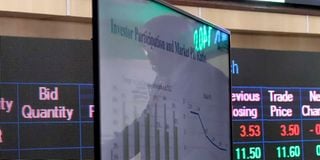
Screen showing market trends at Nairobi Securities Exchange. 

Photo credit: File | Nation Media Group

The Nairobi Securities Exchange (NSE) has shed Sh132.74 billion in valuation over the last four days after coming under pressure from selling by local institutional investors who are increasing their holdings of cash and cash equivalents in the face of rising global risks brought by the war pitting Iran against Israel and United States.

By close of trading on Thursday, the NSE was headed to its biggest weekly loss in market capitalisation this year, reversing some of the gains that had seen the bourse post a year-to-date return of 15.8 percent or Sh465.53 billion by the end of last week.
In the foreign exchange market, the shilling weakened to Sh129.20 yesterday, as per the Central Bank’s official rate, having traded at an unchanged Sh129.02 for 19 straight sessions until Monday.

Globally, markets have been sent into turmoil by the escalation of the conflict in the Middle East from Saturday, which threatens oil supplies and risks triggering higher inflation.

In major stock markets, investors have sold both equities and bonds this week, leaning toward holding dollars due to uncertainty over the outcome and duration of the conflict that pits the US and Israel on one side and Iran on the other.

News agency Reuters reported that global equity funds recorded outflows of $9.1 billion on Monday alone, the highest in two months.

In the local market, analysts said that institutional investors with large exposure to equities have also been converting some of their shares into cash to protect the gains they have made in the recent price rally while increasing flexibility in case an inflation spike raises yields in the fixed income market.

Safaricom and large banks have accounted for the bulk of the valuation loss this week, led by Safaricom at Sh50.08 billion, KCB Group at Sh19.3 billion, Absa Bank Kenya at Sh14.4 billion and Equity Group at Sh10.4 billion.

Foreign investors have however turned net buyers this week, bucking their recent trend of net sales from the local bourse. They made net purchases of Sh672 million between Monday and Wednesday, in contrast to the net sales of Sh910.5 million last week.

“While the Middle East situation has not had 100 percent transition locally, what is happening in the region has had a hand in market activity this week. Even local institutional investors are willing to get back to a stronger cash and cash equivalent position, especially now that companies such as Safaricom have gone ex-dividend,” said Wesley Manambo, a senior research associate at Standard Investment Bank.

“For foreign investors, the exposure to Kenyan equities is only a small part of their global holdings, but local institutions have a larger share of their assets in the market. They thus factor in the inflationary impact of potential fuel shortage, which could result in higher interest rates in the bonds market and exchange rate volatility.”

Kenya has been on a monetary policy easing path in the last 18 months, partly enabled by low inflation and a stable shilling. The Central Bank of Kenya (CBK) has made 10 successive base rate cuts since August 2024, lowering the policy rate to 8.75 percent from 13 percent.

The resultant fall in returns from fixed income assets such as Treasury bills and bonds have seen investors reallocate assets to the equities market, powering a bull run at the NSE that has seen the bourse add Sh1.34 trillion in market capitalisation since the beginning of 2025, to the current Sh3.277 trillion.

CBK's monetary policy committee meeting on February 10 said it made the latest rate cut of 0.25 percentage points after concluding that there was scope for a further easing of the monetary policy stance due to stable inflation and exchange rate.

“The MPC will closely monitor the impact of these policy decisions as well as developments in the global and domestic economy and stands ready to take further action as necessary in line with its mandate,” said the CBK.

This twin stability is now threatened by the Middle East conflict, especially if the price of oil keeps rising and fighting threatens timely shipments from Saudi Arabia and the United Arab Emirates, which supply Kenya’s fuel.

Benchmark oil prices have risen sharply due to the conflict, with the Middle Eastern benchmarks outpacing those from Europe and the US.

Murban Crude price from the UAE —the benchmark for Kenya's imports— stood at $92.13 per barrel yesterday, having gone up 24 percent since last Friday, and marking the highest price since September 2023.

Brent Crude price has meanwhile gone up by 7.6 percent since Friday to $83.65 a barrel, representing the highest price for the benchmark since July 2024.

Kenya is however hoping that its bilateral arrangement on oil imports under what is known as a government-to-government arrangement with the UAE and Saudi Arabia will shield the country from supply problems, even as the prospects of a longer running conflict remain on the table.

Daniel Kiptoo, the director general of the Energy and Petroleum Regulatory Authority (Epra), said that the State-owned suppliers under the arrangement have confirmed they will be able to meet and honour their obligations, unlike commercial entities that have declared force majeure on their contracts with buyers.

PAYE Tax Calculator

Note: The results are not exact but very close to the actual.