Between stigma and opportunity: Kawangware’s real estate paradox

An aerial view of Kawangwae, Nairobi showing informal housing in the foreground contrasted with emerging high-rise residential and commercial buildings in the background, highlighting rapid urban development in the area on January 19, 2026. Lucy Wanjiru | Nation

Photo credit: Lucy Wanjiru | Nation Media Group

Kawangware announces itself before it explains itself. The road narrows, with the smell of open trenches competing with the calls of hawkers balancing tomatoes, phone chargers and second-hand shoes on wooden carts.

Tin-roofed shanties lean into each other alongside the interruption of half-finished stone buildings that look lost in the surrounding.
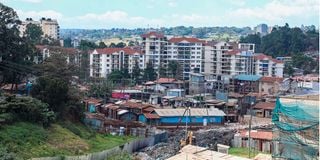
The drainage channels double as footpaths, and when it rains, residents admit that the surrounding sinks into chaos of mud and stagnant water.

However, Kawangware is located on one of Nairobi’s most strategic corridors. Just off Naivasha Road are gated apartments and other desirable real estate, putting the settlement uncomfortably close to the city’s middle-class ambitions. Sleek developments are rising up, facing away from the slum’s reality.

Even the public transport tells the story, ageing Kenya Bus Service (KBS) buses and battered matatus dominate the route. Major hospitals, supermarkets and lifestyle amenities are scarce, reinforcing the estate’s image as a place people pass through, not settle into.

When you ask a resident of the upcoming estates where they live, they will most likely have you know it is, ‘Along Naivasha Road,’ not Kawangware.

Building value in the village

Christine Njoki has never known another home. Born and raised in Kawangware, she has watched the settlement evolve from a forested land into one of the city’s most densely populated and commercially active neighbourhoods.

Ms Njoki, married with six children, lives in Kawangware 56, an area she describes to be both social and economic.

“In Kawangware, I have done so many businesses, and all of them do well. People are many here. Whatever business you put up, there are people who want to buy,” she says

Her current venture is a small food outlet selling chips and soft drinks. Over the years, she has sold clothes during festive seasons, fruits when in season, water when supply allows, and food year-round.

The land she lives on was not bought, but inherited. “This place was given to me by my grandfather after my parents died. He is the one who took care of me.”

The appreciation has been dramatic. Her land, measuring 100 by 100 feet, was originally bought for Sh200,000.

“Land does not depreciate, it appreciates, so if I decide to sell this land today, I can sell it for Sh22 million or maybe Sh18 million if I decide to go lower,” she says.

Christine Njoki Njoroge during the interview in Kawangwae, Nairobi on January 19, 2026.

Photo credit: Lucy Wanjiru | Nation Media Group

For Ms Njoki, Kawangware’s appeal lies in affordability and community.

“Life is cheap in the slums. Food is fresh, water is cheap, and people support each other. People here promote each other. This is where the money is hidden,” Ms Njoki says.

From his post as caretaker, John Mbithi has a front-row view of Kawangware’s changing housing market. Standing outside the apartment block he oversees, he looks past a line of iron-sheet shanties toward a building that, at first glance, appears unremarkable but appealing compared to its surrounding.

It has no elevator, no polished lobby but it affords some modern fittings and a bit of decorative finishes that would normally justify the rents it commands. However, a bedsitter here goes for Sh14,000, while a one-bedroom unit costs Sh24,000, prices that rival more established neighbourhoods with far better finishes.

“The location of the building has a very big advantage, we are not in the middle of the slum and we are also just beside the road,” he says.

Strategic positioning

The building sits directly along the road, a strategic position that allows tenants to avoid navigating the area’s inner informal paths which gives them immediate access to public transport and nearby businesses.

“Most of the tenants are working people, young professionals who have just started their careers, small business owners, and young couples looking for space they can afford without moving too far from their places of work,” Mr Mbithi says.

“Many of them do not commute daily to the Central Business District (CBD), they work around Dagoretti, Ngong Road and Westlands and this makes proximity more important than luxury finishes,’’ he adds.

Despite sitting just beyond a stretch of shanties, the demand is high because the building offers what tenants value most, which Mr Mbithi explains to be convenience, security through visibility and ease of movement.

According to Mr Mbithi, two factors consistently keep the units occupied. “The rooms are big, and we don’t have water problems,” he says.

Kawangware remains one of Nairobi’s most complex real estate paradoxes, a settlement that has been long labelled a slum, but sitting on some of the city’s most strategic land, just minutes from Westlands, Ngong Road and the CBD.

According to real estate investment expert, Johnson Denge, the area’s reputation is still crucial to the buyer behaviour, even as new developments technically position themselves “along Naivasha Road” rather than within Kawangware itself.

“Kawangware is also segmented into various parts and to a larger extent it still carries the tag of a slum,” Mr Denge says. “There are areas like Kawangware 46 along Naivasha Road that are considered a bit upper lower-middle, and then there are areas like Kanunganga, Stage Two and the lower parts toward Kangemi that are still much considered as low-end,” he adds.

Uneven gentrification

This internal segmentation, he explains, means that gentrification is happening unevenly. While some pockets are attracting modern apartment developments, others are still informal, holding the perceptions that continue to influence pricing, demand and investor appetite.

One of Kawangware’s advantages, Mr Denge says, lies in its land tenure history, something that mostly distinguishes it from other informal settlements.

“Unlike other slums that had no clarity on land, had no ownership or titling, Kawangware was actually well surveyed, well titled, and the land belongs to actual people or landlords,” he says.

For decades, much of that land remained locked in the hands of families who were unwilling to sell.

“This was ancestral land, and the old guard would not want to release land for investment. Over time, with a new generation coming in, they are willing to engage investors, joint ventures and financing for the purpose of gentrification.” Mr Denge says.

“Just like the normal demand-and-supply aspect in business, there is enough demand for housing, and that attracts developers and investors who are coming in to take advantage of that,” he adds.

Proximity, not aesthetics

Despite its stigma, Kawangware’s pricing logic is based on proximity rather than its perception. Mr Denge says properties in and around the area are still cheaper than comparable locations offering similar access to jobs and amenities.

“If you compare Kawangware to areas offering similar access, like Kilimani, the prices are about five times lower,” he says.
That affordability, he adds, gives developers flexibility.

“You have more leeway to do smaller units and higher densification in Kawangware, and you are almost sure of the lower and lower-middle-income market coming to rent,” he says.

Land prices currently stand at Sh80 million to Sh100 million per acre, a level Mr Denge says is comparable to areas like Ruaka, despite Ruaka being far from the CBD.

“Kawangware is not necessarily doing a lot of sales, it is doing a rental market,” he says.

Rentals drive the market

Rental demand remains the estate’s strongest anchor. Mr Denge says some affordable housing developments are already active in the area.

“There are developers doing houses ranging between Sh1 million to about Sh3 million. Rent ranges between Sh10,000 and Sh25,000 for one- to two-bedroom units, which is relatively affordable,” he says.

He attributes the fast uptake to improving access and rehabilitation works.

“Rehabilitation has been ongoing, giving easier access, and because of the changing perception, there is enough demand that these houses are occupied very fast,” he says.

However, he points our that Kawangware’s transformation is still constrained by infrastructure and social challenges. “There is still a lot of work to be done on infrastructure, especially social amenities, water, roads and security,” he says.

A view of Kawangwae, Nairobi highlighting rapid urban development in the area on January 19, 2026.

Photo credit: Lucy Wanjiru | Nation Media Group

While large hospitals and shopping malls are scarce within Kawangware itself, he argues that surrounding neighbourhoods partially fill the gap.

“You’ll find good education facilities around Dagoretti Road, Ngong Road and Uhuru Highway, which are able to serve this population,” he says.

“Compared slums like Kibra, Dandora or Mukuru, Kawangware offers better access to amenities though not as sophisticated as they should be,” Mr Denge adds.

Insecurity, he says, continues to suppress rental growth in certain pockets.

“Rents don’t grow as much as expected, especially on older units and in interior areas. The areas are segmented, attracting different categories of dwellers,” he says.

The price gap between perceived “secure” and “insecure” zones is stark.

“You’ll find that prices in areas perceived to have insecurity are almost half of similar units in areas like Kawangware 46 and along Naivasha Road,” he says.

PAYE Tax Calculator

Note: The results are not exact but very close to the actual.