Time flies with great content! Renew in to keep enjoying all our premium content.
Kenya should rethink trade future beyond the extension of Agoa
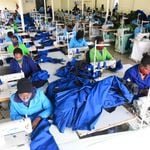
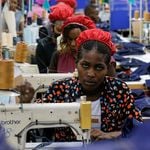
Kenyan workers prepare clothes for export at the New Wide Garment Export Processing Zone (EPZ) factory operating under the USÂ African Growth and Opportunity Act (Agoa) in Kitengela, Kajiado County, Kenya on September 19, 2025.
I've had countless conversations over the past few months with policymakers and exporters navigating impossible uncertainty about contracts and commitments they entered into in good faith.
What I've come to realise from these conversations is this: the African Growth and Opportunity Act (Agoa) isn't just a trade policy.
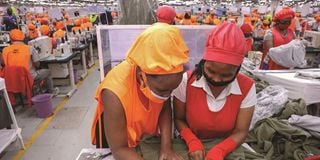
For example, in Kenya, it's a lifeline for over 66,000 women and youth in our textile and apparel sector alone. It's the difference between prosperity and precarity for hundreds of thousands more across horticulture, manufacturing, and agriculture.
But it's also something else. It's a mirror reflecting a deeper question we must ask ourselves: What kind of trade partnership do we truly want with the US?
The numbers tell only part of the story. Yes, Agoa has delivered measurable impact. Africa's exports to the US grew from $17.9 billion in 2002 to $31.4 billion in 2022, with a notable peak in 2008, when exports reached $86.1 billion.
Kenya is one of the success stories, with exports growing from $110 million in 2000 to $771.3 million by 2024. Our textile and apparel sector, which accounts for more than 90 percent of our Agoa exports, has created tens of thousands of jobs, primarily for women and young people.
These aren't just statistics. They are lives that were transformed. They represent school fees paid. They're families lifted out of poverty. But here's what the numbers don't capture: the anxiety of entrepreneurs who've built businesses around duty-free access, only to watch that certainty evaporate into political uncertainty.
The stress of workers who've just heard that their jobs hang in the balance of Congressional debates thousands of miles away.
The recent talks of a one-year extension are a relief, not a solution. It would give us breathing room, but it doesn't give us what businesses need most: predictability. You cannot build a sustainable enterprise on a one-year horizon.
You cannot attract foreign direct investment when your competitive advantage expires annually. You cannot plan for growth when you're constantly planning for survival.
As business leaders, we must be honest about what this moment demands. It's not just about renewing Agoa. It's about reimagining what our trade partnership with the US should look like for the next generation.
The Agoa uncertainty isn't just a crisis.
It's a mirror reflecting an uncomfortable truth about how we've structured our economies.
We've built export machines pointed outward while our largest market,1.4 billion Africans with a combined gross domestic product (GDP) of over $3 trillion, remains largely untapped. We have the youngest, fastest-growing population on earth. We have complementary economies that could support integrated value chains spanning the continent.
What we lack is the commitment to trade with each other first.
There are three truths we must acknowledge.
First, Agoa was never meant to be permanent, and that's actually okay. The purpose of trade preferences was always to build capacity, strengthen competitiveness, and graduate to more sustainable trade models. Kenya has done precisely that. We've built world-class manufacturing capacity that can compete anywhere.The question isn't whether we can survive without Agoa. It's whether we're brave enough to thrive beyond it.
Second, bilateral trade agreements take time, but the work must start now. President Ruto's pursuit of a bilateral trade agreement with the US is the right strategy. Such an agreement would offer the long-term predictability our businesses desperately need. But these negotiations are complex, requiring alignment across multiple sectors and stakeholders.
That's why we need a robust transition framework. Not one year. Not a series of annual cliffhangers. But a meaningful bridge, perhaps five years, that allows us to complete bilateral negotiations without holding our breath every 12 months.
Third, we cannot put all our trade eggs in one basket. Even as we pursue deeper ties with the US, we must accelerate implementation of the African Continental Free Trade Area. We must cultivate markets in Asia, Europe, and the Middle East.
We must ensure that our young entrepreneurs aren't dependent on any single market access pathway. Diversification isn't disloyalty. It's a smart economic strategy.
The writer is the CEO of the American Chamber of Commerce in Kenya.