Treasury cushions poorest with Sh3.5bn SHA spend

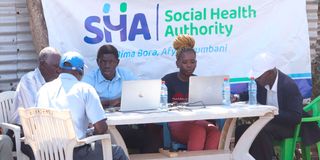
Elderly persons from Arujo register for the Social Health Authority (SHA) at Arujo Location Chiefs camp in Homa Bay Town on March 5, 2025.

Photo credit: George Odiwuor | Nation Media Group

The government has spent Sh3.56 billion in the current financial year to cover health insurance premiums for some of the country’s poorest households, under a programme aimed at shielding vulnerable families from medical costs.

Supplementary budget documents from the Treasury show the cash was released on October 22, 2025, as “cash transfer beneficiary’s insurance premium for indigents” through the State Department for Social Protection and Senior Citizens Affairs, under the National Social Safety Net programme.
The Treasury last week tabled a mini-budget seeking the National Assembly’s nod for the expenditures in line with constitutional requirements.

Article 223, which is implemented through Section 36(9) of the Public Finance Management (National Government) Regulations, permits State offices to exceed approved budget allocations by up to 10 percent to meet unforeseen and unavoidable needs.

The Constitution requires the Treasury to table in the House a mini-budget two months after withdrawal of unbudgeted money from the Consolidated Fund without the approval of the members of parliament.

The payment followed the launch of the National Government Sponsorship Programme by President William Ruto on September 19, 2025. Under the programme, the State pledged to pay health insurance premiums for 558,000 vulnerable households, translating to 2.2 million people who cannot afford contributions to the Social Health Authority (SHA).

Under the Social Health Insurance Fund financing model, salaried workers contribute 2.75 percent of their gross salary, while those in the informal sector are assessed through a means-testing tool that evaluates income and assets.

The minimum annual contribution for informal workers is Sh3,600, equivalent to Sh300 per month. Those not able to raise the amount upfront can access the “Lipa SHA Pole Pole” option, which is integrated into the Hustler Fund ecosystem, allowing them to borrow the premium and repay it in instalments.

“Some of us pay Sh1,040, Sh1,020, Sh1,500 or Sh1,300 per month. But we know there are people who cannot even pay Sh300. That's why we're here today to announce that the government will pay for them,” Dr Ruto said at the time.

“...No Kenyan going to an outpatient facility at any hospital, dispensary or health centre should pay. That service has already been paid for by the government.”

However, an analysis by the Parliamentary Budget Office for the period ending June 2025 shows the State-backed health insurance scheme is heavily reliant on a small pool of salaried workers.

Of the 27 million members registered with the SHA in the year to June 2025, formal sector employees accounted for 5.4 million, but only 4.3 million made contributions during the period.

These workers collectively paid Sh47 billion, averaging Sh10,930 per contributor over the year. Participation from the informal sector remained even more limited at the time. About 860,000 individuals contributed to the Sh23 billion collected from the sector, translating to an average payment of Sh26,744 per person, while an estimated 20.7 million informal workers made no contributions at all.

In total, the SHA received Sh75.5 billion in the 2024/25 financial year, including Sh5 billion from national and county governments to support low-income households.

The PBO, an agency that advises lawmakers on fiscal and budgetary matters, warned that the large number of non-contributing members has created a significant funding gap for the scheme, raising concerns about its long-term sustainability and its ability to promptly settle claims.

“The SHA financing base appears weak as it is heavily dependent on contributions from the formal sector or salaried employees who are a minority in the workforce,” the office wrote in its report.

Follow our WhatsApp channel for the latest business and markets updates.

PAYE Tax Calculator

Note: The results are not exact but very close to the actual.