Time flies with great content! Renew in to keep enjoying all our premium content.
Prime
She quit medicine to become a mechanic, and built car inspection business
Joan Nyambura, founder of 4Real Ke and an automotive technician specialising in car inspection, inspects a car at Precision Automotive in Nairobi on February 14, 2026.
She became a mechanic out of owning a jalopy. “With an old car, you have to learn how to fix things because old cars can be demanding,” she says, remembering how breakdowns transformed her into a car expert.
She loves 4x4 vehicles and, at the time, she was simply trying to get from one place to another in hers without drama. In that period, she learned that cars, like people, communicate constantly, and that ignoring those signals can be expensive.
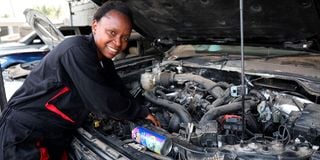
Her breaking point, and perhaps her eureka moment, was an episode that still irritates her years later. She recalls paying Sh30,000 to a technician who promised to fix her car, only for it to stall less than a kilometre from the repair site.
“He hadn’t repaired anything,” she says. “He just cleared the dashboard error codes. The problem never went away. That’s when I realised many motorists don’t know what they’re actually paying for.”
For Joan Nyambura, now 32, it was a moment that did more than waste money. She says it exposed a structural problem in the car market, one where sellers, brokers, and mechanics often understand far more than buyers do, and where that imbalance shapes transactions with buyers often on the losing end.
“No one is really representing the consumer. Everyone else in the transaction has an incentive. The buyer usually doesn’t have information.”
She describes herself as academically gifted from an early age, the kind of student teachers and family predicted would follow a conventional professional route.
After high school, she enrolled at a local university to study medicine, which was viewed by everyone who knew her then as the natural progression towards a fulfilling career. “I was an A student, and medicine felt like the logical next step.”
That logic, she says, was never in line with her passion and conviction. By her second year, she says she felt disconnected from the path she was on. She struggled to picture herself as a doctor. “I realised I wasn’t excited about the future I was preparing for.”
Nyambura stepped into the uncertainty she calls jua kali. Expectedly, her choice disappointed some people and worried others, but she knew staying was only postponing an inevitability.
After leaving school, she began working around cars informally as a broker. She connected buyers with sellers, earning a commission for facilitating deals. “If someone wanted to buy and someone else wanted to sell, I connected them.”
The more transactions she dealt with, the more she noticed patterns that unsettled her. Buyers often assumed imported cars were automatically reliable, especially those sourced from Japan. “People think ‘imported’ means perfect. But a lot can happen between inspection abroad and delivery locally.”
She began checking cars more closely before recommending them to clients, first as a precaution that would soon become a standard procedure.
This revealed recurring issues: tampered mileage, concealed faults, and generic replacement parts passed off as genuine ones. “I kept seeing the same problems, and it made me realise the biggest gap in the market wasn’t mechanical. It was informational. When it’s your only car, you can’t afford guesswork. You either learn or you keep paying.”
Her learning process was informal at first. She watched online tutorials, took advice from friendly mechanics, and learned through trial and error in parking lots.
Eventually, she decided to formalise her knowledge and enrolled for technical training in automotive engineering at the Railway Training Institute in Nairobi.
Returning to school felt completely different from her earlier university experience. “The first time I studied, I was following a path set for me. The second time I studied because I wanted a desired skill set in a field, I had much passion for.”
While training, she worked in garages and began documenting her experiences online, posting educational videos that explained vehicle diagnostics in everyday language. Some of her early videos depict her doing a total engine overhaul. “People don’t want jargon, as I came to understand. They want someone to translate what the car is saying.”
As her online following grew, so did requests for help from motorists who were unsure about purchases. “Most people were looking for reassurance from someone they considered a professional. That’s when I understood there was a gap. Buyers needed someone neutral. Someone is not selling the car and not fixing it. Just someone who could tell them the truth.”
The growth in her online presence also attracted brands that wanted to work with her. “I started working with Precision Automotive in marketing their services. It is also where I took my industrial attachment and started working officially as an automotive car inspector.”
Then she ventured out to build her own brand. She began offering independent vehicle inspections, travelling across Nairobi and Mombasa. The inspections surprised Nyambura as much as they did her clients.
Cars that looked good externally sometimes revealed deep mechanical problems once she took a keener look at them. Others had missing electronic modules, failing transmissions, or evidence of long-term wear inconsistent with the mileage displayed. “Sometimes clients assume I’ll confirm their excitement. But my job isn’t to validate feelings. It’s to present facts.”
Over time, she began to see her role less as a mechanic and more as an interpreter between machines and people. “I don’t tell people what car to love. I tell them what condition it’s in so they can decide. If I inspect and also repair, I benefit from finding faults. That creates a conflict of interest. I want my only incentive to be accuracy.”
Building an inspection-focused operation, however, required more than technical knowledge. She says scaling forced her to think like an entrepreneur rather than a technician.
The growing demand meant hiring and training other inspectors, developing reporting systems, and standardising processes to ensure consistency. “I also had to adjust my pricing from Sh6,000 to Sh10,000, create a membership scheme where clients receive more than just a one-time inspection. For example, what do you do if we inspect your newly imported car, then you get involved in an accident, and it requires inspection after repair?” she poses.
For accuracy and real-time reporting, she has developed protocols through a system her company bought, requiring inspectors to upload diagnostic results, photographs, and notes in real time, allowing reports to be reviewed before reaching clients.
“The system ensures transparency and accountability, both internally and externally. I review reports remotely and can advise clients progressively on what they need to know. A car is usually the second biggest purchase after a house. Its mechanical fitness shouldn’t be based on hope.”
She has two offices, Nairobi and Mombasa, with five car inspectors in both sites.
Looking back, she says her path appears coherent even though it wasn’t at first. Leaving medicine, struggling with unreliable vehicles, and losing money on poor repairs — all these led her to her purpose. “At the time, they felt like detours. Now I see them as preparations to a higher calling.”
She believes her academic background still influences her work. The discipline characteristic of medical training forms the backbone of how she approaches diagnostics — methodically, systematically, and with an emphasis on evidence. “Engineering, like medicine, is about identifying root causes. You don’t treat symptoms if you want lasting results.”
She often meets young women curious about technical careers. “I advise them to look at things pragmatically. What works for one person may not be ideal for another. I tell people to pursue their careers from a practical standpoint. That way, jobs do not feel like lofty tasks but a labour of love. Also, don’t wait to feel ready. Start with what’s in front of you. Skills grow from use.”