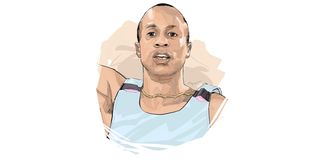
Kenyan-born athlete Stephen Cherono, who switched to Qatari citizenship in 2003 and changed his name to Saif Saeed Shaheen, angered a judge by attempting to disown the identity he used during his previous bankruptcy filing.
Cherono—who holds the 3,000-metre steeplechase world record—responded to a preliminary objection in a land case by claiming he was a “stranger to the bankruptcy proceedings filed against him” in a Kisumu court in 2015.
This came as his appeal was opposed by Daniel Ladama Ruto on the grounds that, as a bankrupt, he lacked the legal capacity to file a case—a matter that Environment and Land Court Judge Charles Kimutai eventually ruled in Cherono’s favour, but delivered a stern rebuke for his perceived dishonesty by denying him the costs of his application.
Justice Kimutai noted that although Ruto’s preliminary objection had failed, Mr Cherono did not approach the court with “clean hands.”
“It has become very evident that the Respondent (Cherono) knowingly lied to this court on the issue of his identity, and denied being the Petitioner/Applicant in Kisumu High Court Bankruptcy Cause No. 5 of 2015,” said Justice Kimutai.
“This court is appalled at the ease with which the Respondent took to lying and feeding this court with falsehoods with regard to his identity while under oath, and this practice must be frowned upon,” said the judge while refusing to grant him the costs of the application and the preliminary objection due to his dishonesty.
In 2002, the athlete changed his name to Shaheen after switching allegiance to Qatar, with the oil-rich Gulf State luring him with an irresistible package that included a guaranteed stipend of $1,000 (Sh128,970) a month for life.
This is more than six times the Sh20,000 an average informal worker takes home in a month, and twice the median income of Sh58,611 per month for formal wage employees, according to data from the Kenya National Bureau of Statistics (KNBS).
“Yes, I have moved for the money,” he confirmed after winning his heat in the 3,000-metre steeplechase qualifiers at the 2003 World Championships in Paris.
Lured by the largesse promised by Qatar against the backdrop of tough economic times in Kenya, some athletes did not hesitate to migrate to the Gulf state.
Albert Kipkurui Chepkurui, now Ahmad Hassan Abdullah, is another Kenyan-born distance runner who also switched his allegiance to Qatar in 2003.
Bahrain is the other Gulf States that has benefited from this migration of desperate athletes, as the country struggles with poor management and meagre rewards.
Athletes have also been known to switch sides to European and American countries.
In 2004, while playing for the Qatari club Al-Arabi, football star Denis Oliech was reportedly offered between Sh200 million and Sh890 million to switch his citizenship to Qatari.
Qatari officials are said to have put him in a room with a phone and given him just one hour to decide his future.
However, the former Harambee Stars captain is said to have famously declined the offer, stating: “I love my country and would not take anything to change my identity.”
The migration of athletes for financial gain caught the attention of the country’s top leadership, with then-President Mwai Kibaki, when meeting the country’s top athletes in 2009 before they left for the World Championships in Helsinki, Finland, urging them to resist the temptation of disavowing their country for money.
“Let us resist the temptation to change our citizenship for financial gains,” the then President told them, reminding the athletes that Kenya is where their talent was nurtured and should remain.
However, it appears that Cherono’s fortunes did not remain steady, with the athlete facing several court cases, including allegations of neglecting his wife and children.
He is also involved in another land ownership dispute in the Environment and Land Court at Eldoret, where he sued Mr Kenneth Kiptum Kandie over property in Uasin Gishu.
The case revolved around conflicting claims to land and alleged irregular registration, with the court being asked to extend the time for filing an appeal against an earlier decision in a related matter.
The High Court in Kisumu on February 25, 2015 declared Cherono bankrupt, meaning his liabilities exceeded his assets.
According to the respondent in the present case, being declared bankrupt meant that Cherono had no legal capacity to lodge the appeal on his own, and that the same should instead have been done by the official receiver.
However, the court came to Cherono’s aid by stating that only creditors were barred, but not debtors.