Safaricom, EABL corporate bonds fail to spark secondary debt trading

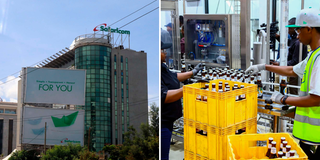
Safaricom PLC headquarters (left) in Westlands, Nairobi and workers at the East African Breweries (EABL) Microbrewery off Thika Road on January 26, 2024.

Photo credit: File | mNation Media Group

The trading of corporate bonds at the Nairobi Securities Exchange (NSE) has remained dismal despite new major issuances by Safaricom and EABL in 2025.

Total corporate bond turnover last year rose to Sh840 million from a meagre Sh40,000 in 2024 but remains well below highs of up to Sh12.47 billion in 2010, according to data from the Capital Markets Authority (CMA).
The sluggish corporate bond market contrasts sharply with a historical record in Treasury bonds turnover, which topped Sh2.7 trillion in 2025 from Sh1.54 trillion the previous year.

Last year, EABL raised Sh16.76 billion at an interest rate of 11.8 percent from its approved Sh20 billion medium-term notes programme.
Safaricom, on its part, raised Sh20 billion from its approved Sh40 billion green bond.

The CMA observed that the two issues failed to trigger more secondary activity even as the corporate bonds were sold late in the year.

"In the fourth quarter of 2025, new corporate bond issuances signalled renewed issuer participation; however, overall liquidity in the corporate bond segment remained constrained. Cumulatively, total corporate bond market activity in 2025 amounted to approximately Sh834 million, underscoring the subdued nature of the market despite the late-year issuance," CMA said in a market soundness report.

"The corporate bond turnover in the Kenyan bond market has been in a prolonged contraction, interrupted only by brief episodes of heightened activity."

According to analysts, investors in corporate bonds, mostly institutions and high-net-worth individuals, prefer to hold the instruments to maturity, limiting the opportunities for trading and hence constraining liquidity in the segment.

Corporate bonds represent opportunities for diversification for institutions, away from just stocks and Treasury bonds.

Institutional investors, who view corporate bonds as premium instruments, have a bias for longer-term investing in contrast to individuals.

The five-year tenured EABL bond is, for instance, deemed to have a short run to maturity, supporting the hold-to-maturity stance.

"Most of the players in the secondary bond market are high-net-worth individuals and institutional investors. Many buy the papers with a long-term view, including holding to maturity," said Wesley Manambo, a senior research analyst at Standard Investment Bank (SIB).

"There is a high probability of investors holding on to the papers because of the superior return vis-a-vis government bonds from a risk perspective."

There are several active bond issuers on the NSE, including EABL, Safaricom, Family Bank, Kenya Mortgage Refinance Company and Linzi Finco.

The total value of outstanding bond issues stands at Sh87.1 billion, with Linzi's asset-backed bond having the highest outstanding amount at Sh44.8 billion.

Fund managers and nominee accounts held the largest proportion of the debt issuances at Sh57.8 billion or 82 percent, followed by the investment companies and banks at 10 percent and six percent, respectively.

Follow our WhatsApp channel for the latest business and markets updates.

PAYE Tax Calculator

Note: The results are not exact but very close to the actual.