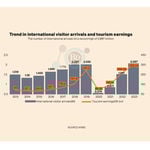
Visitor arrivals through the country’s two main airports and other borders grew by 48.1 percent to 1.8 million during the first nine months of this year, coinciding with a visa-free policy that took effect at the start of 2025.
Data from the Kenya National Bureau of Statistics (KNBS) shows that in the nine months to September, visitors entering the country through the Jomo Kenyatta International Airport and the Moi International Airport, excluding Kenyans, rose from 1.27 million in a similar period last year.
The rise came in the wake of a decision by Kenya to impose a visa-free policy for all visitors, which, from the start of this year, was in a bid to grow tourism and boost earnings to the economy.
It also coincided with an increase in flight frequencies by several international airlines into the country, allowing for more travelers into Kenya.
Kenya introduced an electronic travel authorisation (eTA) system in 2024 as part of its visa-free policy on the expectation that the high number of visitors would lead to increased spending, thus boosting the economy.
The eTA has, however, sparked off complaints, especially for frequent visitors from non-African countries, given that, besides the charges, there is the short validity period of the permit. The eTA was later scrapped.
In the period under review, several airlines added new routes, including Kenya Airways and Etihad, while Air France expanded its passenger capacity with a larger aircraft from Paris to Nairobi.
Increased visitor numbers are set to further drive the country’s earnings from tourism, from the record high of Sh352.54 billion recorded last year, even though executives remained jittery about US President Donald Trump’s protectionist trade policies and the non-renewal of preferential terms under the African Growth and Opportunity Act (Agoa).
Last year, some 2.08 million tourists visited the country, up from 1.54 million who came a year earlier.
But the visitor numbers from June this year are likely to have been impacted by the anti-government protests that rocked Kenya.
A Central Bank of Kenya (CBK) survey published last month showed that Chief Executive Officers in the tourism and manufacturing sectors expect to suffer the biggest hit from Trump’s protectionist trade policies and the non-renewal of the Agoa terms.
The survey showed that overall, about two-thirds (64 percent) of the respondents expect to be negatively impacted by the recently raised US trade tariff on Kenyan goods and the expiry of the Agoa, which provides duty-free access to the US for thousands of products from 32 eligible African countries.
“Most respondents anticipate being affected by the recent US trade tariffs and policy changes through higher import costs for inputs and finished goods and reduced exports to the US after the expiry of Agoa,” the CBK survey said.
“They also expect lower consumer demand due to reduced disposable incomes from declining profits and job losses, as well as secondary effects on local businesses reliant on affected clients. For instance, the hotel industry reported reduced business, with fewer conference bookings from NGOs and other donor-funded programmes” it added.
President Trump, on April 2, 2025, imposed a 10 percent tariff on imports from some African nations, including Kenya.
Mr Trump invoked the International Emergency Economic Powers Act to impose a baseline tariff on all US trading partners in a bid to address what he termed as ‘absence of reciprocity in our bilateral trade relationships’.
Kenya is also among African countries set to be hardest hit by non-renewal of the Agoa deal with projections by the UN Conference on Trade and Development indicating that the country’s average weighted trade tariff with the US will nearly triple to 28 percent on expiry of the preferential trade deal, signaling a major blow to jobs and investments in the country’s textile and apparel sector.